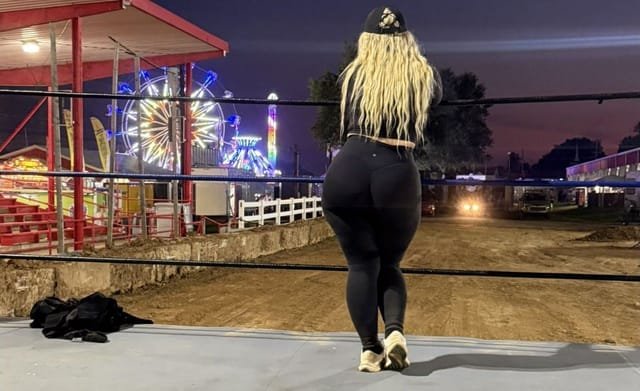
Paige Collett has opened up about an intensely personal chapter of her life, discussing her experience with Complex Regional Pain Syndrome (CRPS), her recovery from wheelchair use and the changes she has experienced in her private life since returning to greater independence.
The independent wrestler, who has been building recognition on the wrestling scene, has previously spoken publicly about the medical condition that significantly affected her life and career. In a recent video shared on X, Collett reflected on her recovery while also discussing dating, intimacy and some unconventional experiences following a difficult period in her life.
Her comments attracted attention because they combined several subjects that Collett has openly discussed with fans: the physical impact of CRPS, the emotional process of grieving lost time, learning about her condition and rediscovering parts of everyday life after being confined to a wheelchair.
While some of her remarks were deliberately provocative, the larger story is about a wrestler attempting to reclaim control over her life after an injury and chronic pain condition disrupted both her professional ambitions and personal independence.
Who is Paige Collett and why has her story attracted attention?
Paige Collett is an emerging professional wrestler who has continued developing her profile on the Independent Wrestling circuit. Her story has received additional attention because her wrestling career has included a major health setback that temporarily changed what she could physically do.
Early in her career, Collett suffered an injury after taking a bump onto concrete during a student wrestling match at Rikishi’s Knox Pro. She subsequently dealt with Complex Regional Pain Syndrome, commonly known as CRPS.
CRPS is a chronic pain condition that can develop after an injury or trauma. It can involve severe pain, changes in skin temperature or color, swelling and heightened sensitivity. The condition can be difficult to manage and may have a major effect on mobility and daily activities.
For an aspiring professional wrestler, the consequences can be particularly disruptive. Wrestling requires physical movement, repeated training and the ability to tolerate demanding athletic activity. A condition that affects mobility and causes persistent pain can therefore threaten much more than a normal work schedule.
How CRPS changed Collett’s life and wrestling ambitions
Collett has previously described how CRPS affected her life and career. At one point, she was confined to a wheelchair, representing a dramatic change for someone attempting to establish herself in a physically demanding profession.
The psychological impact of such a transition can be just as significant as the physical consequences. A wrestler’s identity is often closely connected to movement, athletic performance and the ability to participate in training. Losing those abilities can create a sense of uncertainty about the future.
Collett has indicated that she went through a prolonged process of educating herself about CRPS and understanding what had happened to her body. She has also spoken publicly about mourning and grieving during that period.
That aspect of her story is particularly important because recovery from a serious health setback is rarely a simple straight line. Physical improvement may happen alongside frustration, uncertainty and emotional adjustment.
For Collett, returning to a more active lifestyle appears to have become an important part of reclaiming the identity she had before the condition disrupted her plans.
Collett’s comments about life after leaving the wheelchair
In her recent discussion, Collett connected her personal experiences to the broader process of recovering from her condition. She explained that she had been open with fans about different stages of the journey, including being in a wheelchair, eventually getting out of it and learning more about CRPS.
She also discussed how her medical condition affected questions about her personal and intimate life. While some details were explicitly personal, her larger point was that CRPS had influenced areas of her life that extended well beyond professional wrestling.
That is an important distinction. Chronic pain and mobility limitations can affect relationships, confidence, social activity and a person’s perception of independence. For someone who previously had a highly physical career goal, those effects can become especially complicated.
Collett’s decision to discuss those experiences publicly reflects the increasingly personal relationship between wrestlers and their audiences. Independent wrestlers often communicate directly with fans through social media, podcasts and interviews, meaning their public identities can extend well beyond what happens inside the ring.
Why Collett’s dating comments went viral
The most attention-grabbing part of Collett’s recent discussion involved a dating experience she described in unusually explicit terms. She recalled an encounter with a man who apparently believed she was 19, despite her saying that she was not.
Collett also described how the interaction eventually ended with her being ghosted. She presented the experience as part of the adventures and personal freedom she wanted to explore after recovering from the limitations imposed by her condition.
Because the comments were highly graphic, they quickly became the most visible part of the story. However, focusing exclusively on the provocative language risks missing the broader context of what Collett was actually discussing.
Her remarks were framed around rediscovering independence and experiencing life after a period in which physical limitations had prevented her from doing many of the things she wanted to do.
In that sense, the story is less about the details of one dating encounter and more about the contrast between the person Collett was while confined to a wheelchair and the person she is becoming after regaining greater mobility.
The deeper story: reclaiming independence after chronic illness
One of the strongest themes in Collett’s comments is personal autonomy.
When someone experiences a serious health condition, ordinary activities can become complicated. Going out, traveling, working, exercising or maintaining relationships may require additional planning or may temporarily become impossible.
For Collett, wrestling added another dimension. Her career depends on physical capability, meaning the loss of mobility threatened the very activity she had chosen as a profession.
Her return to a more active lifestyle therefore carries a significance beyond simply getting back into the ring.
It represents a shift from having her choices restricted by a medical condition to making decisions about how she wants to live again.
That is also why her unusually candid social-media presence can be understood in a different way. By discussing uncomfortable or embarrassing experiences alongside the serious parts of her health journey, Collett is presenting recovery as complicated rather than polished.
CRPS awareness has become part of Collett’s public identity
Collett has also used her platform to raise awareness about CRPS, a condition that is not always well understood by the general public.
Her willingness to discuss the condition can help demonstrate how seriously it can affect mobility and quality of life. Her experience also illustrates why injuries that initially appear to be isolated incidents can sometimes have much longer consequences.
CRPS can be challenging because symptoms and severity can vary significantly between individuals. It is not simply a matter of dealing with ordinary soreness after a wrestling injury.
For athletes, the distinction is especially important. Continuing to perform through pain is common in professional wrestling and other sports, but persistent or unusual symptoms can require medical evaluation rather than being dismissed as routine physical wear and tear.
Collett’s experience gives her a personal reason to discuss those issues with wrestling fans who may otherwise know little about the condition.
From wheelchair to wrestling: why her return matters
Collett’s journey also offers a different perspective on the phrase “comeback.”
In professional wrestling, a comeback usually means returning after an injury, suspension or time away from competition. Collett’s situation was more complicated because her health challenges affected her mobility and personal life as well as her wrestling ambitions.
That makes her continued presence on the independent scene particularly meaningful.
Rather than allowing the CRPS chapter to become the defining conclusion of her career, she has continued working toward establishing herself as a wrestler while using her experiences as part of her public voice.
The independent wrestling environment can also provide performers with opportunities to build their identities in ways that differ from major televised promotions. Wrestlers can have more direct communication with audiences and can often shape their own public narratives.
For Collett, that flexibility has helped create a platform where her wrestling career and CRPS advocacy can exist alongside each other.
Paige Collett’s journey compared with a conventional wrestling comeback
| Aspect | Typical wrestling comeback | Paige Collett’s journey |
|---|---|---|
| Initial setback | Usually a wrestling injury | Injury followed by CRPS and major mobility challenges |
| Main challenge | Returning to physical competition | Regaining mobility while managing a chronic pain condition |
| Career impact | Temporary interruption | Significant disruption to wrestling and personal life |
| Public story | Focused mainly on wrestling | Combines wrestling, recovery and CRPS awareness |
| Current direction | Return to competition | Independent wrestling plus public advocacy and personal storytelling |
The comparison shows why Collett’s story deserves more context than a viral headline. Her comeback is not simply about stepping back into a wrestling ring. It is about rebuilding different parts of her life after a condition dramatically changed her circumstances.
Why her unfiltered personality could help her career
Professional wrestling has always rewarded performers who can create memorable personalities, and Collett’s willingness to speak without much filtering could become part of her appeal.
Independent wrestling in particular often depends on performers creating recognizable identities outside traditional television storylines. A wrestler who generates discussion online can potentially turn that attention into interest in live events, interviews and wrestling appearances.
There is, however, a difference between attention and long-term career growth.
Provocative comments can create short-term engagement, but sustained success still depends on wrestling ability, character development, professionalism and the ability to connect with audiences over time. Collett’s challenge will be converting her growing visibility into a broader wrestling identity rather than becoming known only for viral personal stories.
Her CRPS journey gives her an additional dimension that cannot be manufactured. It is a genuine part of her life and provides a meaningful foundation for connecting with fans who have experienced serious health challenges themselves.
The real-world impact of Collett’s CRPS advocacy
Perhaps the most valuable part of Collett’s public story is the awareness created around a condition that many people may not recognize.
When a professional wrestler talks openly about chronic pain and mobility loss, it can challenge the perception that athletes simply recover from injuries and return to normal. Some injuries can develop into much more complicated health situations.
Collett’s experience also highlights the importance of understanding the emotional side of recovery. Her references to mourning and grieving show that physical limitations can involve a genuine sense of loss.
Recovery, therefore, does not necessarily mean returning to exactly the person someone was before an injury. It can involve building a new routine, developing a different relationship with the body and discovering new priorities.
That message may ultimately have greater long-term value than the viral nature of her latest comments.
What could be next for Paige Collett?
Collett’s future will likely depend on how successfully she balances three parts of her public identity: professional wrestler, independent personality and CRPS advocate.
Her wrestling career remains the central platform. Continued appearances and strong performances can establish her credibility with independent wrestling audiences.
At the same time, her openness about CRPS gives her an opportunity to contribute to conversations about chronic pain and recovery. That could become an important part of her legacy if she continues educating audiences while progressing professionally.
The third element is her personality. Her willingness to discuss her private experiences makes her highly shareable on social media, but maintaining a sustainable career will require turning that attention into genuine audience connection.
If those elements work together, Collett could build a distinctive identity that is not dependent on one viral moment.
Conclusion: Paige Collett’s story is bigger than one shocking confession
Paige Collett’s latest comments generated attention because of their unusually explicit nature, but the broader story is far more significant.
Her experience with CRPS changed her mobility, career and personal life after an injury early in her wrestling journey. Being confined to a wheelchair represented a major disruption for someone pursuing a profession built around physical performance.
Yet Collett has continued moving forward. She has spoken openly about the difficult emotional process of dealing with her condition, educated herself about CRPS and returned to pursuing her wrestling ambitions.
Her recent discussion about dating and personal freedom reflects that larger process of reclaiming independence. The provocative details may attract the clicks, but her recovery is what gives the story lasting substance.
As Collett continues to make a name for herself on the independent wrestling scene, her biggest opportunity may be to turn her unusual journey into a complete wrestling identity—one built not only around controversy, but also resilience, character and authenticity.
For breaking news and live news updates, like us on Facebook or follow us on Twitter and Instagram. Read more on Latest Sports on thefoxdaily.com.


COMMENTS 0