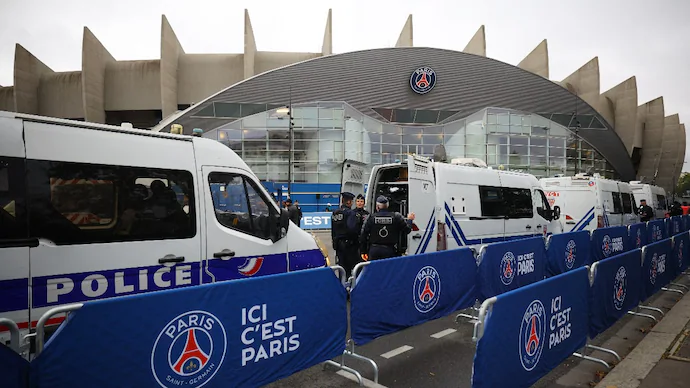
Paris Saint-Germain’s highly anticipated Ligue 1 meeting with Lyon has been rescheduled for Monday, October 26, after the Paris police prefecture raised security concerns about holding the match during a weekend of planned demonstrations and major sporting events. The fixture, originally scheduled for Sunday evening at the Parc des Princes, will now take place at 8:30 pm local time.
The decision highlights the challenges facing French authorities as they prepare to manage public demonstrations, protect major sporting venues and deploy security personnel across the Paris region. With an NFL regular-season game also scheduled for Sunday at the Stade de France, police resources are expected to come under additional pressure.
For Ligue 1, the change affects more than the matchday schedule. PSG versus Lyon is an important early-season encounter involving two teams competing near the top of the standings. The postponement also creates fresh logistical considerations for players, supporters, broadcasters and stadium staff, all of whom must adjust their plans to accommodate the revised fixture.
Why Has PSG vs Lyon Been Moved to Monday?
The immediate reason for the postponement is a security order issued by the Paris police prefecture, which prohibited the match from taking place at its originally scheduled time on Sunday, October 25.
The French professional football league, the Ligue de Football Professionnel (LFP), confirmed the change on Friday. The league said it had acknowledged the police order and agreed with Ligue 1+ to move the fixture to Monday, October 26, at 8:30 pm.
The original kickoff had been scheduled for 8:45 pm on Sunday at the Parc des Princes, PSG’s home stadium in Paris. The revised arrangement gives authorities greater flexibility to manage security requirements during a weekend marked by planned protests and other high-profile events.
The decision reflects the influence public-safety considerations can have on professional sport. Although football fixtures are normally organised around broadcasting commitments, team preparation and supporter travel, authorities can impose restrictions when security conditions make an event difficult to manage safely.
In this case, the change does not mean the match has been cancelled. Instead, the fixture has been moved to the following evening, preserving the contest while altering the timetable for both clubs.
Planned Protests Put Pressure on Paris Security Operations
The postponement comes as French authorities prepare for another weekend of demonstrations in the capital. The planned protests follow a wave of rioting and looting that affected Paris and other French cities on October 17, raising concerns about public safety and the deployment of police personnel.
French Prime Minister Sebastien Lecornu said earlier in the week that authorities would organise a massive security operation for demonstrations planned on Saturday. Troops were also expected to reinforce police personnel as officials prepared for the anticipated crowds and potential disturbances.
For security agencies, the challenge involves more than maintaining a visible police presence at demonstration sites. Authorities must also account for transport routes, crowded public spaces, emergency access, stadium perimeters and the movement of spectators attending major events.
Paris regularly hosts large sporting and cultural gatherings, but simultaneous events can create competing demands for personnel and operational resources. Demonstrations in one part of the city can affect traffic management and transport arrangements elsewhere, even when the events themselves are geographically separate.
In the case of PSG vs Lyon, the police decision illustrates how the wider security environment can influence the organisation of a football match. A fixture may be manageable under ordinary circumstances but become more difficult to stage when authorities must prioritise several large-scale operations at the same time.
The available information establishes that police concerns prompted the schedule change. It does not, however, establish that the match itself was the target of a specific threat. The distinction matters because a precautionary decision about security capacity is not the same as evidence of a direct threat to players or supporters.
NFL Game at Stade de France Adds to the Weekend’s Challenges
Another major sporting event is scheduled to take place in the Paris region on Sunday: an NFL regular-season game between the Pittsburgh Steelers and the New Orleans Saints at the Stade de France in Saint-Denis.
The venue is approximately 10 kilometres from Place de la Bastille, where the planned demonstrations are expected to begin. The geographical proximity adds another consideration for authorities coordinating crowd management, transport and security operations across the capital and its surrounding areas.
The game is particularly significant because it marks the NFL’s first regular-season fixture in Paris. An event of this profile requires extensive preparation involving stadium operations, spectator access, traffic arrangements and security coordination.
Unlike a domestic football match involving a familiar group of regular spectators, an international American football event can attract visitors unfamiliar with local transport systems and stadium access arrangements. Organisers therefore need clear communication and coordinated entry procedures to help spectators reach the venue safely.
The NFL fixture also places the question of security at the centre of the weekend’s sporting calendar. French authorities must account for the requirements of a major international event while preparing for demonstrations elsewhere in the region.
The two sporting events are not taking place at the same stadium, but their timing creates a wider operational challenge. Security planning must consider the combined demands of multiple events rather than treating each venue in isolation.
Trump and Aaron Rodgers Comment on the NFL Fixture
The security situation surrounding the NFL game has attracted attention in the United States. US President Donald Trump expressed concern about the event on Friday and suggested that the league could have postponed it in view of the situation in France.
Pittsburgh Steelers quarterback Aaron Rodgers also addressed the issue, saying he believed the NFL would have cancelled the fixture if the league considered conditions unsafe.
The comments underline the difficult balance faced by sports organisers when security concerns emerge shortly before a major event. Cancelling or postponing a fixture can disrupt travel arrangements, broadcasting plans and ticket holders’ schedules, while proceeding requires confidence in the safety measures put in place.
However, the NFL game and the PSG-Lyon fixture are subject to separate organisational decisions. The French police order concerning the Ligue 1 match should not be interpreted as confirmation that the NFL game has been cancelled or that authorities have declared it unsafe.
The distinction is important for spectators planning to attend either event. Any changes to an event’s status should be confirmed through the relevant league, club or organiser rather than inferred from decisions affecting another fixture.
Football Schedule Already Disrupted by Security Concerns
PSG and Lyon are not the only clubs affected by changes to the French Football calendar. Toulouse’s Ligue 1 home match against Troyes was moved from Saturday to Sunday at the request of local authorities.
The adjustment indicates that security-related scheduling decisions are affecting more than one fixture. Local authorities may assess the circumstances surrounding an event and request changes when the original arrangements conflict with public-safety requirements.
The disruption has also extended beyond match schedules. Marseille and Lille reported that their official club stores were looted during the previous weekend’s violence.
Those incidents demonstrate how civil unrest can affect professional football organisations outside the stadium. Club shops, retail operations, employees and surrounding businesses can all face disruption when public disorder spreads into commercial areas.
For clubs, the immediate consequences may include changes to opening arrangements, damage to property and the need to review security procedures. The broader impact depends on the location and severity of incidents, and the available information does not establish the total financial losses associated with the reported looting.
The situation also illustrates why football authorities must coordinate with local officials rather than make scheduling decisions based solely on sporting considerations. A match may be ready to proceed from a team-preparation perspective, yet local conditions can still require a change.
PSG vs Lyon Remains a Crucial Early-Season Ligue 1 Match
Despite the postponement, the sporting importance of PSG versus Lyon remains unchanged. According to the supplied standings, Lyon are top of Ligue 1 with 14 points after seven matches, with reigning French and European champions PSG level on points and separated by goal difference.
The meeting therefore offers both teams an opportunity to strengthen their position in the early title race. With the clubs closely matched in the standings, the result could influence the order at the top of the table, although its precise effect will depend on other results and subsequent fixtures.
For Lyon, facing PSG presents an opportunity to test their position against one of the leading sides in French football. Remaining competitive against direct challengers is important for any club seeking to sustain a strong start over the course of a long league campaign.
PSG, meanwhile, will be looking to protect their standing as reigning domestic champions. Matches against teams near the top of the table can carry additional significance because they offer a chance to gain points while simultaneously denying a close rival the opportunity to do so.
Nevertheless, one fixture cannot determine the outcome of a league season. Early standings can change considerably as teams encounter different opponents, injuries and variations in form. The significance of Monday’s match lies in the points available and the opportunity for either side to establish momentum, rather than any guarantee that the result will determine the title.
Injuries Could Influence the Contest
The match also coincides with the Ballon d’Or ceremony in London. PSG forward Ousmane Dembele, identified in the supplied report as the 2025 winner, and teammate Khvicha Kvaratskhelia are among the players attracting attention, although both are dealing with injuries.
Their availability is therefore an important consideration ahead of kickoff. An injury can affect a team’s attacking options, tactical flexibility and ability to change a match from the bench. However, the precise impact depends on the severity of the injury, the player’s recovery and the coach’s assessment of fitness.
The rescheduling itself does not guarantee that either player will be available. An additional day between the original and revised match dates may provide more recovery time, but it should not be treated as evidence that an injured player will be fit to participate.
Supporters should therefore distinguish between a confirmed fixture change and any assumptions about team selection. Official squad announcements and pre-match updates will provide a clearer indication of which players are available.
What the Rescheduling Means for Supporters and Broadcasters
Moving a high-profile football match by one day can create practical difficulties for everyone involved, even when the revised kickoff remains within the same weekend.
Supporters who planned to attend on Sunday may need to reconsider transport, accommodation and work commitments. Those travelling from outside Paris could face additional costs or find that their existing arrangements no longer fit the revised schedule.
Local transport and stadium access are also important considerations. A change in kickoff time can affect when spectators arrive, how crowds move through surrounding areas and the coordination of security personnel around the venue.
Broadcasters and commercial partners must adjust their schedules as well. Live sports coverage depends on carefully arranged production teams, advertising slots and programme timings. A fixture change can require those arrangements to be revised, although the exact commercial consequences of this postponement have not been established.
For the clubs, preparation plans may also need minor adjustments. Training sessions, player recovery routines, media commitments and travel arrangements can all be affected when a match is moved at short notice.
These logistical consequences help explain why leagues generally seek to avoid late changes. However, the inconvenience of rescheduling must be weighed against the need to comply with public-safety decisions and ensure that an event can be organised under appropriate conditions.
How Security Decisions Can Affect Professional Football
The PSG-Lyon postponement offers a broader example of the relationship between professional sport and public security. Football fixtures depend on more than the availability of players and stadiums. They also require a functioning transport network, coordinated crowd management and sufficient resources to respond to emergencies.
When demonstrations and major sporting events occur during the same period, local authorities must evaluate how the different activities interact. Even when there is no direct connection between a protest and a match, the combined demands on public services can influence whether an event proceeds as planned.
Police assessments are particularly important because security requirements vary by location and circumstance. Stadium capacity, spectator movements, access routes and the wider public environment all contribute to the planning process.
For football leagues, the lesson is that fixture planning must retain some flexibility. A schedule established weeks in advance cannot account for every development affecting public safety. Cooperation between clubs, leagues, stadium operators and authorities becomes essential when circumstances change.
There is also a communication challenge. Fans need timely and accurate information about revised dates, kickoff times and ticket arrangements. Conflicting reports can cause unnecessary travel or confusion, particularly when multiple events in the same city are affected by the same broader situation.
Clear communication from the relevant organisers is therefore a practical part of managing a postponement. Supporters should check the latest information from their club, the league and the event’s official channels before travelling.
What Happens Next for PSG, Lyon and Paris Authorities?
The immediate priority is to carry out the revised match arrangements while authorities continue preparations for the planned demonstrations and Sunday’s NFL fixture.
For PSG and Lyon, attention will return to the football once the revised schedule is confirmed and preparations for Monday’s kickoff are completed. Both clubs will need to adapt their routines to the new date while monitoring the availability of injured players.
For supporters, the most important details are straightforward: the match has moved from Sunday, October 25, at 8:45 pm to Monday, October 26, at 8:30 pm local time, and the venue remains the Parc des Princes according to the supplied report.
The wider security situation will depend on how the planned demonstrations unfold and how authorities manage the competing demands on police resources. The postponement alone does not establish whether further sporting events will be affected.
Any additional changes would depend on subsequent decisions by the relevant authorities and organisers. Until further announcements are made, it would be premature to assume that the revised PSG-Lyon fixture or the NFL game will face additional disruption.
Ultimately, the move underlines the importance of public safety in the organisation of major sporting events. PSG versus Lyon remains a significant Ligue 1 contest, but its revised date reflects a decision to accommodate security requirements during an unusually demanding weekend for Paris. For the clubs and their supporters, the focus now shifts to Monday’s match, while authorities continue working to manage demonstrations and sporting events across the region.
For breaking news and live news updates, like us on Facebook or follow us on Twitter and Instagram. Read more on Latest Football on thefoxdaily.com.






COMMENTS 0