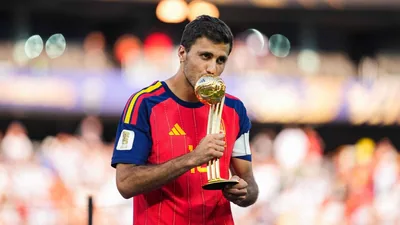
Rodri to Barcelona has emerged as one of the most intriguing transfer stories surrounding the Catalan club, with reports suggesting that the Spanish midfielder is edging closer to a move to Camp Nou. The potential deal would represent a major change in Barcelona’s transfer priorities, particularly after the club had been heavily linked with Atletico Madrid striker Julian Alvarez.
According to reports, Barcelona have made progress in their pursuit of Rodri after the midfielder reportedly chose to explore a move to the Catalan giants despite interest from Real Madrid. While the transfer remains dependent on an agreement between the clubs and the completion of the necessary formalities, the reported shift in Barcelona’s strategy has raised an important question: why would a team that needs attacking reinforcements make a world-class defensive midfielder its priority?
The answer lies in the type of player Rodri is.
Barcelona already possess considerable attacking talent and a deep group of technically gifted midfielders. What they have lacked, however, is a specialist capable of protecting the defence, controlling the tempo and providing authority in front of the back four. Rodri could address all three problems simultaneously.
Why Barcelona Are Reportedly Prioritising Rodri
Barcelona’s reported interest in Rodri becomes easier to understand when the squad is examined beyond its headline names.
The club has a talented midfield group featuring Pedri, Frenkie de Jong, Dani Olmo, Gavi, Fermin Lopez, Marc Bernal and Casado. On paper, that appears to be an area of strength rather than an obvious weakness.
But having several midfielders is not the same as having the right profile of midfielder.
Since Sergio Busquets left Barcelona, the club has struggled to find a natural successor capable of combining defensive positioning, passing range, composure under pressure and game management at the highest level.
Rodri is one of the rare players who can perform all those responsibilities without requiring the rest of the midfield structure to compensate for him.
That distinction could be especially important for a Barcelona side that wants to dominate possession while simultaneously becoming more difficult to punish on transitions.
Rodri Could Fill the Busquets-Sized Gap
The comparison with Busquets is inevitable, although Rodri has developed his own identity as a defensive midfielder.
Busquets became the central reference point of Barcelona’s possession game for more than a decade. His ability to receive the ball under pressure, position himself between the lines of opposition attacks and move possession forward allowed Barcelona’s more creative players to operate with greater freedom.
Rodri offers a modern version of several of those qualities.
He can sit in front of the defence, break up attacks and recycle possession, but he is also comfortable progressing the ball and influencing the rhythm of a match. His physical presence gives him an additional defensive dimension.
For Barcelona, that could be crucial.
Instead of asking Pedri or another creative midfielder to compensate defensively, Rodri could provide the foundation that allows those players to concentrate on progressing attacks.
Barcelona’s Champions League Problem Is Not Scoring Goals
One of the strongest arguments for pursuing Rodri is found in Barcelona’s European numbers.
The Catalan club have demonstrated that they can score goals at an elite level. During the most recent Champions League campaign referenced in the report, Barcelona scored 32 goals in 12 matches, an average of 2.67 goals per game.
That is the profile of a team capable of going deep into Europe’s premier competition.
The problem came at the other end.
Barcelona conceded 20 goals in those 12 matches, averaging 1.67 per game, and did not record a clean sheet during the campaign.
That contrast tells an important story. Barcelona did not necessarily need to become dramatically more dangerous in attack. They needed to become harder to score against.
Rodri could be viewed as a solution to precisely that problem.
The Real Value of Rodri Is Control
It would be easy to describe Rodri simply as a defensive midfielder, but that would underestimate his value.
His biggest contribution could be control.
Barcelona’s style depends on controlling possession, territory and the rhythm of matches. When the team is able to dictate where the game is played, its attacking players become more dangerous.
But possession without defensive control can become vulnerable.
A team can dominate the ball for long periods and still concede dangerous opportunities when possession is lost. This is particularly relevant to Barcelona’s high defensive line and aggressive approach.
Rodri’s positioning could give the team a crucial layer of protection behind its creative midfielders.
He can also slow matches down when necessary rather than treating every possession as an invitation to attack immediately. That ability to change tempo is often overlooked when transfer discussions focus primarily on goals and assists.
Rodri Could Make Barcelona’s High Line Safer
Hansi Flick’s football demands intensity.
Barcelona want to press aggressively, maintain a high line and recover possession quickly. The strategy can overwhelm opponents when executed correctly, but it also creates space behind the midfield and defence.
This is where the profile of the holding midfielder becomes extremely important.
A technically gifted player who lacks defensive positioning may struggle in that environment. Rodri, by contrast, has spent years operating in possession-dominant systems while dealing with the defensive responsibilities that come with them.
His presence could allow Barcelona’s defenders to play more aggressively without leaving the entire team exposed whenever possession changes hands.
That could be particularly valuable against Champions League opponents capable of exploiting even small spaces during transitions.
Frenkie de Jong’s Injury Problems Add Another Layer
Barcelona’s reported interest also needs to be viewed through the fitness concerns surrounding Frenkie de Jong.
De Jong remains an important part of the team’s midfield structure, but recent injury problems have highlighted how vulnerable Barcelona can become when a key midfielder is unavailable.
Rodri would not simply be another midfielder added to the squad for depth.
He would provide a completely different type of security.
Barcelona could potentially use him as the defensive anchor while giving Pedri and De Jong greater freedom to operate higher up the pitch. Alternatively, his presence could allow the team to adapt its midfield depending on the opponent.
That tactical flexibility becomes increasingly valuable during a long Champions League campaign.
Why the Reported €65 Million Price Could Be Significant
The reported transfer figure of around €65 million makes the story even more interesting.
Modern football transfers have produced increasingly extraordinary valuations, particularly for younger players with potential. Barcelona would therefore have to consider whether paying a substantial fee for an established superstar could actually represent better value than spending similar money on a less proven player.
The comparison with Manchester City’s reported acquisition of Elliot Anderson for a club-record £116 million illustrates how quickly the market can escalate.
Rodri would not represent a low-cost signing, but the calculation is different when the player is already established at the highest level.
Barcelona would potentially be paying for certainty rather than potential.
That is an important distinction for a club whose immediate objective is to compete for the Champions League rather than simply build for the future.
Rodri’s World Cup Impact Strengthens the Case
Rodri’s performances for Spain at the World Cup further strengthen the argument that he can operate at the highest level under pressure.
He was named the tournament’s player of the tournament, underlining his influence beyond the club game.
Spain’s possession-based approach also provides a useful tactical comparison for Barcelona.
The midfielder’s role was not limited to winning the ball. He helped Spain maintain control, offered an outlet during buildup and protected the defensive structure behind the attacking players.
According to the figures cited in the source material, Spain conceded only once in matches Rodri played during the tournament.
While team defensive records cannot be attributed to one player alone, the statistic illustrates how important his presence was within Spain’s structure.
Barcelona vs Real Madrid: A Potential Transfer Twist
The reported possibility of Rodri choosing Barcelona over Real Madrid would add another dimension to the story.
Real Madrid have also been linked with the midfielder, making any decision involving the two Spanish giants significant.
For Barcelona, signing a player of Rodri’s stature from a position where they have lacked a natural solution would be valuable enough on its own.
Doing so while preventing a major domestic rival from strengthening the same area would add another strategic benefit.
However, transfer reports should not be treated as confirmation until the clubs formally announce an agreement.
What About Julian Alvarez?
The reported change in Barcelona’s priorities is particularly notable because Julian Alvarez had been strongly associated with the club’s attacking plans.
Barcelona had been searching for a striker as Robert Lewandowski’s time at the club came to an end, while Alvarez had reportedly expressed a desire to leave Atletico Madrid.
Barcelona were not the only club interested, with Arsenal also linked with the Argentine forward.
Atletico, however, have remained reluctant to sell.
That resistance may have contributed to Barcelona reassessing their options.
Instead of allowing an uncertain striker pursuit to dominate their transfer strategy, the club could potentially secure a player who addresses a clearly identifiable tactical weakness.
The Key Comparison: Alvarez or Rodri?
| Factor | Julian Alvarez | Rodri |
|---|---|---|
| Primary role | Forward | Defensive midfielder |
| Potential impact | Goals and attacking depth | Control, defensive stability and buildup |
| Barcelona need addressed | Post-Lewandowski attacking succession | Long-term holding midfield role |
| Tactical benefit | More attacking options | Greater balance behind attacking players |
| Champions League relevance | Additional finishing power | Improved control and defensive protection |
The comparison suggests why Barcelona could view Rodri as the more strategically important acquisition.
Adding another elite attacker would certainly strengthen the squad. But if the team’s biggest European weakness is defensive control, spending heavily on another forward may not solve the problem that has repeatedly eliminated them from the Champions League.
Rodri Could Change Pedri’s Role Too
One of the biggest secondary effects of signing Rodri could be the impact on Pedri.
Pedri is at his best when he can influence the game through positioning, passing and movement rather than constantly worrying about covering enormous defensive spaces.
A reliable holding midfielder behind him could give Pedri more freedom to receive the ball between lines and dictate attacking sequences.
It could also reduce the amount of defensive work required from Barcelona’s creative midfielders.
In simple terms, Rodri could make the players around him better without necessarily needing to dominate the statistics sheet himself.
The Biggest Risk: Rodri’s Fitness
There is, however, one major consideration Barcelona cannot ignore: availability.
Rodri’s importance means that Barcelona would need to manage his workload carefully. A player whose entire value is based on controlling the team’s structure becomes less useful if he is repeatedly unavailable.
Barcelona would therefore need a reliable backup capable of operating in the same tactical role.
Signing Rodri would solve one problem, but it should not create another by leaving the squad completely dependent on one player.
Why This Could Be Barcelona’s Most Important Signing
Transfer windows often focus on glamorous positions.
Strikers score goals. Wingers create highlights. Creative midfielders produce assists. Defensive midfielders, however, often determine whether the rest of the structure works.
That is why Rodri could become a more consequential signing than a headline-making attacking acquisition.
Barcelona already have enough creativity to hurt elite opponents. Their challenge is maintaining control when those opponents respond.
Rodri could provide the missing bridge between attacking ambition and defensive security.
Unique Insight: Barcelona May Not Need More Attackers as Much as They Need Fewer Defensive Mistakes
The most important lesson from Barcelona’s recent European struggles is that attacking quality alone does not guarantee Champions League success.
The club’s scoring numbers demonstrate that it can produce goals at a remarkable rate. The bigger concern has been what happens when the opposition survives the initial pressure and attacks the space left behind.
That means Barcelona’s next step may not be about becoming more spectacular.
It may be about becoming more controlled.
Rodri’s potential arrival would represent that philosophical shift: from simply adding more attacking talent to building a structure capable of surviving the most difficult moments of elite European football.
What Rodri Could Mean for Barcelona’s Champions League Ambitions
If the reported transfer becomes reality, Rodri could immediately become one of the most important players in Flick’s system.
His role would extend beyond tackling and interceptions. He could dictate the first phase of possession, protect the defence, control the pace of matches and provide experience during difficult European nights.
That experience could prove decisive in knockout football, where a single defensive mistake can erase months of excellent work.
Barcelona’s challenge will not be simply reaching the latter stages of the Champions League. The club wants to win the competition again and restore itself to the top tier of European football.
For that objective, balance may matter more than another attacking headline.
Conclusion: Rodri Could Be the Missing Piece
Rodri’s potential move to Barcelona could become much more than another major transfer. It could address one of the club’s most persistent tactical weaknesses and provide Hansi Flick with the defensive midfielder needed to make Barcelona’s possession-heavy football more resilient.
The reported interest also represents a significant change from the club’s pursuit of Julian Alvarez. While another elite striker would improve Barcelona’s attacking options, Rodri could address the area that has hurt them most against Europe’s strongest teams: control without the ball and protection during transitions.
His reported €65 million valuation would also make the potential deal particularly intriguing in an increasingly expensive transfer market.
Nothing is official until the clubs confirm the transfer. But if Barcelona can bring Rodri to Camp Nou, the signing could ultimately prove to be less about adding another superstar and more about fixing the foundation of the team.
And if Barcelona finally find the defensive balance to match their attacking quality, the road back to Champions League glory could become considerably shorter.
For breaking news and live news updates, like us on Facebook or follow us on Twitter and Instagram. Read more on Latest Football on thefoxdaily.com.






COMMENTS 0