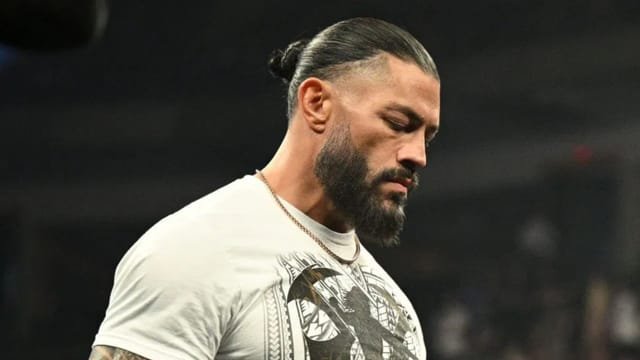
The Roman Reigns overrated debate has taken another turn after former WWE Champion Jinder Mahal offered a strong defence of The Tribal Chief. As discussion continues among wrestling fans about Reigns’ place among WWE’s biggest stars, Mahal argued that there is little evidence to support the claim that the former world champion is overrated.
Roman Reigns has spent years at the centre of WWE’s biggest storylines. His transformation from a heavily protected babyface into The Tribal Chief helped redefine his character, while his Bloodline saga became one of the company’s most important long-term narratives.
Mahal’s comments are particularly interesting because the overrated label has followed Reigns throughout different stages of his career. While some fans criticised his early presentation and pushed-back attempts to make him WWE’s top babyface, his later heel character received widespread recognition for its storytelling, character work and ability to generate major interest.
Jinder Mahal strongly rejects the Roman Reigns overrated argument
Mahal addressed the debate through a video shared with his fans, questioning whether anyone currently on the WWE roster offers a stronger overall package than Reigns.
“Is Roman Reigns overrated? Is there anybody on the roster that is more marketable, better at promos, has better storytelling in matches? I don’t think so. Not Punk, not Cody, not Oba Femi. Can you name someone who is better?”
The argument is significant because Mahal did not focus on just one part of Reigns’ career. Instead, he highlighted three qualities that are particularly important for a modern WWE headliner: marketability, microphone ability and storytelling inside the ring.
Those qualities help explain why Reigns has remained one of WWE’s central attractions for such a long period.
Mahal’s comparison with names such as CM Punk, Cody Rhodes and Oba Femi also shows how high the bar has become for WWE’s leading stars. All three have different strengths, but Mahal believes Reigns remains ahead when the entire package is considered together.
Roman Reigns’ career transformation changed the conversation
The Roman Reigns overrated debate cannot be properly understood without looking at how dramatically his WWE character evolved.
Earlier in his career, Reigns was positioned as one of WWE’s principal babyfaces. The company clearly viewed him as a future franchise player, but a significant portion of the audience rejected the presentation.
The problem was not necessarily Reigns’ athletic ability. Instead, many fans felt that the character and presentation did not match the reaction WWE wanted from the audience.
The turning point came when Reigns embraced a different identity and became The Tribal Chief. The character allowed him to use a more controlled and arrogant personality, while Paul Heyman’s involvement added another layer to his presentation.
Rather than constantly trying to convince the audience that Reigns was the company’s hero, WWE allowed him to become the villain at the centre of the story.
The Bloodline became a major part of Reigns’ success
The Bloodline storyline played a huge role in changing perceptions of Reigns.
The story created an extended narrative around family, power, loyalty and control. Reigns was no longer simply chasing another championship. He became the central figure in a larger wrestling universe involving several members of the Anoa’i family and their relationships with him.
That gave WWE an opportunity to develop stories over a much longer period than the typical rivalry cycle.
The addition of different Bloodline members also allowed Reigns to occupy different positions within the story. At various points, he was a leader, manipulator, champion and family figure whose decisions affected everyone around him.
This long-form storytelling is one of the main reasons supporters reject the argument that Reigns is simply a heavily protected WWE star.
Dutch Mantell admits he was wrong about Roman Reigns
Jinder Mahal is not the only wrestling figure to reconsider his opinion of Reigns.
Veteran wrestling personality Dutch Mantell has also acknowledged that his earlier assessment of Reigns changed as the character developed.
Speaking on his Story Time with Dutch Mantell podcast, Mantell explained that he initially questioned how long WWE would continue pushing Reigns before deciding that he was not the right answer.
“That’s what I used to think too. I said, ‘How long are they going to push Roman before they realize that he’s not the answer?’ But the more he went, the more he got over a heel. And then he drew some money as a heel.”
Mantell’s comments provide an important counterpoint to the overrated criticism. His original doubts were based on Reigns’ earlier presentation, but the wrestler’s evolution changed his assessment.
That distinction matters. A wrestler can be poorly received in one character or booking phase without being incapable of becoming a successful main-event performer.
Why the heel version of Roman Reigns worked so well
The Tribal Chief character solved several problems that had affected Reigns earlier in his career.
First, it gave him greater control over his personality. Reigns could speak with authority rather than trying to present himself as the universally likeable hero.
Second, the character created natural conflict. A dominant champion who demands loyalty provides an obvious reason for other wrestlers to challenge him.
Third, it made Reigns’ relationships with other characters meaningful. The Bloodline was not simply a group surrounding a champion; it became part of the central narrative.
Finally, the character allowed Reigns to tell stories through restraint. Instead of relying on constant physical action, his presence, facial expressions, promos and interactions could create tension before a match even began.
Reigns’ strength goes beyond championship statistics
One reason the overrated label can be difficult to evaluate is that professional wrestling cannot be measured purely through conventional sporting statistics.
Championship reigns, victories and title defences are useful indicators, but they do not fully explain why one wrestler becomes a bigger attraction than another.
Marketability, crowd reaction, merchandise interest, storyline importance, television presence and the ability to generate anticipation for major events all contribute to a wrestler’s value.
This is where Mahal’s argument becomes particularly relevant.
He is essentially judging Reigns as a complete WWE performer rather than simply asking whether Reigns is the most technically gifted wrestler on the roster.
Roman Reigns vs Cody Rhodes vs CM Punk
Mahal specifically mentioned CM Punk and Cody Rhodes while making his case for Reigns. The comparison is interesting because each wrestler represents a different style of WWE main-event appeal.
| Wrestler | Major Strength | Distinctive Appeal |
|---|---|---|
| Roman Reigns | Character, storytelling and star presence | The Tribal Chief persona and Bloodline legacy |
| Cody Rhodes | Emotional storytelling and traditional babyface appeal | Underdog-style journey and family legacy |
| CM Punk | Promo ability and connection with fans | Authentic, outspoken personality |
| Oba Femi | Athletic presence and physical dominance | Emerging powerhouse character |
The comparison does not prove that Reigns is objectively better than every wrestler named. Wrestling performance is subjective, and fans can reasonably value different qualities.
What it does show is why Reigns remains difficult to dismiss. His value is based on a combination of skills rather than a single characteristic.
The biggest evidence against the overrated label
Perhaps the strongest argument against calling Reigns overrated is his ability to remain relevant across different eras of WWE programming.
A wrestler can receive a major push because management believes in them. But maintaining that position over many years requires more than management support.
The audience has to remain interested.
Reigns’ ability to reinvent his character and become more effective as a heel demonstrates adaptability. His Bloodline work also gave him an opportunity to participate in long-running stories rather than relying entirely on championship matches.
That evolution is important when evaluating his career as a whole.
Could the Roman Reigns criticism ever return?
That does not mean every criticism of Reigns is automatically invalid.
Wrestling fans can reasonably argue that certain periods of his career were overexposed or that WWE relied too heavily on his presence at the top of the card. A wrestler being commercially successful does not mean every creative decision involving that wrestler is successful.
The more useful question is therefore not whether Reigns has ever been overpushed, but whether his overall body of work justifies his position as one of WWE’s most important stars.
Mahal’s answer is clearly yes.
Why Reigns’ storytelling remains his biggest strength
Among the qualities Mahal highlighted, storytelling may be the most important.
Professional wrestling is ultimately built around making audiences care about what happens next. Athletic ability can make a match impressive, but storytelling gives the match emotional meaning.
Reigns’ strongest WWE period has been defined by stories that extended beyond individual matches. His relationships with Bloodline members created consequences, betrayals and alliances that could continue across months and major events.
That long-term approach helped turn individual matches into chapters of a larger narrative.
It also explains why Reigns could generate interest even when he was not wrestling every week.
Roman Reigns’ legacy is now bigger than the original push
The most interesting part of the Roman Reigns story is that his eventual success came after a period when many fans questioned WWE’s decision to make him the company’s leading star.
His transformation demonstrates an important lesson about wrestling character development: sometimes the problem is not the performer but the role in which the performer is being presented.
Once Reigns was given a character that suited his strengths, the audience response changed dramatically.
That does not mean every fan must rank him as the greatest wrestler in WWE history. It does mean that the “overrated” label becomes much harder to defend when examining his full transformation and long-term impact.
Conclusion: Jinder Mahal’s argument has a strong foundation
Jinder Mahal’s defence of Roman Reigns has added another layer to an ongoing wrestling debate. His argument is straightforward: when marketability, promos, character development and match storytelling are considered together, Reigns remains extremely difficult to surpass.
Dutch Mantell’s admission that he once doubted Reigns but later recognised his success as a heel provides another interesting perspective.
The bigger lesson from Reigns’ career is that his WWE legacy cannot be judged solely by the criticism he received early in his run. His transformation into The Tribal Chief, the success of the Bloodline storyline and his ability to remain a central attraction have fundamentally changed the conversation.
Fans will continue to debate whether Roman Reigns is overrated, and that is part of what makes wrestling interesting. But one thing is difficult to dispute: Reigns has become one of WWE’s most influential modern characters, and his evolution from a polarising babyface into a defining heel is a major part of that legacy.
For breaking news and live news updates, like us on Facebook or follow us on Twitter and Instagram. Read more on Latest Sports on thefoxdaily.com.






COMMENTS 0