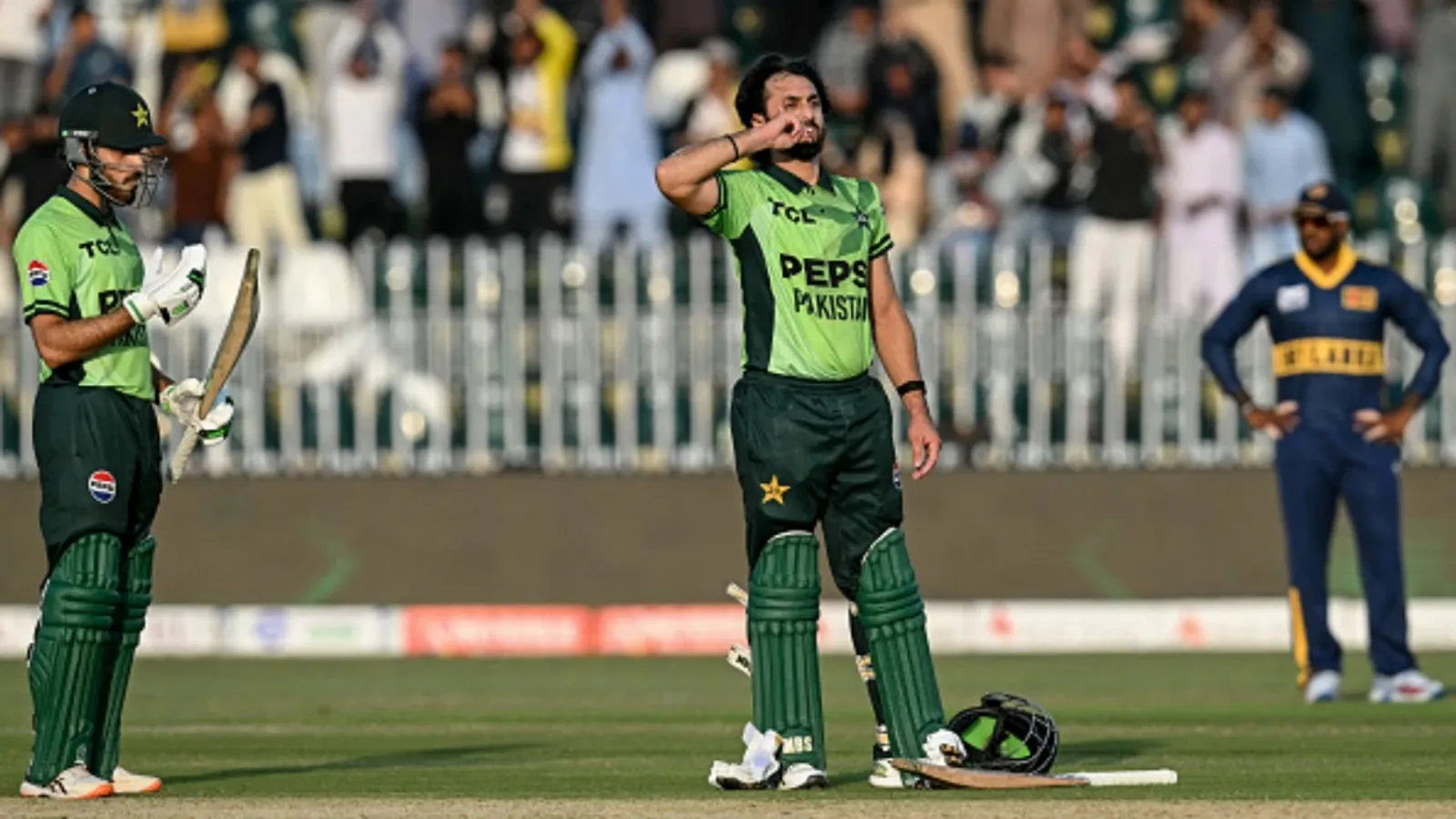
Pakistan batter Salman Ali Agha delivered a powerful response to recent selection setbacks, smashing a brilliant 107 off just 90 balls to help Pakistan defeat Sri Lanka by 37 runs in the opening match of the ODI tri-series at Rawalpindi Cricket Stadium on October 18. The century not only played a crucial role in Pakistan’s victory but also established Agha as the country’s most prolific ODI centurion among batters occupying the No. 5 position or lower.
Agha’s remarkable performance came at a particularly important moment in his career. The 32-year-old was recently removed as Pakistan’s T20I captain and left out of the Test squad. He was also sent home midway through Pakistan’s England tour, despite having led the T20I side in the series opener in the absence of Babar Azam.
Rather than allowing those setbacks to affect his confidence, Agha returned to domestic cricket and worked his way back into form. After producing significant runs in first-class cricket, he carried that momentum into the ODI tri-series, delivering a match-winning century against Sri Lanka.
His innings helped Pakistan recover from a difficult position and post a competitive total of 307. Although the hosts lost wickets during the closing stages and were unable to finish with a bigger score, their bowlers subsequently restricted Sri Lanka to 268, securing a 37-run victory.
Beyond the result, Agha’s innings carried a powerful message about resilience, domestic cricket and the importance of judging players on their performances. The Pakistan batter also clarified that his emotional celebration after reaching three figures was dedicated to his young son rather than aimed at selectors or team management.
Salman Ali Agha Breaks Mohammad Yousuf’s Long-Standing ODI Record
Agha’s century against Sri Lanka was his fourth in ODI Cricket, moving him past former Pakistan batting great Mohammad Yousuf for the most ODI hundreds by a Pakistan batter batting at No. 5 or lower.
Yousuf had previously held the record with three centuries in that batting position range. Agha’s latest achievement places him ahead of several prominent Pakistan players who have contributed significantly in the middle and lower-middle order.
Former all-rounders Abdul Razzaq and Shahid Afridi, along with wicketkeeper-batter Umar Akmal, have each scored two ODI centuries while batting at No. 5 or lower. Agha has now moved beyond that group with his fourth hundred.
His overall ODI record also underlines his effectiveness as a middle-order batter. According to the supplied statistics, Agha has scored 1,649 runs in 53 ODIs at an average of 44.56 and a strike rate of 97.86.
Among Pakistan batters with at least one ODI century while batting at No. 5 or lower, none has a better batting average than Agha. His strike rate is surpassed only by Iftikhar Ahmed, at 109.72, and Afridi, at 132.52.
The figures highlight Agha’s ability to combine consistency with attacking intent. Middle-order batters often have to rebuild an innings after early wickets or accelerate when a platform has already been established. His record suggests he has become increasingly effective in both situations.
How Agha Compares With the World’s Best Middle-Order Batters
Agha’s record-breaking achievement also places his performance in a wider international context. Overall, the record for the most ODI centuries by a batter at No. 5 or lower is jointly held by England’s Jos Buttler and South Africa’s David Miller.
Among Asian batters, India’s MS Dhoni and Yuvraj Singh lead the category with seven centuries each while batting at No. 5 or lower.
Although Agha still has ground to cover to match those international records, his latest achievement represents an important milestone in his career. He has established himself as a dependable middle-order contributor for Pakistan, capable of scoring at a high rate without sacrificing the consistency needed to build substantial innings.
His century against Sri Lanka was especially significant because it came after a difficult period involving leadership changes and selection disappointment. Rather than responding publicly with criticism, Agha allowed his batting to become the main focus.
For Pakistan, his continued development could prove valuable as the team looks to build a reliable middle order capable of performing in different match situations. His combination of a strong average and an aggressive strike rate offers the side an important option in the 50-over format.
Pakistan Lose Early Wickets Before Agha Rescues the Innings
Pakistan’s innings did not begin as smoothly as the final score of 307 might suggest. Sri Lanka captain Kusal Mendis won the toss and elected to bowl first at Rawalpindi Cricket Stadium, and the visitors made early inroads into the home side’s batting lineup.
Babar Azam was dismissed for 45 from 57 balls after falling short of a half-century. His wicket came around the 20th over, bringing Agha to the crease at a time when Pakistan needed stability and a batter capable of accelerating later in the innings.
Saad Baig followed a couple of overs later, returning to the pavilion after scoring 39 from 40 deliveries. Pakistan subsequently lost four wickets for 118 runs in 21.5 overs, leaving the hosts in need of a substantial partnership to prevent the innings from slipping away.
Agha initially focused on settling at the crease before gradually increasing the scoring rate. His first boundary came in the 25th over, when he struck Kamindu Mendis for two consecutive fours.
While Agha began to find his rhythm, Hasan Nawaz provided support at the other end. The partnership allowed Pakistan to recover from the early setbacks and establish a platform for a competitive total.
Hasan Nawaz Partnership Gives Pakistan Fresh Momentum
Agha reached his half-century from 48 deliveries in the 36th over, demonstrating how effectively he had balanced patience with attacking cricket. By that stage, he had helped Pakistan rebuild its innings after losing several wickets during the middle overs.
Hasan Nawaz also contributed to the recovery, looking to attack when opportunities arose. However, his innings ended when he attempted a pull shot against Asitha Fernando and was dismissed for 37 from 49 balls.
Nawaz’s innings included two fours and two sixes, and his contribution proved important in maintaining the scoring rate alongside Agha.
The pair shared a 97-run partnership for the fifth wicket, helping Pakistan recover from a difficult position. Their stand provided the stability needed to move the innings forward and allowed Agha to take greater responsibility for the attacking phase.
After Nawaz’s dismissal, Agha increasingly took charge of the scoring. His approach changed from rebuilding the innings to targeting boundaries, giving Pakistan the opportunity to push towards a total above 300.
Agha Accelerates to His Fastest ODI Century
Agha’s acceleration became more noticeable during the final 10 overs of Pakistan’s innings. His first six came against Eshan Malinga in the 40th over, signalling a more aggressive approach as he attempted to maximise the scoring opportunities.
He continued to find the boundary against Sri Lanka’s bowlers and reached his century in the 45th over. Two consecutive fours against Fernando took Agha to three figures from just 82 balls.
The hundred was a major personal achievement, particularly given the circumstances surrounding his recent omission from Pakistan’s Test squad and removal as T20I captain. His innings demonstrated his ability to respond to disappointment through performances on the field.
Agha eventually scored 107 runs from 90 deliveries, striking 10 fours and one six. The knock combined controlled batting during the recovery phase with aggressive stroke play as Pakistan attempted to build a formidable total.
However, his innings ended in the same over in which he reached his century. Agha failed to get sufficient elevation on a shot and was caught at long-on by Dasun Shanaka.
When he departed, Pakistan were 291/7 after 46.5 overs. His dismissal left the hosts needing a strong finish from the remaining batters to turn their promising position into an even bigger total.
Pakistan Fall Short of a Strong Finish Despite Agha’s Century
Despite Agha’s outstanding innings, Pakistan struggled to maintain its scoring momentum during the closing overs. Malinga struck twice in the following over, dismissing Faheem Ashraf and Naseem Shah as Sri Lanka quickly removed two more batters.
The pressure continued during the final stages of the innings. On the penultimate delivery, Haris Rauf was run out while attempting to complete a second run, leaving Pakistan all out for 307 in 49.5 overs.
The total gave Pakistan a competitive platform, but the hosts could have finished with a more imposing score had they retained more wickets after Agha’s departure.
His dismissal was a turning point in the final overs because Pakistan lost the batter most capable of sustaining the attack. The lower order was unable to provide the late acceleration required to take the total significantly beyond 307.
Nevertheless, Agha’s century ensured that Pakistan recovered from a difficult start and reached a total that ultimately proved sufficient. The bowlers backed up his contribution by taking regular wickets during Sri Lanka’s chase.
Shaheen Afridi Leads Pakistan’s Bowling Attack
Sri Lanka’s chase began with problems similar to those Pakistan had experienced earlier in the match. The visitors lost early wickets and found themselves under pressure at 91/4 in 19.3 overs.
Despite the difficult start, Pavan Rathnayake and Janith Liyanage attempted to revive the innings with important half-centuries. Their contributions kept Sri Lanka in contention and prevented the match from becoming a straightforward chase for Pakistan.
However, the momentum shifted again when Liyanage and Dasun Shanaka were dismissed in consecutive overs. Those wickets disrupted Sri Lanka’s recovery and left the visitors struggling to maintain the required scoring rate.
Pakistan’s bowling attack then took control of the closing stages. Captain Shaheen Afridi claimed three wickets, leading the attack and helping prevent Sri Lanka from building another substantial partnership.
Naseem Shah, Haris Rauf and Faheem Ashraf picked up two wickets each, providing valuable support to their captain. The collective effort ensured that Sri Lanka were bowled out for 268 in 48.1 overs, handing Pakistan a 37-run victory.
The result gave Pakistan a positive start to the ODI tri-series and underlined the importance of the team’s ability to recover from difficult periods in both innings.
Salman Ali Agha Explains His Century Celebration
Agha’s celebration after reaching his century attracted attention because it came shortly after a challenging period in his international career. His removal as T20I captain and omission from the Test squad had prompted discussion about his position within Pakistan Cricket.
However, Agha clarified that his celebration was not intended as a message to the selectors or team management. Instead, he dedicated the moment to his young son, who watches him play on television.
“I don’t have enough time to message someone or prove someone wrong. I love my cricket, I love batting and I like playing for Pakistan. That was only celebration and my little son watches TV like this, so the [celebration] was for him,” Agha explained.
His explanation shifted the focus away from speculation about disagreements with Pakistan’s cricket authorities and towards his personal motivation for playing the game.
The batter’s comments also reinforced his stated commitment to Pakistan cricket. Despite recent setbacks, he emphasised his love for batting and representing his country rather than presenting his century as an act of retaliation.
His performance against Sri Lanka provided a timely reminder of his value to the national team. The innings demonstrated that, regardless of changes in leadership responsibilities or selection decisions, Agha remains capable of delivering match-winning performances.
Agha Calls for Greater Respect for Pakistan’s Domestic Cricket
Alongside discussing his celebration, Agha highlighted what he believes is an important issue in Pakistan cricket: the need to give greater recognition to performances in domestic competitions.
After being left out of the Test squad, he returned to first-class cricket and responded with an unbeaten triple century in his first appearance. He followed that innings with a century and another half-century before joining the national camp ahead of the ODI tri-series.
Agha believes these performances deserve greater respect because domestic cricket presents its own challenges. He argued that scoring runs in first-class competitions is not easy and that successful performances should be recognised rather than dismissed because they come outside international cricket.
“I think we don’t give enough respect to our domestic cricket. The conditions there are not that easy and scoring runs is not an easy job. Otherwise, everyone would go there and score runs,” the 32-year-old said.
He also addressed the reaction that domestic performances sometimes receive on social media, explaining that players can be criticised or their achievements undervalued even after scoring heavily in domestic competitions.
“If a player like me scores runs in domestic cricket, former cricketers say on social media that he has scored runs in domestic cricket, but scoring runs there is not that easy. You have to play well to score runs there,” he added.
Agha’s comments highlight the importance of maintaining a strong connection between domestic and international cricket. First-class competitions give players opportunities to develop their technique, rebuild confidence and demonstrate their readiness for higher levels of competition.
His own experience provides a clear example. After being omitted from the Test squad, he returned to domestic cricket, produced significant scores and subsequently delivered a century in an ODI against Sri Lanka.
Saud Shakeel and Saad Baig Also Highlight Domestic Cricket’s Value
Agha made it clear that his argument was not limited to his own career. He also pointed to the performances of Saud Shakeel and Saad Baig as examples of players whose domestic achievements have helped prepare them for opportunities at the international level.
“I don’t think this is a good message either, because the players who come from there after performing have earned it. I was performing there for 10 years before I came into international cricket. Saud Shakeel was also there, and Saad Baig has performed in domestic cricket and did well today,” he further added.
His comments reflect a broader argument about player development and selection. Domestic cricket provides an important foundation for international teams, allowing players to build experience and prove their consistency over longer periods.
For Agha, recognising those achievements would help create a stronger pathway into the national side. Players who perform consistently in domestic competitions should have their efforts evaluated fairly when selectors consider future opportunities.
His century against Sri Lanka also showed how domestic cricket can help an experienced international player regain form after a difficult period. Rather than allowing selection disappointment to derail his season, Agha used the opportunity to score runs and return to the international stage with confidence.
What Salman Ali Agha’s Record Means for Pakistan
Agha’s latest century could prove important for Pakistan as the team looks to strengthen its batting lineup in the ODI format. His ability to bat at No. 5 or lower gives the side flexibility, particularly when early wickets force the middle order to rebuild an innings.
His record of 1,649 runs in 53 ODIs at an average of 44.56 highlights his consistency. A strike rate of 97.86 also shows that he can maintain an aggressive approach without relying exclusively on low-risk accumulation.
Those qualities are particularly valuable in modern ODI cricket, where middle-order batters must adapt quickly to changing match situations. They may need to stabilise the innings after early wickets, accelerate during the middle overs or provide late runs when the team has wickets in hand.
Agha’s innings against Sri Lanka included all three elements. He arrived when Pakistan had lost important wickets, helped rebuild the innings through a partnership with Nawaz and then accelerated to reach his century from just 82 balls.
Although Pakistan’s lower order could not capitalise fully on his platform, his knock played a major role in securing the eventual victory. It also reinforced the argument that Agha remains a strong option for the middle order despite recent changes to his responsibilities within the national setup.
Pakistan to Face England in the Next ODI Tri-Series Match
Pakistan will next face England in the ODI tri-series at the same venue on October 20. The upcoming contest will present a more demanding challenge for the hosts as they attempt to maintain their winning momentum.
England will be led by Harry Brook and arrive with several notable absences from their squad. Fast bowler Jofra Archer is unavailable, while Jacob Bethell continues his rehabilitation and has not been included in the team.
Wicketkeeper-batter Jos Buttler has also recently undergone hamstring surgery, with Jordan Cox expected to fill in for him.
Agha will be looking to carry his form into the next match after delivering one of the standout performances of the opening fixture. The last time he faced England in an ODI was in 2023, when he scored a half-century.
His latest century will provide a significant confidence boost ahead of the contest. However, England’s bowling attack will present a different test, and Pakistan will need contributions from across the batting order to produce another strong performance.
The hosts will also want to improve their finishing after losing several wickets in the closing overs against Sri Lanka. If Agha can continue his form and the rest of the lineup provides stronger support, Pakistan could be well placed to build on its opening victory.
Conclusion: Salman Ali Agha Answers Selection Setbacks With a Record-Breaking Century
Salman Ali Agha delivered an emphatic response to recent selection setbacks by scoring 107 from 90 balls in Pakistan’s 37-run victory over Sri Lanka. His fourth ODI century while batting at No. 5 or lower broke Mohammad Yousuf’s long-standing Pakistan record and reinforced his reputation as a dependable middle-order batter.
After being removed as T20I captain and left out of the Test squad, Agha returned to domestic cricket and produced significant scores before carrying his form into the ODI tri-series. His innings against Sri Lanka combined composure, attacking intent and the ability to take responsibility when Pakistan needed a recovery.
He also used the opportunity to emphasise the importance of domestic cricket, arguing that strong performances in first-class competitions deserve greater recognition. His comments about dedicating his celebration to his son further showed that his focus remains on his cricket and family rather than proving a point to selectors.
With England next on the schedule, Agha will have another opportunity to demonstrate his value to Pakistan. His record-breaking century has provided a timely boost for the team and a compelling reminder that performances on the field remain the strongest response to setbacks.
For breaking news and live news updates, like us on Facebook or follow us on Twitter and Instagram. Read more on Latest Cricket on thefoxdaily.com.






COMMENTS 0