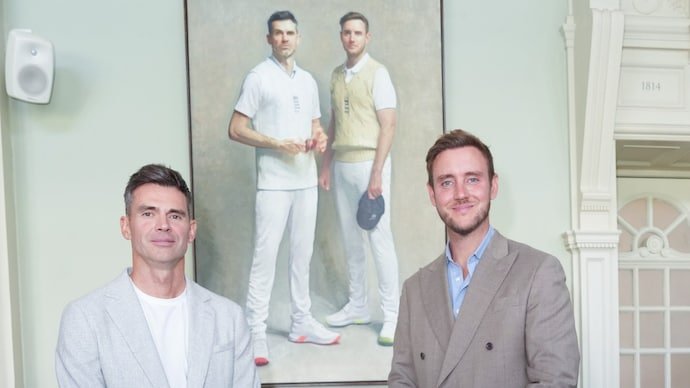
Stuart Broad and James Anderson reunited at Lord’s on Wednesday as England’s iconic fast-bowling duo received a permanent tribute to their extraordinary Test careers. The former England quicks unveiled a joint portrait in the Long Room, celebrating a partnership that helped define the national team’s bowling attack for more than a decade.
The portrait was unveiled at 5pm ahead of England’s Test against Pakistan at Lord’s. More than a celebration of two individual careers, the occasion recognised the remarkable longevity of a partnership that lasted 17 years and produced a combined 1,308 Test wickets.
Anderson finished his international Test career with 704 wickets from 188 matches, while Broad collected 604 wickets in 167 Tests. Their combined numbers place them among the most productive bowling partnerships in Test cricket, while their long association made them a defining part of modern English cricket.
Stuart Broad and James Anderson return to the Home of Cricket
Lord’s has witnessed some of the most important moments in English cricket, making it an especially fitting location for the joint portrait.
Broad and Anderson returned to the ground not as active Test cricketers but as two players whose careers have become part of England’s cricketing history. Their appearance in the Long Room provided a symbolic reunion between two players who spent years sharing dressing rooms, bowling attacks and some of the biggest occasions in international cricket.
The joint portrait captures the scale of their contribution. While individual records can measure wickets, matches and milestones, they cannot completely explain the value of a bowling partnership that remained effective across different generations of England teams.
For supporters, the unveiling also offered an opportunity to see the pair together again after both had stepped away from Test cricket.
A 17-year partnership that transformed England’s bowling attack
The most remarkable feature of the Broad-Anderson partnership was its longevity.
The two fast bowlers shared England’s international journey for approximately 17 years. During that period, they experienced changes in captains, coaches, teammates, playing conditions and approaches to Test cricket.
Yet their roles remained remarkably consistent. Anderson became renowned for movement, precision and relentless control, while Broad developed into a bowler capable of using bounce, attacking the stumps and creating pressure through sustained aggression.
That difference in style was one of the reasons the partnership worked so effectively.
James Anderson’s record-breaking Test career
James Anderson finished his Test career with 704 wickets from 188 matches, establishing himself as England’s most prolific Test wicket-taker.
His career was built around qualities that became increasingly valuable as he aged. Rather than depending solely on raw pace, Anderson mastered swing, seam movement, changes of angle and subtle variations in release.
His ability to repeatedly challenge batters outside the off stump made him particularly dangerous when conditions offered even modest assistance. In English conditions, his control and movement could create pressure without requiring extravagant changes in pace.
Anderson’s longevity was equally remarkable. Fast bowling places significant physical demands on a player, yet he continued performing at the highest level well beyond the age at which many quicks have already retired.
Stuart Broad’s 604 Test wickets
Broad ended his Test career with 604 wickets in 167 matches, placing him alongside Anderson in an elite group of Test bowlers.
His bowling style was different from Anderson’s, and that difference often made the pair more difficult to handle as a combination.
Broad could extract bounce from a length that appeared relatively conventional, attack the stumps aggressively and create uncertainty with changes in angle. He was also capable of producing sudden bursts of wickets that could transform a Test match within a short period.
That ability to shift momentum became a major part of his identity as an England cricketer.
Why Anderson and Broad worked so well together
Their combined success was not simply the result of having two exceptional bowlers in the same team.
Their contrasting strengths created tactical problems for opposing batting line-ups.
Anderson’s movement and control could encourage batters to play cautiously, while Broad’s bounce and attacking lines created another type of challenge at the opposite end.
When both were operating effectively, the pressure could build from both sides simultaneously. One bowler could restrict scoring while the other searched for the breakthrough.
This is an important reason why their combined wicket tally tells only part of the story.
The numbers behind the legendary partnership
| Statistic | James Anderson | Stuart Broad | Combined |
|---|---|---|---|
| Test matches | 188 | 167 | 355 appearances |
| Test wickets | 704 | 604 | 1,308 wickets |
| International role | Fast bowler | Fast bowler | England pace partnership |
| England Test career ended | 2024 | 2023 | Both retired |
The numbers demonstrate just how unusual their careers were. Two bowlers from the same country accumulating more than 600 Test wickets each is an extraordinary achievement in itself.
The portrait is more than a celebration of statistics
The joint portrait was painted by artist Jamie Routley and will become part of the collection at Lord’s.
The recognition is significant because the portrait does not simply celebrate two successful individuals. It commemorates a partnership that became closely associated with England’s Test identity.
The MCC’s heritage and collections committee currently funds two new cricket portraits each year, with selections requiring approval from its cricket committee.
That makes the inclusion of Broad and Anderson together particularly meaningful. Their careers have become part of the wider historical story of cricket at Lord’s.
Broad and Anderson reached the 600-wicket milestone
One of the most remarkable aspects of their careers is that both players crossed the 600-wicket mark in Test cricket.
That achievement placed them in an extremely exclusive category. Test cricket demands far more than occasional brilliance: bowlers must maintain fitness, skill, discipline and effectiveness over years of international competition.
Doing so while playing for the same national side makes their achievement even more unusual.
Their combined tally of 1,308 wickets demonstrates the scale of their contribution to England’s Test cricket over nearly two decades.
Their partnership survived several eras of English cricket
Another way to understand their importance is to look beyond individual matches.
Anderson and Broad played through multiple phases of English Test cricket. England changed captains and coaches, adopted different tactical approaches and experienced periods of success and disappointment.
Through those changes, the pair remained central to the bowling attack.
That continuity gave England something every Test side values: experienced bowlers who understood how to manage long spells, build pressure and exploit small changes in pitch or weather conditions.
They also provided a reference point for younger bowlers entering the England setup.
The end of an era
Broad retired from Test cricket in 2023, bringing his international career to an emotional conclusion.
Anderson continued for another year before ending his international career in 2024.
The gap between their retirements was relatively small compared with the length of their partnership, but it marked the end of one of England’s most recognisable bowling combinations.
Their departures inevitably created a leadership and experience gap within England’s pace attack.
Replacing one experienced fast bowler is difficult. Replacing two players with more than 1,300 combined Test wickets is a much larger challenge.
What England lost when Broad and Anderson retired
The obvious loss was wickets, but England also lost years of tactical knowledge.
Test fast bowling requires an understanding of when to attack, when to defend, how to alter a field and how to manage physical workload over several days.
Anderson and Broad had accumulated that knowledge through hundreds of matches.
Young bowlers can develop similar skills, but experience cannot be transferred instantly. That is why their retirement represents more than the departure of two names from a scorecard.
England lost a bowling partnership that had become part of the team’s institutional knowledge.
Their contrasting styles made the partnership stronger
Anderson and Broad were never identical bowlers, and that was precisely the point.
Anderson’s greatest weapon was often his ability to move the ball and repeatedly challenge batters through accuracy. Broad, meanwhile, could use his height and bounce to create a different line of attack.
When one struggled to find the ideal rhythm, the other could sometimes maintain pressure from the opposite end.
That balance is an important lesson in Test bowling partnerships: two bowlers do not necessarily need identical strengths. Complementary skills can create greater problems for a batting side than two bowlers operating in exactly the same way.
Why their Lord’s tribute matters to English cricket
The decision to honour Broad and Anderson together reflects the importance of partnerships in cricket history.
Individual records are easy to identify. Partnership achievements can be harder to measure because they involve cooperation, pressure and tactical understanding.
The portrait provides a permanent visual reminder of something the statistics cannot fully capture: England’s fast-bowling identity for a significant portion of the 21st century was built around these two players.
At Lord’s, where generations of cricketers have been celebrated, their presence in the Long Room connects their careers with the broader history of the game.
A useful comparison with modern Test bowling
Modern international cricket has become increasingly demanding for fast bowlers. Players face packed schedules across formats, extensive travel and pressure to remain effective in different conditions.
Against that backdrop, the length of Anderson and Broad’s Test careers becomes even more impressive.
Their success was based not simply on speed but on adaptation. Both developed their methods as their careers progressed, allowing them to remain competitive even as their physical capabilities naturally changed.
That adaptability may ultimately become one of the most important parts of their legacy.
What future England bowlers can learn from Anderson and Broad
The next generation of England fast bowlers will inevitably be compared with Broad and Anderson, but attempting to reproduce their exact careers would be unrealistic.
A more useful lesson is to study the principles behind their longevity.
- Consistency matters: Repeatedly hitting the right areas can create pressure even without spectacular movement.
- Different skills can complement each other: Anderson and Broad succeeded partly because their bowling styles created different problems.
- Adaptation is essential: Both bowlers evolved as their careers progressed.
- Experience has value: Managing Test spells and understanding match situations develops over years of competition.
- Partnerships amplify individual quality: Two excellent bowlers working together can become more effective than either operating in isolation.
The legacy of 1,308 Test wickets
The combined figure of 1,308 Test wickets is the clearest numerical representation of what Anderson and Broad achieved together.
But their legacy goes beyond the number.
They became familiar figures for generations of England supporters, repeatedly taking the new ball, bowling long spells and returning for crucial periods of matches.
Their careers also demonstrated that fast bowlers can build extraordinary longevity through skill development and tactical intelligence rather than relying solely on youthful pace.
That is perhaps why the Lord’s portrait feels appropriate. It celebrates not just how many wickets they took, but how long they remained important to England.
Conclusion
Stuart Broad and James Anderson’s reunion at Lord’s provided a fitting tribute to one of the greatest fast-bowling partnerships in England’s Test history.
The pair combined for 1,308 Test wickets across 355 appearances, with Anderson finishing on 704 wickets from 188 Tests and Broad ending with 604 wickets from 167 matches.
Their 17-year partnership survived multiple generations of English cricket and became a defining feature of the national team’s Test bowling attack.
The joint portrait by Jamie Routley will now remain at Lord’s as a permanent reminder of their contribution. Broad retired in 2023, while Anderson ended his international career in 2024, but their influence on English cricket is likely to last considerably longer.
The most important part of their legacy may not be the individual records. It is the example they set of how two bowlers with different strengths can combine, adapt and remain effective for an extraordinary length of time.
For England, finding the next Broad-and-Anderson combination will be a difficult task. For supporters, however, the portrait at Lord’s ensures that this remarkable partnership will remain visible at the Home of Cricket long after their final deliveries have been bowled.
For breaking news and live news updates, like us on Facebook or follow us on Twitter and Instagram. Read more on Latest Cricket on thefoxdaily.com.


COMMENTS 0