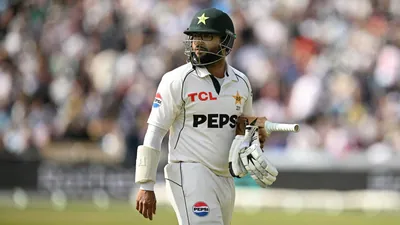
Imam-ul-Haq injury controversy has become an unexpected talking point during Pakistan’s ongoing Test against England at Lord’s, after former England fast bowler Stuart Broad publicly questioned the Pakistan batter’s decision to practise on the sidelines while wearing tape on his injured left calf.
Imam sustained a low-grade calf strain while fielding on the opening day of the second Test. The injury came after he had already endured a difficult start to the match, including two dropped catches. Pakistan subsequently ruled him out of the remainder of the Test, leaving the visitors with one fewer specialist batter.
The situation took another turn on Day 4 when Imam was seen practising batting away from the main action. His left calf was taped, and he appeared to be moving cautiously while hitting the ball. The footage immediately attracted attention, particularly because reports suggested Pakistan could potentially use him as a batter if the match situation became desperate.
Broad, speaking on Sky Sports, was highly critical of the presentation of the training session. His comments have added another layer to an already sensitive discussion surrounding player injuries, public perception and the responsibility of professional cricketers to communicate clearly with supporters and teammates.
Why Imam-ul-Haq Was Ruled Out of the Test
Imam’s injury occurred during fielding on the first day at Lord’s. He suffered the problem in his left calf and initially received attention from Pakistan’s medical staff.
The injury was subsequently assessed as a low-grade calf strain, and Pakistan decided that he would not be available for the remainder of the match. That decision meant the team had to manage its batting resources without one of its established top-order options.
The timing was particularly unfortunate because Imam had already struggled for runs in the series. His scores in the opening Test were 42 and 0, while Pakistan suffered defeat against England in Leeds.
That combination of limited recent output and an injury during a crucial Test naturally increased the attention surrounding his absence. However, the injury itself and questions about its seriousness are separate issues, and public footage alone cannot establish the medical condition of a player.
What Happened During Imam’s Day 4 Practice?
Before play on Day 4, Imam was seen near the sidelines practising his batting. Tape was visible around his injured left calf, and he appeared to be hobbling while moving around during the session.
The sight generated interest because an injured player continuing to practise can mean several different things. It can indicate rehabilitation, a fitness assessment, an attempt to maintain rhythm, or preparation for an unlikely emergency appearance.
Reports from the Pakistan camp suggested that Imam could potentially bat if his team reached a situation where his contribution became absolutely necessary. That possibility made his appearance with a bat particularly noticeable.
But without a medical assessment being made public, it would be inappropriate to conclude from the footage alone whether the injury was severe, improving, or being managed according to the team’s medical advice.
Stuart Broad Questions the Presentation
Broad’s criticism focused less on the existence of the injury and more on how Imam appeared while practising.
Speaking on Sky Sports, the former England bowler suggested that the visible tape and apparent hobbling looked unnecessary and described the display as being “all for show”. He argued that Imam could have carried out his practice away from public view if the purpose was simply rehabilitation or preparation.
Broad’s reaction reflects a familiar sporting debate: when an injured player is seen training, observers can interpret the same action in completely different ways.
For a player, practising may be part of a genuine attempt to determine whether he can contribute. For spectators and former players, however, highly visible rehabilitation can sometimes appear contradictory when the player has officially been ruled out.
That difference in perception is what has made the incident bigger than the original injury.
Imam Had Already Faced Scrutiny After Dropped Catches
The controversy did not occur in isolation. Imam’s injury came on a difficult opening day in which he dropped two important catches while fielding.
Errors in the field can quickly increase pressure on a player, particularly during an overseas Test where every missed opportunity can become significant. When an injury follows such an episode, the player can find himself under intense scrutiny from supporters, analysts and former cricketers.
That context is important when assessing the subsequent training footage. A player dealing with both physical discomfort and criticism may understandably want to demonstrate that he remains committed to contributing to the team.
At the same time, visible attempts to show fitness can create more questions rather than fewer if observers believe the behaviour is inconsistent with an official injury ruling.
Previous Allegations Add Another Layer
Broad’s comments were made against the background of earlier allegations involving Imam’s injury history.
Former Pakistan batter and chief selector Mohammad Wasim previously raised questions about whether Imam had exaggerated injury concerns. Wasim recalled an incident from 2022 involving a Test in which, according to his account, the team physiotherapist had warned him about a possible injury-related situation involving the batter before an official decision had been announced.
Wasim said the situation subsequently developed in the way he had been warned it might, and he also referred to complaints from coaches about similar situations involving the player.
Those claims have become relevant again because Broad’s criticism has revived the broader discussion around Imam’s injury record. However, allegations and opinions should not be treated as medical evidence, and the current calf strain remains a matter for Pakistan’s medical and team-management staff.
The Bigger Issue: Injuries and Cricket’s Public Trust Problem
The Imam situation highlights a wider challenge in modern professional cricket. Players are increasingly visible through television coverage, social media, training footage and behind-the-scenes content.
That means even routine rehabilitation can become part of the public conversation.
A player once could complete a private fitness session without millions of viewers analysing every movement. Today, a short clip showing an injured cricketer batting can trigger debates about selection, commitment and honesty within minutes.
This creates a difficult balance for teams. Medical information must remain appropriately private, but unclear communication can leave room for speculation.
One potential solution is straightforward communication from team management. If an injured player is practising as part of rehabilitation and remains unavailable for competitive action, stating that clearly can prevent unnecessary confusion.
Could Imam Have Batted Despite Being Ruled Out?
The possibility of Imam returning to the crease should not be confused with being fully fit.
In professional sport, medical teams can sometimes allow injured players to perform limited activities while still determining that they are not fit enough for full competitive participation. Batting practice, therefore, does not automatically mean a player is ready to play a Test innings.
Test cricket presents additional physical demands. A batter may need to run between the wickets, change direction, withstand long periods at the crease and continue fielding for extended periods across a match.
A player who can face a few deliveries in a controlled training environment may still be unable to meet those demands safely.
This distinction is crucial when interpreting Imam’s Day 4 appearance. The footage may show that he was capable of some cricket activity, but it cannot by itself determine whether he was match-fit.
Pakistan’s Batting Takes Another Hit
From Pakistan’s perspective, losing Imam is significant because Test cricket places enormous value on batting depth.
An injury to a top-order batter can force the remaining players to carry a greater workload. It can also affect tactical decisions, particularly when the team needs to chase a target or survive difficult sessions.
Pakistan’s situation was made more challenging by Imam’s limited returns in the first Test. After scoring 42 in one innings and being dismissed for a duck in the other, the batter needed an opportunity to rebuild confidence.
Instead, the calf injury removed him from the contest and shifted attention away from his batting toward his fitness.
Imam-ul-Haq’s Recent Test Numbers in Context
| Match/Stage | Imam-ul-Haq’s Contribution |
|---|---|
| First Test vs England | 42 runs and 0 runs |
| Second Test, Day 1 | Left calf injury while fielding |
| Second Test status | Ruled out of the remainder of the match |
| Day 4 | Seen practising batting with the injured calf taped |
Why Broad’s Comments Have Resonated
Broad’s remarks have attracted attention partly because he is a former international fast bowler who spent years operating under the intense scrutiny of Test cricket.
Players from that generation understand that injuries are part of the professional game, but they also understand how quickly perceptions can change when a player’s actions appear inconsistent with his official status.
Broad’s argument is essentially about optics and professionalism rather than establishing a medical diagnosis.
That distinction matters. Whether Imam’s injury is genuine is a question for qualified medical professionals. Whether the public training session was wise or necessary is a separate question on which former players and fans can reasonably disagree.
What Pakistan Can Learn From the Incident
Pakistan’s team management could potentially reduce similar controversies through clearer communication around injured players.
If a player is unavailable but undergoing rehabilitation, communicating that he is completing a controlled batting session could provide useful context. It would also help supporters understand why an apparently injured player is still carrying a bat.
Modern sports teams increasingly recognise that communication is part of injury management. The absence of information does not necessarily stop speculation; it can sometimes encourage more of it.
What Happens Next for Imam-ul-Haq?
The immediate priority for Imam is recovery from the left calf strain and assessment by Pakistan’s medical staff. His return should ultimately depend on his fitness rather than outside pressure or criticism.
For Pakistan, the bigger concern is maintaining batting stability while dealing with injuries and the demands of the Test series.
For Imam personally, the situation presents another challenge at a time when his performances are already under scrutiny. The best response will come through consistent performances when he is medically cleared to return.
Conclusion
Stuart Broad’s criticism of Imam-ul-Haq has transformed a routine injury update into one of the talking points of the Pakistan-England Test at Lord’s. Broad questioned the Pakistan batter’s decision to visibly practise while wearing tape on his injured calf, arguing that the session appeared unnecessary and overly theatrical.
However, the footage cannot determine the seriousness of Imam’s injury. A player can participate in controlled rehabilitation or batting practice while still being medically unfit for competitive cricket.
The controversy ultimately raises a broader issue about transparency in modern cricket. With almost every training moment capable of being recorded and shared, teams need to communicate clearly while respecting players’ medical privacy.
For Imam, the focus now should be on recovery and returning only when medically ready. For Pakistan, his absence creates another selection and batting challenge. And for cricket fans, the episode is a reminder that what looks simple on a television screen can be considerably more complicated behind the scenes.
For breaking news and live news updates, like us on Facebook or follow us on Twitter and Instagram. Read more on Latest Cricket on thefoxdaily.com.






COMMENTS 0