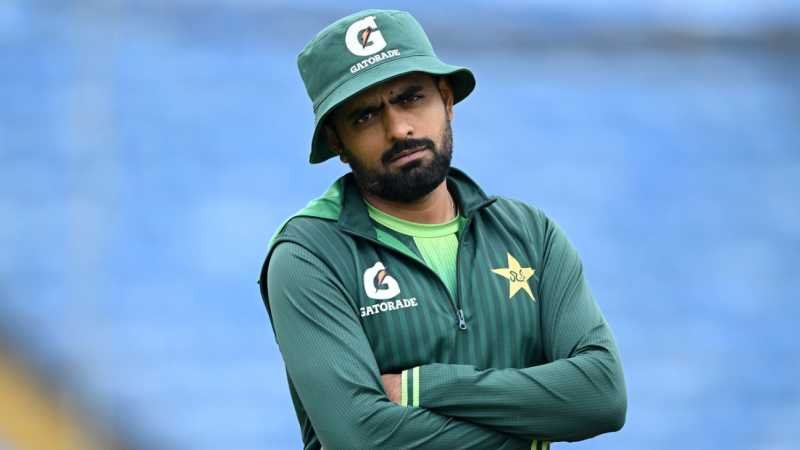
Babar Azam injury update has become one of the biggest talking points ahead of Pakistan’s opening Test against England, with the former Pakistan captain still a major doubt for the series opener at Headingley. Pakistan are expected to make a late selection decision after their medical panel assesses the condition of Babar’s injured right hand.
Babar suffered an impact injury while batting during Pakistan’s second Test against the West Indies and was struck on the same hand again during the warm-up match against the Professional County Club Select XI in Beckenham. He retired hurt from that game and did not return to the field, with the Pakistan Cricket Board describing the decision as precautionary.
The latest development came after Pakistan trained at Headingley on Monday, two days before the three-match Test series begins. Babar did spend some time batting in the nets, but his session was relatively brief. While he did not appear to be in obvious discomfort, the limited workload means Pakistan still have to wait for medical advice before making a final call.
The uncertainty is particularly significant because Babar remains one of Pakistan’s most important batting options, while his possible absence could also create a leadership question within the Test squad.
Why Babar Azam’s Availability Is Still Uncertain
Babar’s current situation is the result of an injury that has been repeatedly tested over a short period.
The original blow occurred during the second Test against the West Indies. Although he was able to continue his involvement, another impact during the warm-up match in Beckenham forced him to retire hurt.
That second incident naturally increased concerns about whether the finger has recovered sufficiently for the physical demands of Test cricket.
A Test match is very different from a short net session. A batter can face fast bowling for extended periods, repeatedly use the injured hand while gripping the bat and absorb further impacts over several days.
Therefore, simply being able to bat briefly in practice does not necessarily mean Babar is ready for a five-day Test.
Babar Bats Briefly at Headingley
Pakistan’s training session in Leeds offered the first useful indication of Babar’s current condition.
He participated in some throwdowns and batting practice, showing that he is able to test the hand with a bat in his hands. However, his time in the nets was short.
The absence of obvious discomfort is encouraging, but Pakistan’s management has understandably avoided making an early commitment.
Mohammad Abbas confirmed that both the medical panel and selection committee still had to make the final decision. The message from the Pakistan camp was clear: medical advice will take priority over the desire to include a star player.
That approach is particularly important with a finger injury because the consequences of returning too early can extend beyond one match.
What Happens If Babar Azam Misses the Test?
If Babar is ruled out, Pakistan could make significant changes to their middle order.
Saud Shakeel and Awais Zafar would potentially both come into the playing XI, giving Pakistan a different combination in the middle order.
Shakeel was already expected to feature after missing Pakistan’s series against the West Indies. His position became even more relevant after he scored a century in the warm-up match in Beckenham.
Zafar, meanwhile, made his Test debut during the second Test against the West Indies. Babar’s absence could therefore create another opportunity for him to continue his international development.
| Player | Current Situation | Potential Impact |
|---|---|---|
| Babar Azam | Doubtful due to right-hand finger injury | Pakistan may need to alter the middle order |
| Saud Shakeel | Available and scored a warm-up century | Strong option for the middle order |
| Awais Zafar | Made his Test debut in the West Indies series | Could retain his place if Babar misses out |
| Shan Masood | Recovering from a fractured finger | Could return if medically cleared |
| Salman Agha | Pakistan’s T20I captain | Potential leadership option if required |
Saud Shakeel’s Warm-Up Century Adds Selection Pressure
One factor working in Pakistan’s favour is that their potential replacement options have already provided reasons for selection.
Saud Shakeel’s century in the warm-up match could hardly have come at a better time. With Babar’s fitness uncertain, a substantial innings from Shakeel gives the selectors a ready-made option rather than forcing them to select a player without recent evidence of form.
That does not make replacing Babar straightforward, however.
Babar’s experience, batting quality and ability to absorb pressure are difficult to replicate with one player. If he is unavailable, Pakistan would need the collective middle order to compensate rather than expecting one replacement to perform the same role.
Shan Masood’s Injury Update Is More Positive
The situation surrounding Shan Masood appears more encouraging, although he too remains subject to medical clearance.
Masood suffered a fractured finger after being struck during the first Test against the West Indies. The injury prevented him from playing the second Test, and he also did not feature in Pakistan’s warm-up match in Beckenham.
However, his latest training session provided a positive sign. Unlike Babar, Masood batted for a longer period in the nets and reportedly completed the whole session.
That represents a meaningful step in his recovery.
Pakistan still need to follow medical advice before selecting him, but the longer batting session gives the team greater reason for optimism.
Pakistan Could Face a Leadership Problem
Babar’s injury creates another issue that goes beyond batting.
Although he is no longer Pakistan’s Test captain, he remains an influential figure within the squad. He took over the captaincy from Masood at the beginning of the series against the West Indies.
If both Babar and Masood were unavailable, Pakistan would potentially have to manage a team missing two senior figures from its leadership structure.
During the warm-up match in Beckenham, Pakistan were led by Salman Agha, who is the team’s T20I captain. However, he has not previously captained Pakistan in Test cricket.
That distinction matters because Test captaincy requires a different type of tactical management. Field placements, bowling changes, session planning and declarations all require decisions that can develop over several days.
Pakistan therefore need to consider not only who replaces an injured batter but also how the leadership structure functions if key senior players are absent.
Why Pakistan Should Avoid Rushing Babar
From Pakistan’s perspective, the temptation to play Babar will naturally be strong. He is one of the team’s most established batters, and an England series provides a major international stage.
However, the short-term benefit of selecting an injured player must be weighed against the possibility of aggravating the problem.
A finger injury is particularly relevant to batting because the hand is involved in almost every aspect of the stroke: grip, bat control, defence and power generation.
If Babar cannot comfortably handle repeated fast bowling, his effectiveness could be compromised even if he passes a basic fitness test.
The smarter selection question is therefore not simply whether he can bat. It is whether he can withstand the workload of a Test match.
England Could Test Babar’s Hand Immediately
The conditions of an England Test can place considerable demands on a batter. Facing a sustained spell from fast bowlers requires a secure grip and confidence in playing both defensive and attacking strokes.
If Babar is selected, England will inevitably test him with deliveries that challenge his technique and physical comfort.
That makes Pakistan’s medical decision particularly important. A player who looks comfortable during controlled throwdowns may experience a very different level of stress when facing competitive bowling at full intensity.
Pakistan’s selectors therefore have to assess both immediate fitness and match-readiness.
The Timing of the Injury Makes the Decision Harder
The timing could hardly be more complicated for Pakistan.
The squad has arrived in Leeds only two days before the Test, leaving limited opportunity for extended rehabilitation or another substantial practice match.
The warm-up injury also came after Babar had already been dealing with the original problem from the West Indies series.
That means Pakistan cannot afford to rely purely on optimism. The medical assessment has to determine whether the hand is sufficiently recovered for the demands of international red-ball cricket.
Pakistan’s Middle Order Faces a Major Test
If Babar misses out, the pressure on Pakistan’s other middle-order batters will increase immediately.
England’s bowlers are likely to challenge Pakistan with sustained spells, movement and changes in pace. Without Babar’s presence, Pakistan may need greater contributions from Shakeel, Zafar and the rest of the batting group.
The upside is that the situation could provide valuable experience to players who are still establishing themselves in Test cricket.
Shakeel’s warm-up century is particularly encouraging because it suggests Pakistan have a batter entering the series with confidence.
But replacing a player of Babar’s stature is rarely about finding an exact substitute. It is about redistributing responsibility across the batting order.
What Pakistan’s Selection Decision Could Signal
The decision over Babar will also reveal how Pakistan view the balance between experience and fitness.
If Babar is cleared and selected, it would indicate that the medical team believes the injury is sufficiently stable for Test cricket. If he is left out, Pakistan would be prioritising long-term fitness and giving the middle order an opportunity to adapt without risking further damage.
Either way, the final decision is likely to have an impact beyond the first Test.
A three-match series rewards teams that can keep their key players fit throughout. Pakistan therefore have to consider not only what gives them the best chance of competing at Headingley, but also how the decision affects the remainder of the England series.
Conclusion
Babar Azam remains a serious doubt for Pakistan’s first Test against England as the team waits for medical clearance on his right-hand finger injury. His brief batting session at Headingley provides some encouragement, but Pakistan are still unwilling to confirm his availability.
Saud Shakeel’s warm-up century gives the selectors a strong alternative, while Awais Zafar could also feature in the middle order if Babar is ruled out. Shan Masood’s recovery offers another positive development after he completed a longer batting session in the nets.
The biggest question is whether Babar is fit enough not merely to bat, but to withstand the demands of a five-day Test against England’s attack. Pakistan’s final selection call will therefore be about much more than the availability of one star player.
With the series opener approaching rapidly, Pakistan must balance immediate competitiveness with long-term fitness. For Babar, the safest route may ultimately depend on one simple question: can his injured hand handle everything Test cricket is about to throw at it?
For breaking news and live news updates, like us on Facebook or follow us on Twitter and Instagram. Read more on Latest Cricket on thefoxdaily.com.






COMMENTS 0