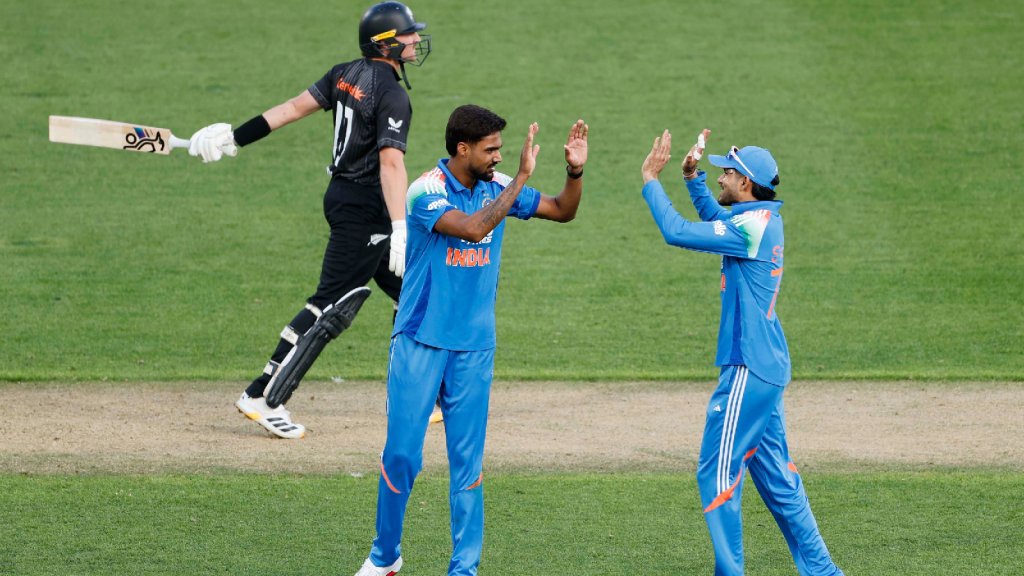
Gurnoor Brar is emerging as an exciting fast-bowling option for India, with his pace, bounce and growing understanding of conditions attracting attention from the national team’s management. The 26-year-old has taken an unconventional route to international cricket, moving from basketball to Fast Bowling before building his reputation through domestic red-ball cricket.
His recent performance in Wellington, where he claimed 4/30 against New Zealand in the second ODI, offered a glimpse of his potential. On a challenging pitch that offered significant bounce, Brar showed patience, controlled his lengths and struck at crucial moments. His performance helped India dismiss New Zealand for 134 and secure a four-run victory under the Duckworth-Lewis-Stern method, taking a 2-0 lead in the five-match series.
Gurnoor Brar’s journey from basketball to fast bowling
Brar’s journey into cricket was not straightforward. His father initially encouraged him to pursue basketball because of his height, believing his physical attributes could give him an advantage in the sport. However, Brar’s own interest was always in cricket, particularly fast bowling.
He began taking the game seriously in his late teens and gradually developed an approach built around pace, aggression and discipline. Rather than relying only on his natural physical attributes, he worked on understanding the technical aspects of fast bowling and how to create opportunities to dismiss batters.
One of his biggest influences was former South African fast bowler Dale Steyn. Brar spent considerable time watching videos of Steyn, studying his bowling style, aggression and ability to take wickets with the red ball. He appeared particularly interested in how Steyn maintained pressure through his line and length rather than depending entirely on short-pitched deliveries.
That influence helped Brar develop a clear understanding of where he wanted to pitch the ball. His approach focuses on targeting a length that forces the batter to play, creating two potential opportunities: beating the batter around the top of off stump or finding an edge that can carry to the slip cordon.
Shubman Gill recognised his potential early
Brar’s progress through domestic cricket attracted attention from several important figures in Indian Cricket. Shubman Gill played an early role in helping him move forward, recognising his ability after watching him bowl in Katoch Shield matches.
Gill had seen Brar during his own Under-19 days and helped him earn an opportunity in the Mohali district team. After spending just one session watching the fast bowler, Gill reportedly made a call that helped Brar secure a place in an Under-23 squad.
His progress continued as he moved into Punjab cricket. The selection panel led by Ajit Agarkar also recognised his potential and fast-tracked him into the group of fast bowlers at the Centre of Excellence. India head coach Gautam Gambhir had reportedly been monitoring his development even before Brar entered the international set-up.
The interest in Brar has not been driven by an extensive Indian Premier League career. He has played only one IPL match, in 2023. Instead, his reputation has largely been built through first-class cricket, where he has played 22 matches and developed the habits associated with a red-ball fast bowler.
People who have worked with him believe his understanding of the longer format, combined with his work ethic, makes him a promising prospect. His development through domestic cricket has helped him build a foundation beyond the demands of limited-overs cricket.
Morne Morkel’s guidance is helping Brar use his height
While Dale Steyn provided inspiration through videos, India bowling coach Morne Morkel has offered Brar more direct guidance. Morkel, who also had a tall fast-bowling frame, understands how to use height to generate bounce and create problems for batters.
Brar has spoken about the value of learning from Morkel, particularly when it comes to selecting the right length for different pitches. His ability to extract bounce is one of his biggest strengths, but knowing when and how to use it remains equally important.
Speaking about the guidance he receives, Brar said:
“Obviously Morne Morkel teaches us a lot. How to use my height. He too had a similar style of bowling. So he keeps telling me a lot. Which length will suit us more on which wicket.”
The advice is particularly relevant because Brar’s height naturally allows him to generate bounce. However, excessive dependence on short-pitched bowling can reduce his effectiveness, especially when the conditions demand a fuller length.
His recent performance against New Zealand suggested that he is beginning to understand this balance. Rather than immediately targeting the batters with bouncers, he spent time building pressure through disciplined bowling before using his extra bounce to create breakthroughs.
Gurnoor Brar’s four-wicket performance in Wellington
Brar produced one of his most impressive international performances in the second ODI against New Zealand in Wellington. Playing on a pitch that offered considerable bounce, he finished with figures of 4/30, recording his career-best ODI bowling performance and his first four-wicket haul in the format.
New Zealand had already lost three wickets to Auqib Nabi and Anshul Kamboj, but Daryl Mitchell continued to resist the Indian attack. Mitchell faced 104 deliveries and scored a fighting 55, while Mitchell Santner supported him as the pair added 59 runs to take their team beyond the 100-run mark.
Mitchell appeared more comfortable dealing with Kamboj’s movement than Brar’s pace. However, the Indian fast bowler remained patient and continued to attack the areas that could bring him wickets.
His discipline proved decisive when he dismissed Tom Latham and Glenn Phillips in the same over. The double breakthrough left New Zealand struggling at 53/5 and changed the direction of the innings.
New Zealand then lost their final five wickets for just 22 runs. Brar also removed Nathan Smith in the 40th over, completing an outstanding spell that helped India bowl the hosts out for 134.
The performance was significant not only because of the four wickets but also because of the way Brar earned them. On a surface with tennis-ball-like bounce, he could have bowled too short and allowed the batters to play comfortably. Instead, he maintained a fuller length and made them work for their runs.
Why Brar avoided overusing the short ball
One of the most encouraging aspects of Brar’s Wellington performance was his understanding of when to use the bouncer. Fast bowlers with natural bounce can sometimes become overly dependent on short-pitched deliveries, particularly when the pitch offers extra carry.
Brar recognised that the short ball would be more effective after he had established control with his fuller deliveries. By making batters consider the possibility of a ball attacking the stumps, he created an opportunity to surprise them with extra bounce.
After the match, Brar explained how he approached his spell and why patience was important.
“Every day I learn what I could have done better. So that is what I learn from every match. And I try to adapt the good things in my memories.”
He also explained that he had initially focused on bowling fuller before using the bouncer at the right moment. He said that while short-ball wickets are valuable, relying on the delivery too frequently would be a mistake.
His comments reflected a developing understanding of fast-bowling strategy. The ability to bowl quickly is important, but controlling the length, reading the batter and selecting the right delivery at the right time are what turn pace into a consistent wicket-taking threat.
India’s search for a reliable ODI wicket-taker
Brar’s emergence comes at a time when India are continuing to assess their options for the ODI pace attack. Several fast bowlers are competing for places, and the team management is looking for a combination that can deliver wickets throughout an innings.
Jasprit Bumrah remains an important part of India’s fast-bowling plans, but finding another dependable wicket-taker alongside him would give the team greater flexibility. India also need a seamer capable of making breakthroughs during the middle overs, when opposition batters often look to rebuild their innings.
Kuldeep Yadav has frequently provided wickets during that phase, but team combinations can make his selection more complicated. A fast bowler who can consistently create chances in the middle overs would offer India another way to control opposition scoring and break partnerships.
Brar’s pace and bounce make him an interesting candidate for that role. His performance in Wellington demonstrated that he can trouble established batters without depending entirely on favourable conditions.
Gurnoor Brar faces competition from Prasidh Krishna
Brar is expected to face competition from other fast bowlers as India continue to shape their ODI attack. Prasidh Krishna is another quick who could compete for a place, making consistency and adaptability important factors in the selection discussion.
One of Brar’s major advantages is his ability to regularly reach speeds of 140 kilometres per hour and above. His repeatable bowling action also gives him a foundation on which he can continue improving his control.
However, pace alone will not guarantee him a regular place in the playing XI. His line and length still require refinement, particularly if he wants to become a dependable option across different conditions and against different batting line-ups.
Improving that control could make his natural bounce even more dangerous. If he consistently hits the right areas, batters will have fewer opportunities to settle against him, while his ability to surprise them with a bouncer could become an additional weapon.
What Gurnoor Brar needs to improve next
Brar’s early international performances have provided encouraging signs, but his development remains a work in progress. The next challenge is to turn his promising spells into consistent performances across different pitches and match situations.
His main area of improvement is control over line and length. Maintaining accuracy over long spells will be particularly important in ODI cricket, where batters can target any loose deliveries and build momentum quickly.
He will also need to continue developing his ability to read conditions. Wellington showed that he can adapt his approach rather than simply bowl short because a pitch offers extra bounce. That flexibility will be essential as he faces teams and surfaces that demand different bowling plans.
His red-ball background could prove valuable in this process. The discipline required in first-class cricket can help fast bowlers develop patience, repeat their actions and understand how to build pressure over extended periods.
Can Gurnoor Brar become a regular India fast bowler?
India’s interest in Brar reflects the potential they see in a fast bowler whose development has been shaped by domestic cricket rather than the spotlight of the IPL. His journey from basketball to professional cricket, his admiration for Dale Steyn and the guidance of Morne Morkel have all contributed to the bowler he is becoming.
The four-wicket haul in Wellington was an important step, showing that Brar can combine speed with patience and make an impact in international cricket. His ability to generate bounce at 140kmph and above gives him a distinct quality, while his willingness to learn suggests there is room for further improvement.
The competition for places in India’s ODI attack will remain strong. Brar still needs to sharpen his control and prove that he can deliver consistently, but his early performances have given the selectors reasons to keep investing in his development.
If he continues to improve his line and length while preserving his natural pace and bounce, Gurnoor Brar could become the kind of fast bowler India are searching for: a seamer capable of taking wickets without relying on the conditions to do the work for him.
For breaking news and live news updates, like us on Facebook or follow us on Twitter and Instagram. Read more on Latest Cricket on thefoxdaily.com.






COMMENTS 0