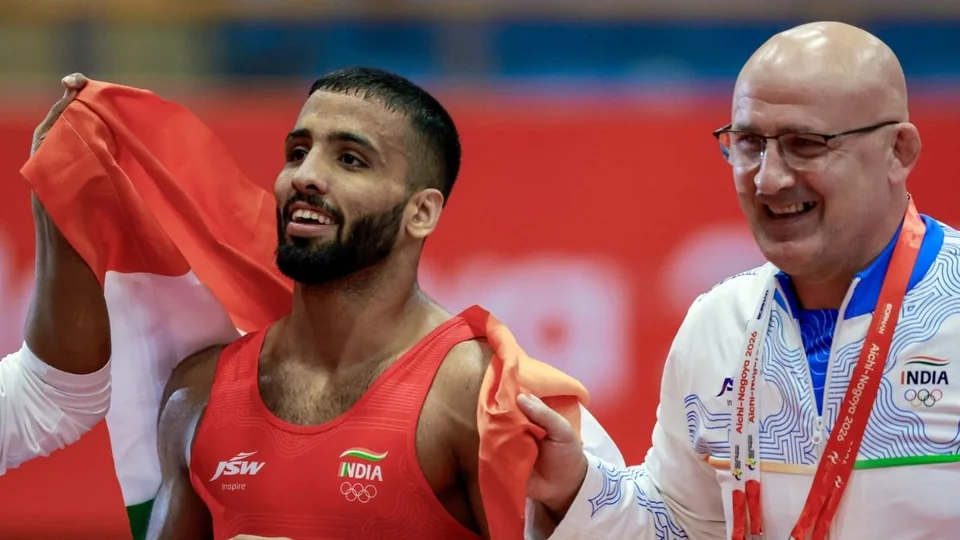
India’s Sujeet Kalkal suffered a heartbreaking quarter-final defeat against Tajikistan’s Abdulmazhid Kudiev at the World Wrestling Championships in Astana, missing out on a place in the semi-finals after a dramatic final few seconds. The Indian freestyle wrestler had entered the competition among the favourites in the men’s 65kg category following an outstanding season that included Asian Championships and Asian Games gold medals.
Kudiev, however, turned the tables on the Asian Games champion, securing a 3-3 victory on criteria after a successful challenge overturned Sujeet’s scoring advantage. The result provided the Tajik wrestler with revenge for his defeat in the Asian Games final, where Sujeet had produced a remarkable comeback to win 10-9 after trailing 9-2.
The defeat ended Sujeet’s hopes of reaching the medal rounds in Astana. His exit was particularly disappointing given his impressive run of results throughout the year and his previous success against several leading international opponents.
Sujeet Kalkal Loses Dramatic Quarter-Final Against Kudiev
Sujeet began his campaign in Astana with a convincing 4-0 victory over Belarusian wrestler Islam Guseinov, setting up another meeting with Kudiev. The quarter-final brought together two wrestlers who were already familiar with each other’s strengths after their memorable Asian Games encounter.
The Indian initially appeared to be in control of the contest. Sujeet defended effectively during the first period and found opportunities to attack, including a quick takedown that helped him establish a 3-1 lead as the bout entered its closing stages.
With approximately 30 seconds remaining, Sujeet attempted another attack. Kudiev responded with a counter, changing the momentum of the contest at a crucial moment. The bout then became a close scoring battle in which a referee’s decision and a successful challenge proved decisive.
Initially, Sujeet was awarded two points for a takedown, taking his score to 5-2 according to the match sequence described in the report. Kudiev challenged the decision, and the review resulted in Sujeet’s two points being removed. At the same time, Kudiev’s original one-point award for a push-out was changed to two points for a counter-attack.
The revised score stood at 3-3. Under wrestling’s criteria system, Kudiev was declared the winner, leaving Sujeet unable to progress to the semi-finals.
How Kudiev Turned the Tables After the Asian Games Final
The quarter-final carried added significance because of the wrestlers’ previous meeting at the Asian Games. Sujeet had beaten Kudiev in a dramatic 65kg final after falling behind 9-2. Rather than surrendering to the deficit, the Indian launched a determined comeback and secured a 10-9 victory to claim the gold medal.
That performance helped establish Sujeet as one of India’s leading freestyle wrestling prospects in the category. His ability to maintain pressure and continue attacking even when behind had been a defining feature of his Asian Games triumph.
The World Championships contest unfolded differently. Sujeet again showed strong defensive awareness and managed to take the lead, but Kudiev found an opportunity to counter in the closing seconds. The successful challenge then changed the scoring situation and ultimately determined the result.
For Kudiev, the victory represented a measure of revenge after the painful Asian Games defeat. For Sujeet, it was a reminder of how narrow the margins can be at the highest level of wrestling, where a single exchange or review can decide a closely fought contest.
The Indian had been enjoying a remarkable run before arriving in Astana. According to the supplied report, he had remained unbeaten in 14 matches during the year leading up to the defeat, winning the Asian Championships, the Asian Games and two international ranking-series titles. His winning streak in United World Wrestling events had reached 19 matches since the previous World Championships.
Those results explain why Sujeet entered the tournament with high expectations. However, his quarter-final loss meant that his search for a first World Championships medal would continue.
Sujeet Misses Repechage Opportunity After Kudiev’s Semi-Final Defeat
Sujeet’s route back into medal contention also ended after Kudiev lost his semi-final against the United States’ Bowen Bassett. In wrestling, repechage opportunities can allow some athletes defeated by finalists to compete for a bronze medal. With Kudiev failing to reach the final, Sujeet could not continue through that route.
The outcome made the quarter-final defeat even more consequential for the Indian wrestler. Despite reaching the last eight and competing closely with a familiar rival, he had no further opportunity to fight for a medal in the 65kg category.
Bassett emerged as one of the tournament’s major surprises. The American defeated former world champion Abasgadzhi Magomedov of Russia in a high-scoring 14-13 contest before recording a 12-2 victory over Kudiev in the semi-final.
His run to the final demonstrated how unpredictable the weight class had become. The results also showed that past achievements and pre-tournament expectations offered no guarantee of success once the competition began.
Top Seeds Fall as the 65kg Competition Opens Up
The men’s 65kg draw experienced another major upset when Iran’s world champion Rahman Amouzad lost his quarter-final against Armenia’s Vazgen Tevanyan. Tevanyan won 3-2, eliminating the top seed and changing the outlook of the competition.
Sujeet’s exit and Amouzad’s defeat meant that two of the category’s leading names were out before the final. Both had entered the championships with strong credentials, making their quarter-final losses among the most significant developments in the weight class.
Tevanyan advanced to the final, where he was scheduled to face Bassett. The American’s victories over Magomedov and Kudiev had made him one of the standout performers of the tournament, while Tevanyan’s win over Amouzad gave Armenia a major opportunity in the title contest.
For Sujeet, the immediate priority will be to assess the defeat and prepare for the next stage of his international career. His season has already demonstrated that he can beat leading opponents, but the World Championships loss highlighted the need to manage decisive moments and scoring situations under pressure.
Questions Surround India’s Freestyle Coaching Arrangements
Sujeet’s quarter-final defeat also came amid questions about India’s coaching arrangements at the World Championships. Freestyle coach Shako Emzarios Bentinidis was not in Sujeet’s corner in Astana, having not travelled with the team.
Bentinidis took charge of India’s freestyle programme in May and had played a role in the team’s preparation for the Asian Games. Under his guidance, Sujeet in the 65kg category and Aman Sehrawat in the 57kg category won gold medals at the continental event.
The report indicated that Bentinidis wanted to travel with the Indian team for the World Championships, but the Wrestling Federation of India (WFI) preferred that he remain at the national camp to train wrestlers there. The federation also cited the importance of preparing athletes for the following year, when qualification for the Los Angeles Olympics would be a major focus.
“We need to prepare our wrestlers for next year which is an LA Olympics qualification year. We also have to give opportunities to Indian coaches to take up responsibility,” a WFI official said.
Bentinidis subsequently went on leave, while freestyle coach Vinod Kumar travelled to Astana with the Indian team. The circumstances raised questions about the relationship between the foreign coach and the federation, although the available information does not establish the full details of any disagreement.
The timing was notable because Bentinidis’s tactical guidance had been credited with helping India’s freestyle wrestlers perform strongly at the Asian Games. Sujeet’s aggressive approach in the final against Kudiev had been one example of the benefits of putting opponents under sustained pressure.
According to the report, Bentinidis had encouraged Sujeet to attack more and take calculated risks. Sujeet followed that approach in the Asian Games final, repeatedly putting Kudiev under pressure and eventually overturning a substantial deficit.
The World Championships defeat does not by itself establish that the coaching arrangements affected the result. However, the absence of the coach who had worked with Sujeet during his successful Asian Games campaign became a talking point after the Indian’s exit.
Manisha Bhanwala Reaches the Women’s 59kg Final
While Sujeet’s campaign ended in the quarter-finals, Manisha Bhanwala delivered a strong performance to reach the final in the women’s 59kg category, a non-Olympic weight class. Her run offered India another opportunity to compete for a gold medal at the championships.
Manisha entered the final after a dominant semi-final against Kazakhstan’s Altyn Shagayeva. She established a 10-0 lead before pinning her opponent, securing her place in the gold-medal bout.
Her earlier performances were equally encouraging. Manisha defeated Canada’s Laurence Beauregard 6-2 before beating Mongolia’s Bolortuya Khurelkhuu 6-0 in the quarter-finals. Those victories carried her into the semi-finals, where she completed her run with another decisive performance.
Manisha was scheduled to face Pan American champion Abigail Elizabeth Nette in the final on Friday. Although Manisha had competed in the 57kg category at the Asian Games, she was wrestling in the 59kg division at the World Championships.
The report highlighted the significance of the opportunity, noting that no Indian woman had won a gold medal at the World Championships. A victory would therefore have represented an important achievement for Indian women’s wrestling.
Manisha had previously won the Asian Championships title the year before, following bronze-medal finishes in three earlier editions of the continental competition. She trains under coach Mandeep Singh at the Sir Chhotu Ram Akhara in Rohtak.
Other Indian Wrestlers Make Their Mark in Astana
India also recorded results across several other women’s weight categories. Neelam Sirohi in the 50kg division and Kajal Dhochak in the 76kg category reached their respective finals but finished with silver medals.
Tanu secured bronze in the women’s 72kg category after defeating the United States’ Precious Rosanna Bell 9-5. Her victory added another medal to India’s overall performance at the championships.
These results offered a broader picture of India’s campaign beyond Sujeet’s quarter-final exit. While the men’s 65kg competition ended in disappointment for one of the country’s leading wrestlers, Indian women continued to challenge for medals across multiple divisions.
Vicky Faces Repechage Challenge in the Men’s 97kg Category
In the men’s 97kg division, Indian wrestler Vicky lost his quarter-final against Japan’s Arash Yoshida. According to the report, he was set to compete in repechage, where he would face Iran’s Hassan Yazdani.
The potential repechage bout offered Vicky another opportunity to remain in contention, depending on the tournament’s progression and eligibility rules. His challenge against Yazdani would be another test against an established international opponent.
What Sujeet Kalkal Must Take From the Defeat
Sujeet’s loss to Kudiev was a painful ending to a season in which he had established himself as one of the most successful wrestlers in his division. His Asian Championships and Asian Games titles, along with two ranking-series victories, demonstrated his ability to compete consistently at a high level.
The defeat also showed how important it is to manage the closing seconds of a match. Sujeet had taken the lead and defended well, but his late attack created an opening for Kudiev to counter. The subsequent challenge changed the score and decided the bout on criteria.
There is no reason to overlook Sujeet’s achievements because of one defeat. His record before the tournament had placed him among the favourites, and he had already shown that he could overcome Kudiev in a high-pressure final. The challenge now is to learn from the quarter-final and return with improved execution in decisive situations.
The next World Championships in Las Vegas are expected to carry added significance as an Olympic qualification event. For Sujeet and the wider Indian Wrestling team, preparations for the Olympic cycle will require consistent international competition, tactical development and careful planning.
Kudiev’s victory in Astana gave the Tajik wrestler his revenge for the Asian Games final, but it also underlined the unpredictable nature of elite wrestling. Sujeet’s campaign ended earlier than expected, while Bassett, Tevanyan and several Indian women produced performances that reshaped the tournament. For India, the focus now turns to building on the medals won in Astana and preparing its wrestlers for the challenges ahead.
For breaking news and live news updates, like us on Facebook or follow us on Twitter and Instagram. Read more on Latest Sports on thefoxdaily.com.




COMMENTS 0