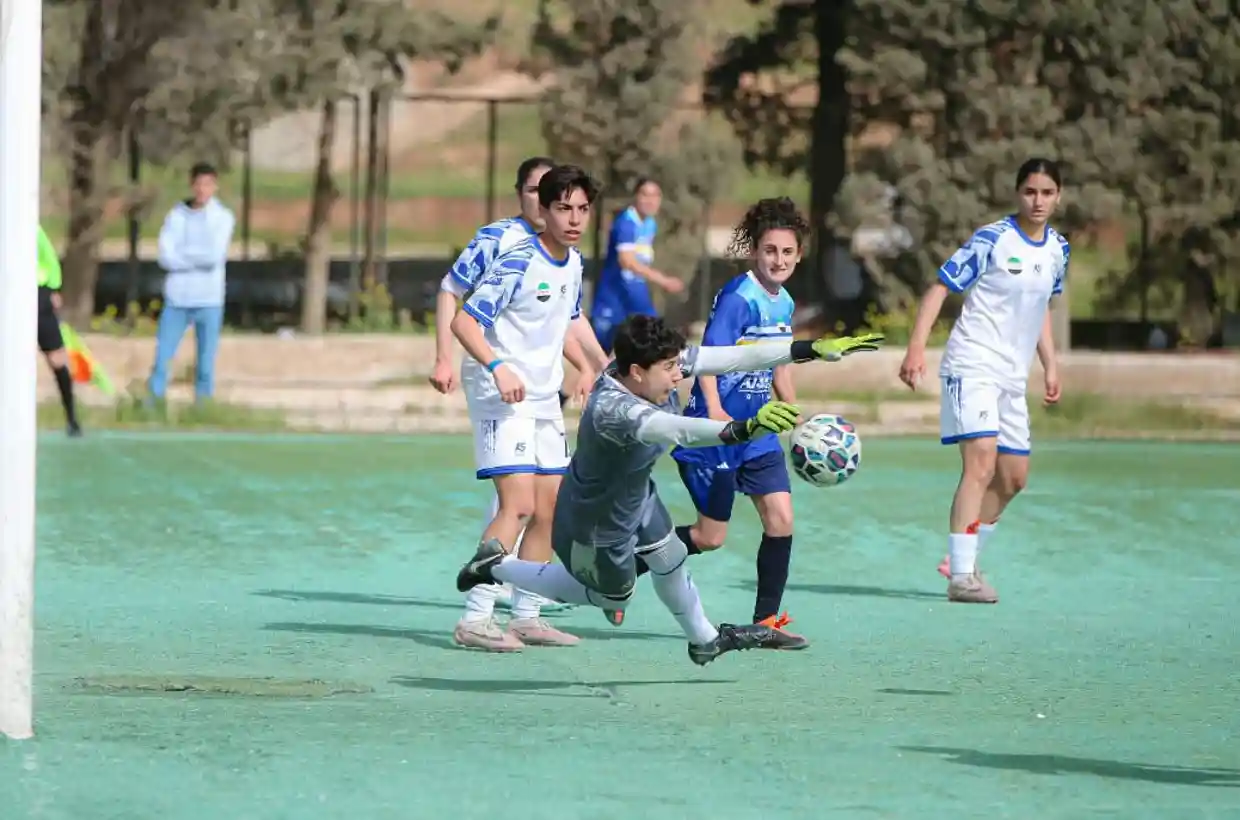
Women’s football in Syria is slowly rebuilding after more than a decade of war, political upheaval and disrupted sporting development. For years, the conflict brought the country’s women’s game almost to a standstill, leaving an entire generation of players without regular competitions, professional opportunities or a functioning national-team structure. Today, however, youth teams are beginning to deliver encouraging results, Syrian players are gaining experience abroad, and local clubs are creating new opportunities for girls to play football.
The journey remains difficult. Financial restrictions, damaged infrastructure, limited training facilities, unpaid wages and a lack of international matches continue to affect players and clubs. The senior women’s national team has not played for more than two years, while many footballers fear that the progress made by the current generation could disappear without sustained support.
Despite these challenges, Syria’s recent youth football achievements have offered a rare source of sporting optimism. Victories at regional tournaments, including the West Asian Football Federation (WAFF) Under-17 Women’s Championship, have demonstrated the potential of Syrian players. For many involved in the game, these successes represent more than trophies: they offer hope to girls growing up in a country still recovering from years of conflict.
How Syria’s civil war disrupted women’s football
Syria’s Women’s Football development was beginning to take shape before the uprising in 2011. The national women’s team played its first international match in 2005, and by 2011 plans were being developed for an 11-a-side women’s league. However, the outbreak of conflict brought those ambitions to an abrupt halt.
For approximately six years, organised women’s football in Syria effectively stopped. The country had no international fixtures at any level of the women’s game during that period, apart from occasional futsal tournaments. Plans to establish a stronger domestic structure were abandoned, while players, coaches and other people involved in football were forced to leave or relocate.
The wider humanitarian consequences of the war also affected the sporting community. More than six million people eventually fled Syria, including hundreds of individuals connected to football. This movement scattered an already small group of female players across different countries, making it difficult to maintain teams, coaching networks and development programmes.
Former national-team goalkeeper Noor Jumaa described the experience as the loss of an entire generation. She said the work that had been built before the conflict seemed to disappear, leaving young players without the opportunities that earlier generations had hoped to create.
Men’s football followed a different path during the conflict. Although Syria was barred from hosting international matches in 2011 because of security concerns, the men’s national team continued playing fixtures abroad. The Assad government also used the team’s sporting achievements to project an image of normality, including welcoming the squad to the presidential palace after its 2012 WAFF Championship victory.
Women’s football, by contrast, lacked comparable visibility and institutional continuity. Girls growing up during those years had few opportunities to watch a Syrian women’s national team or imagine a clear pathway into International Football.
A new generation of Syrian girls discovers football
Despite the absence of a stable women’s football structure, some young girls continued to find ways to play. Their stories reveal how individual opportunities, neighbourhood connections and social media helped introduce a new generation to the sport.
Raneem Abo Lateef, now a 21-year-old goalkeeper for Syria, recalled watching the men’s national team and wishing that the country had a national team for girls. Her opportunity arrived unexpectedly after her family moved to a new house. A girl living nearby told her that a relative was starting a girls’ football club.
Abo Lateef described the discovery as a dream coming true. What had previously seemed like an impossible opportunity suddenly became a realistic way to participate in the sport.
Julnar Mustafa, another member of the national team, discovered football through a different route. Born in 2008 in Hasakah, she spent hours playing with boys in her neighbourhood. She also recorded videos of herself dribbling and performing football tricks before uploading them to Facebook.
A regional coach eventually noticed her videos and invited her to join a team. That opportunity helped Mustafa move from informal neighbourhood football into organised competition.
However, access to football remains difficult for girls in parts of Syria. Mustafa explained that in her community in Hasakah, sports participation for girls can face strong social restrictions. She said girls were often discouraged from taking part in sport altogether, not just football.
These experiences highlight two connected challenges facing women’s football in Syria: the need for better sporting opportunities and the need to create an environment in which girls can participate without social pressure or restrictions.
Syria’s women’s national team returns to international football
After years without international activity, Syria attempted to revive its women’s national team in 2017. The country entered the Asian Cup qualifiers in Vietnam, assembling a squad through tryouts announced by the Syrian Football Association on Facebook.
The players had approximately one month to prepare for the tournament. Many had experienced little organised football during the previous six years, and the team entered the competition without the preparation and development opportunities available to more established national sides.
Syria lost all its matches, including a 14-0 defeat against Myanmar. The results exposed the considerable gap between the team and its regional opponents.
Noor Jumaa, who was part of the squad, later described the campaign as one of the worst in the country’s football history. The players faced criticism after the tournament, despite having had very limited preparation.
Maha Al-Katreb, another member of that squad, recalled seeing opponents arrive with larger coaching teams and younger players who were already training alongside their senior national sides. The contrast highlighted how far Syria had fallen behind in women’s football development.
For Al-Katreb, the experience became a turning point. Injuries had ended her playing career earlier than expected, and she gradually moved into coaching and administration. Rather than leaving the sport, she began working towards building a development programme that could provide better opportunities for future generations.
Domestic leagues and youth teams provide a foundation for recovery
One of the most important developments in Syria’s women’s football revival came in 2019, when a six-team senior women’s league was established. The introduction of youth national teams followed, creating a more structured pathway for young players to develop their skills and gain competitive experience.
The country also held the inaugural edition of its youth league in 2026. These competitions represent an attempt to rebuild women’s football from the grassroots level rather than relying only on occasional national-team gatherings.
Al-Katreb played an important role in this process. During her time with the Syrian Football Association, she developed the country’s first women’s football strategy and submitted it to FIFA. The plan focused on expanding female participation and creating a pathway from grassroots football to the national teams.
The strategy recognised that rebuilding the senior national team would require long-term investment in younger players, coaches, schools and local competitions.
“You have to start building from the bottom if you want to see results after these 10 years,” Al-Katreb said. “So that we don’t burn one generation after another.”
The approach reflects a wider challenge for countries rebuilding sporting structures after conflict. A national team cannot remain competitive without a consistent supply of trained players, organised leagues, qualified coaches and regular opportunities to compete.
Plans to increase female participation in Syrian football
The scale of the challenge was clear in the figures recorded in 2022. Women accounted for only 1,000 of Syria’s 25,000 registered footballers, demonstrating how limited female participation remained compared with the men’s game.
The women’s football strategy developed by Al-Katreb aimed to increase female participation by 150% over four years. One of its major objectives was the establishment of 33 school training centres across 11 provinces, with the capacity to accommodate 1,650 girls by 2026.
School-based programmes can play an important role in expanding access to football, particularly in communities where girls may not have access to established clubs. They can also help identify talented players at an early age and provide a pathway into regional competitions and national youth teams.
However, targets and development plans need consistent financial and administrative support to become sustainable. Training centres require equipment, qualified coaches, safe facilities and regular competition opportunities. Without these resources, participation programmes risk remaining limited in their impact.
The Syrian government’s plans to rehabilitate sporting infrastructure are another part of the wider recovery effort. Rami Alsubea, an adviser at the Ministry of Sport and Youth, said that 48 sports facilities had been rehabilitated in 2025. The government also outlined plans to rehabilitate approximately 150 more facilities and construct around 20 new ones by 2028.
Restoring sporting facilities is also connected to Syria’s ambition to meet hosting requirements set by FIFA and the Asian Football Confederation. Improved infrastructure could eventually support more domestic competitions and create opportunities for international matches to return to the country.
Financial restrictions continue to hold back women’s football
Even as Syria’s football structures begin to recover, financial restrictions remain one of the biggest obstacles. International sanctions and banking limitations previously prevented the Syrian Football Association from accessing millions of dollars in FIFA development funding.
These restrictions affected the federation’s ability to benefit fully from programmes such as FIFA Forward, which supports football development through funding for infrastructure, administration and other projects.
Although broad economic sanctions have since been lifted, an estimated $11.5 million in funds remains inaccessible to the Syrian federation. Both the SFA and FIFA have said they are working to establish a mechanism that would allow the money to be transferred.
For now, the support available has been reflected in the provision of training equipment, but the wider financial problem remains unresolved.
The impact is felt directly by players and clubs. The national team and regional women’s league are operated by the Syrian Football Association, but clubs often struggle to meet basic financial responsibilities. Some players say their clubs can go months without paying wages, while payments that eventually arrive may be lower than the amounts originally agreed.
National-team duty also provides limited financial support. Players reportedly receive a daily allowance of $20 during national-team activities, including training camps. The total allowance is capped at $200 for the length of their stay, regardless of how long the camp or assignment lasts.
For some players, the costs associated with travelling and participating in football can exceed the money they receive. This makes it difficult to treat football as a sustainable career, particularly for those who do not have additional financial support.
Clubs struggle to survive despite the growth of the women’s league
Several women’s football clubs have folded since the domestic league was established in 2019. Financial difficulties, the continuing consequences of the war and wider instability have made it challenging for teams to maintain their operations.
Clubs that remain active often struggle to provide basic resources for their players. Limited training facilities, insufficient preparation time and financial uncertainty can affect both performance and the long-term development of young footballers.
One of Syria’s most successful women’s teams is Al-Hilal, which has been renamed Qamishlo Sport. The club has established itself as a leading force in the domestic game and currently holds both senior and youth league titles.
However, success on the pitch has not necessarily translated into financial security. Head coach Daleel Khalid has criticised the lack of adequate support for women’s football and highlighted shortages in training camps, preparation and infrastructure.
“There’s an absence of adequate support from all sides and the parties responsible for Syrian women’s sports, whether in terms of training camps and preparation, or the capabilities and infrastructure needed to develop the game,” Khalid said.
His comments underline the difference between sporting achievement and institutional development. A club can produce talented players and win domestic competitions while still struggling to provide the resources needed to maintain long-term progress.
Al-Hilal’s run to the 2026 WAFF Women’s Clubs Championship final
Al-Hilal’s participation in the 2026 WAFF Women’s Clubs Championship offered an important test of the team’s development. The tournament brought together league champions from six regional competitions, providing Syrian players with an opportunity to compete against clubs with different levels of experience and resources.
Despite having only a short training camp at home before the competition, Al-Hilal reached the final against Saudi champions Al-Nassr. Players including Raneem Abo Lateef and Julnar Mustafa represented the club during the tournament.
Their performances demonstrated that Syrian teams can compete with stronger regional opponents even when they do not have access to comparable facilities, coaching resources or preparation time.
The tournament also provided individual recognition for Syrian footballers. Al-Hilal’s Mai Al-Jani was named the competition’s best player after a series of impressive performances.
Al-Jani described the award as a collective achievement rather than an individual success, sharing the recognition with her teammates, coaching staff and other Syrian girls continuing to play football despite difficult circumstances.
Born in 2006 in a small village in Homs province, Al-Jani has emerged as one of Syria’s promising attacking players. She won the domestic league’s Golden Boot in the 2024-25 season and has continued to make an impact for both her club and country.
Syria’s youth teams deliver historic regional success
One of the most encouraging developments in Syrian women’s football has been the success of its youth national teams. The country won its first international title in women’s football at the 2023 WAFF Under-17 Championship.
Al-Jani was named the tournament’s best player, while Al-Katreb was part of the coaching staff as an assistant. The victory provided evidence that a structured youth programme could produce competitive results despite the difficulties facing the wider football system.
Syria repeated the Under-17 WAFF triumph at the 2026 edition with a completely different squad. Winning consecutive regional titles with different groups of players suggested that the country was beginning to develop a wider pool of young talent.
For Noor Jumaa, the achievement carried significance beyond football. She described the victory as a moment of joy that the country needed.
“It was joy that everyone in the country needed,” Jumaa said.
She also explained that the Syrian team had to operate with considerably fewer technical and administrative resources than its competitors. According to Jumaa, only nine people were managing the team’s requirements, while other sides had larger staffs and access to gameplay technology that Syria could not obtain.
The contrast shows how much progress Syrian youth teams have achieved despite operating with limited resources. Their results also demonstrate the potential that could be unlocked through better preparation, technical support and investment.
Rona Aizouk’s professional journey highlights opportunities abroad
For some Syrian women footballers, playing abroad has become an important route towards professional development. Rona Aizouk, one of the most experienced players in the current generation, made history in 2023 when she became the first Syrian-born woman to sign a professional football contract.
Named after Brazilian footballer Ronaldinho, Aizouk joined Saudi club Najmat Jeddah after attracting attention through her performances in Syria. However, the move was not straightforward. Visa refusals and paperwork complications delayed her arrival until just two days before the season began.
Her time in Saudi Arabia lasted only a few months, and she was unable to extend her stay. Nevertheless, the experience gave her an opportunity to see the difference between the resources available to professional clubs in the region and the conditions faced by players in Syria.
“There’s no comparison. Everything is better, the treatment, the training, the facilities. It’s just different,” Aizouk said.
She also described the psychological pressure that Syrian players can experience while trying to develop their careers at home. In her view, footballers often have to overcome obstacles beyond the demands of training and competition simply to achieve limited progress.
After returning to Damascus to complete her studies, Aizouk attracted interest from several clubs in Jordan, where she now plays. Her experience abroad has become a source of motivation and a way to demonstrate what Syrian players can achieve despite the circumstances from which they come.
For Aizouk, success is not only about personal progress. She wants her journey to send a message to other girls who may believe that a difficult background or the consequences of war make professional football impossible.
Players raise concerns about the Syrian Football Association
While youth teams and individual players have achieved important milestones, concerns remain about the leadership and pace of development within the Syrian Football Association.
Maha Al-Katreb left the federation more than a year before the reported account, while Noor Jumaa is now part of a two-woman team leading its women’s football department. The department was appointed following the arrival of the federation’s current president, Feras al-Teet.
Several players have publicly criticised the federation’s leadership and questioned how quickly improvements are being made. The Guardian contacted Al-Teet for comment, but he declined to respond.
The concerns are particularly significant because the federation is responsible for the national team and regional league. Decisions about fixtures, training camps, funding and competition structures directly affect players’ ability to develop their careers.
One of the clearest examples is the senior women’s national team, which has not played an international match for more than two years. Players say they have not been given a reason for the extended absence of fixtures.
For a national team to remain competitive, regular matches are essential. Training alone cannot provide the same experience as facing opponents, adapting to different playing styles and testing tactical decisions under competitive pressure.
Why regular international matches are vital for Syria’s players
Raneem Abo Lateef has expressed concern that the current generation could experience the same disruption that affected players before them. She believes that the senior national team needs opportunities to compete, even if those opportunities initially come through friendly matches.
“We need competition, regardless of the level,” Abo Lateef said. “A friendly fixture is a good start. Anything.”
Her comments highlight a central issue in the recovery of women’s football in Syria. Youth teams may win regional championships, and individual players may secure opportunities abroad, but the absence of a functioning senior national-team schedule makes it difficult to create a continuous development pathway.
Regular international matches help players gain experience, improve team coordination and measure their progress against other countries. They also provide visibility for the women’s game and can encourage more girls to join local clubs.
Without those opportunities, players risk losing valuable years of development. The fear is particularly strong among footballers who have already seen an earlier generation miss out because of war and institutional disruption.
Aizouk has also delivered a direct message to those responsible for the future of the sport, calling for action to protect Syrian football and the generations of players who depend on it.
“Save Syrian football,” Aizouk said. “Save the generations. Save us.”
What needs to happen for women’s football in Syria to grow?
Syria’s recent youth achievements provide a foundation for future development, but sustaining that progress will require long-term planning and practical support. The country’s football authorities face the challenge of turning individual successes into a stable national structure.
First, the senior women’s national team needs a regular schedule of international matches. Even a limited programme of friendly fixtures could help players regain competitive experience and provide continuity between youth and senior football.
Second, domestic clubs need more reliable financial support. Regular wage payments, better training facilities and properly organised competitions would make it easier for players to remain involved in the sport.
Third, the development of school training centres and youth leagues must continue. Expanding access in different provinces could help identify new talent and reduce the risk of losing another generation of players.
Finally, the issue of inaccessible FIFA development funding needs to be addressed. If the reported $11.5 million can be transferred through an agreed mechanism, it could provide important resources for infrastructure, coaching and football development projects.
These measures will not reverse the effects of 14 years of conflict overnight. However, consistent investment and administrative planning could help create the conditions in which Syrian girls can play football, develop professionally and represent their country regularly.
Conclusion: Syrian women’s football finds hope despite years of disruption
Women’s football in Syria is rebuilding after a period in which war, displacement and financial restrictions destroyed much of the progress made before 2011. An entire generation missed out on regular competition, while the national team spent years without international activity and domestic structures struggled to survive.
Today, youth championships, the return of a senior league, emerging talents and opportunities abroad are providing signs of progress. Syria’s consecutive WAFF Under-17 titles and Al-Hilal’s run to the 2026 Women’s Clubs Championship final have demonstrated that the country’s players can compete beyond their limited resources.
However, the challenges remain serious. Clubs face financial difficulties, players report unpaid wages and the senior national team has been inactive internationally for more than two years. The reported $11.5 million in inaccessible FIFA funding and the need for better facilities also underline the scale of the work ahead.
The experiences of players such as Noor Jumaa, Raneem Abo Lateef, Julnar Mustafa, Mai Al-Jani and Rona Aizouk show both the resilience of the current generation and the importance of protecting its future. Their achievements have created hope, but sustaining that hope will require regular competition, stronger administration and meaningful investment.
For Syrian women’s football, the next challenge is not simply winning another regional trophy. It is building a system in which girls can discover the game, receive proper training, compete consistently and pursue football careers without facing the same barriers that affected the generations before them.
For breaking news and live news updates, like us on Facebook or follow us on Twitter and Instagram. Read more on Latest Football on thefoxdaily.com.





COMMENTS 0