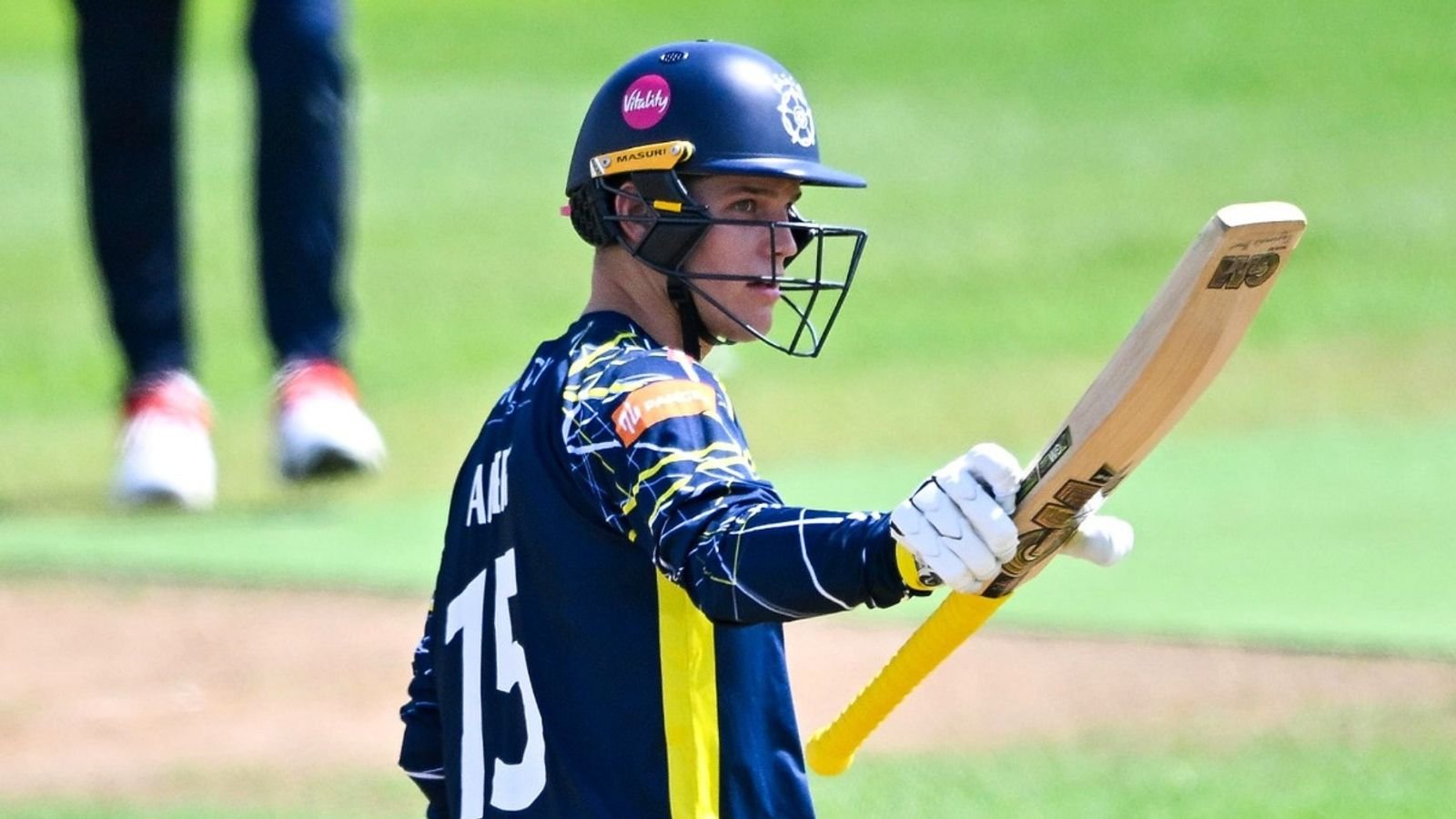
Toby Albert six sixes in six balls became the headline moment of Hampshire’s England Domestic One-Day Cup 2026 clash against Sussex at the County Ground in Hove on August 10. The 24-year-old batter delivered one of the most destructive passages of batting in the tournament, turning a promising innings into an extraordinary display of clean hitting.
Albert’s assault came after Hampshire had already established a strong platform through centuries from Alistair Orr and Ben Mayes. Arriving in the latter stages of the innings, Albert had limited time to make an impact. Instead of settling in cautiously, he immediately attacked the bowling and eventually produced the rare feat of hitting six sixes in six consecutive deliveries.
His extraordinary cameo lasted only 37 balls, but it yielded 86 runs, including eight sixes and five fours. The innings helped Hampshire reach a formidable 383 for 9, a total that ultimately proved beyond Sussex despite a century from Charlie Tear and a valiant 92 from Jack Leaning.
Toby Albert’s Six-Sixes Sequence Turns the Match on Its Head
Albert’s six-sixes sequence came during a remarkable late-innings acceleration. By the time he reached the middle, Hampshire were already well placed, but his explosive batting transformed the team’s final total into a much more intimidating target.
The sequence began against Robert Kirtley. Albert cleared the long-off boundary with the first delivery of the over, immediately putting pressure back on the bowler.
Kirtley responded with a slower delivery, but Albert adjusted brilliantly. He dragged the ball from outside off stump and sent it over deep midwicket for another maximum.
The bowler then attempted to move the ball away from Albert’s hitting arc. The Hampshire batter shuffled across, created his own access to the ball and smashed it over the bowler’s head for another six.
Kirtley went fuller with the final delivery of the over, but Albert stayed deep in his crease and launched the ball over long-on.
Four deliveries had produced four sixes.
It was already an extraordinary sequence, but Albert’s assault continued into the next over, completing the six-sixes-in-six-balls feat.
How Toby Albert Completed Six Sixes in Six Balls
The achievement was not simply a case of repeatedly swinging at anything in his hitting zone. Albert’s sequence showed different methods of clearing the boundary, including hitting straight, through the leg side and over long-on.
| Ball | Bowler | Result |
|---|---|---|
| 1 | Robert Kirtley | Six over long-off |
| 2 | Robert Kirtley | Six over deep midwicket |
| 3 | Robert Kirtley | Six over the bowler’s head |
| 4 | Robert Kirtley | Six over long-on |
| 5 | Next delivery | Six |
| 6 | Next delivery | Six |
The final two sixes completed a sequence that immediately became one of the most memorable moments of the 2026 domestic season.
Albert Reaches His Fifty in Just 26 Balls
Albert’s acceleration did not begin with the six-ball sequence. He had already demonstrated his intent before reaching his half-century.
In the 43rd over, he struck Oosthuizen for two consecutive sixes to move to fifty from only 26 deliveries.
That meant Albert was already scoring at an extraordinary rate before his six-sixes assault. Rather than slowing down after reaching his half-century, he increased the tempo further.
His final figures of 86 from 37 balls included eight sixes and five fours, giving him a strike rate of more than 232.
In an innings where Hampshire’s top order had already done most of the groundwork, Albert supplied the kind of late acceleration that can completely change the projected total in a limited-overs match.
Hampshire’s Top Order Sets the Platform
Albert’s fireworks should not obscure the work done earlier in the Hampshire innings.
Openers Alistair Orr and Ben Mayes provided the foundation with centuries. Orr scored 105 from 105 balls, while Mayes made 109 from 115 deliveries.
Their contrasting contributions ensured Hampshire had enough wickets and overs available for the middle and lower order to attack later in the innings.
Orr eventually fell to Robert Kirtley, while Mayes was dismissed by Nantes Oosthuizen. Tom Prest followed soon after, but Hampshire’s innings remained firmly on course for a large total.
Albert then arrived at exactly the right stage for maximum impact.
Why Albert’s Cameo Was So Important for Hampshire
There is a major tactical difference between scoring quickly at the beginning of a one-day innings and doing so during the final stages.
At the back end, batters know that there are fewer opportunities remaining to compensate for a quiet over. That makes boundary-hitting particularly valuable.
Albert’s 86 from 37 balls came at a point when Hampshire needed to convert their strong platform into a match-defining total.
Instead of simply adding another 40 or 50 runs, he contributed 86 at an extraordinary scoring rate. His innings therefore had an impact far beyond the raw number of runs.
It pushed Hampshire toward 383 for 9 and forced Sussex to chase at a demanding rate from the start.
The Significance of Albert Going Unsold in The Hundred
Albert’s performance carries an additional storyline because the 24-year-old batter went unsold in The Hundred.
Being overlooked in a franchise draft does not necessarily determine a player’s ability or long-term prospects, particularly in English domestic cricket, where performances across competitions can quickly change perceptions.
Albert’s innings against Sussex is exactly the type of performance that can attract attention. Six consecutive sixes provide an obvious highlight, but the larger story is his ability to score 86 from 37 balls after arriving in the latter stages of a high-scoring innings.
For a young batter, that combination of power and game awareness can be valuable evidence of T20-style skills being transferable into one-day cricket.
The timing of his performance also makes the innings particularly intriguing. The Hundred places a premium on aggressive batting, and Albert’s ability to produce an extended burst of boundary-hitting demonstrates the kind of power that franchise teams often seek.
Albert’s Six-Sixes Feat Shows More Than Raw Power
Six consecutive sixes are naturally associated with brute force, but Albert’s sequence involved considerable shot selection.
He did not simply target one area of the ground. He cleared long-off, deep midwicket, the straight boundary and long-on during the sequence.
That variety made it harder for the bowler to find a safe escape route.
When a batter can access multiple parts of the field, changing the line or length becomes increasingly difficult for the bowler. A delivery outside off stump may still be dragged over the leg side, while a fuller ball can be driven straight or launched over long-on.
Albert’s sequence therefore demonstrates an important aspect of modern white-ball batting: power becomes even more dangerous when combined with the ability to manipulate the field.
Sussex Fight Back Despite Hampshire’s Huge Total
Hampshire’s 383 for 9 appeared to put the match firmly in their control, but Sussex did not surrender easily.
The home side’s chase began poorly, with Tom Haines and Oliver Carter managing only four runs each.
Charlie Tear and Jack Leaning then rebuilt the innings with a 139-run partnership for the third wicket.
Tear played an important role in repairing the damage, eventually scoring 111 from 94 balls. His century provided Sussex with a realistic platform from which to consider an unlikely chase.
John Simpson followed Tear back to the pavilion, but Leaning continued to provide resistance.
Jack Leaning’s 92 Keeps Sussex in the Contest
Leaning’s innings became increasingly important as Sussex tried to keep up with the required rate.
He scored 92 from 95 balls and shared a 96-run partnership with Danial Ibrahim.
Ibrahim also contributed a brisk 55 from 42 deliveries, giving Sussex another burst of momentum.
However, the challenge of chasing 384 eventually became too great.
Tom Prest struck twice in the 43rd over, removing Ibrahim and George Thomas, and the required rate moved beyond Sussex’s reach.
Leaning was eventually dismissed in the 45th over, ending one of Sussex’s most important resistance efforts of the innings.
Sussex Bowled Out for 332
Captain John Carson provided some late entertainment with an unbeaten 32 from only 19 balls, but Sussex’s lower order could not complete the chase.
Sussex were eventually bowled out for 332 in 48.5 overs, giving Hampshire a 51-run victory.
Jack’s four-wicket haul proved important for Hampshire, particularly because Sussex had managed to score more than 300 despite the enormous target.
The result demonstrated that Hampshire could not afford to relax even after reaching 383. Sussex’s middle-order partnerships ensured the match remained competitive for much of the chase.
Hampshire vs Sussex: Key Performances
| Player | Team | Performance |
|---|---|---|
| Toby Albert | Hampshire | 86 off 37 balls, 8 sixes and 5 fours |
| Alistair Orr | Hampshire | 105 |
| Ben Mayes | Hampshire | 109 off 115 balls |
| Charlie Tear | Sussex | 111 off 94 balls |
| Jack Leaning | Sussex | 92 off 95 balls |
| Danial Ibrahim | Sussex | 55 off 42 balls |
| Jack | Hampshire | Four wickets |
The Bigger Picture for Toby Albert
Albert’s performance could prove significant beyond this individual match.
At 24, he remains at an age where domestic performances can influence future opportunities. A batter who can combine conventional one-day batting with the ability to produce explosive late-innings hitting offers selectors and franchise teams a useful skill set.
The six-sixes sequence will inevitably dominate the headlines, but his overall innings may be the more meaningful indicator of his potential.
Scoring 86 from 37 balls after arriving in the later stages of an innings requires immediate assessment of conditions. There is little time to play yourself in, meaning the batter must quickly identify which deliveries can be attacked and which should be left alone.
Albert managed to do that exceptionally well against Sussex.
Why Six Sixes in Six Balls Is So Rare
Hitting six sixes from six consecutive deliveries is one of the most difficult achievements in cricket because it requires the batter to overcome several variables simultaneously.
The bowler can change pace, alter length, move the ball across the crease or adjust the field. The batter also has to make six successful contacts, each capable of clearing the boundary.
One mistimed shot is enough to end the sequence.
That is why six-sixes sequences immediately become memorable regardless of the level of cricket in which they occur. They combine sustained aggression, timing and an extraordinary degree of execution.
Albert’s achievement is therefore more than a collection of sixes. It was a concentrated display of power-hitting under match conditions.
What Albert’s Performance Could Mean for Future Opportunities
It would be premature to suggest that one innings guarantees a franchise opportunity or selection at a higher level. However, performances like this inevitably create attention.
Albert has now demonstrated that he can produce an explosive innings against a strong domestic opponent while contributing directly to a match-winning total.
For franchise scouts, the interesting question will be whether he can reproduce that impact consistently.
One spectacular innings creates headlines. A sustained run of high-quality performances creates selection cases.
Albert’s next challenge is therefore not simply to repeat the six-sixes feat, which would be an extraordinary expectation, but to show that the underlying qualities behind the innings are repeatable.
Conclusion
Toby Albert’s six sixes in six balls provided the defining moment of Hampshire’s 51-run victory over Sussex in the England Domestic One-Day Cup 2026.
The 24-year-old batter, who went unsold in The Hundred, arrived late in Hampshire’s innings and transformed the momentum with a breathtaking display of power-hitting. He reached his fifty from only 26 balls before finishing with 86 from 37 deliveries, including eight sixes and five fours.
His remarkable six-ball sequence came after Hampshire’s openers Alistair Orr and Ben Mayes had already scored centuries, allowing the visitors to post 383 for 9.
Sussex fought back through Charlie Tear’s 111, Jack Leaning’s 92 and Danial Ibrahim’s 55, but ultimately fell short at 332 in 48.5 overs.
For Albert, however, the result is only part of the story. His performance has placed his name firmly in the spotlight and demonstrated the kind of explosive batting that can change a match in a matter of deliveries.
The six consecutive sixes will be the viral highlight, but the bigger takeaway is that Albert has shown the ability to turn a late-innings opportunity into a decisive contribution. After being overlooked in The Hundred, the young Hampshire batter has delivered a timely reminder that domestic cricket can produce performances impossible for selectors and franchise scouts to ignore.
For breaking news and live news updates, like us on Facebook or follow us on Twitter and Instagram. Read more on Latest Cricket on thefoxdaily.com.





COMMENTS 0