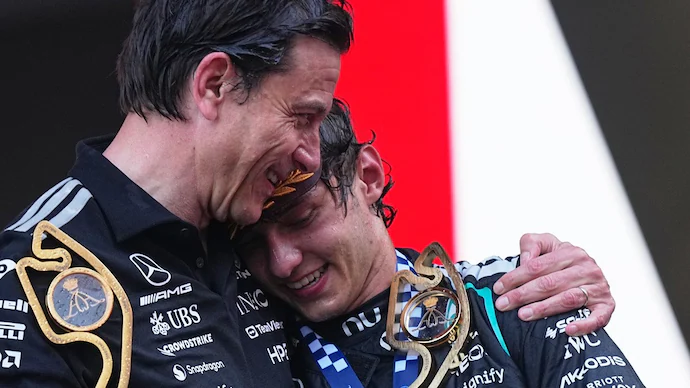
Mercedes team principal Toto Wolff has paid tribute to the people behind Kimi Antonelli‘s historic Formula 1 championship, describing the Italian driver’s success as a collective achievement in an emotional email to team employees. Wolff reflected on the decision to promote an 18-year-old Antonelli in place of seven-time world champion Lewis Hamilton, acknowledging the criticism surrounding the move and the challenges the young driver faced during his early Formula 1 career.
Antonelli, now 20, made history by becoming the youngest-ever Formula 1 Drivers’ Champion after finishing third at the Mexico City Grand Prix on Sunday. His achievement surpassed Sebastian Vettel’s previous record, established in 2010, by more than three years.
In the email, which was made public by Mercedes deputy team principal Bradley Lord on LinkedIn, Wolff stressed that the championship should not be viewed as the result of one person’s decision. Although he had backed Antonelli’s promotion, he insisted that countless employees, engineers, drivers and family members had contributed to the journey.
“Success has many fathers. Failure is an orphan,” Wolff wrote, before adding that he had been given “far too much credit for a story that belongs to so many people.”
Toto Wolff reflects on the gamble of replacing Lewis Hamilton
Wolff recalled first meeting Antonelli when the Italian was just 11 years old and following his progress through karting and the junior racing categories. He believed in the youngster’s potential, but understood that promoting him to Mercedes would attract significant attention.
Replacing Hamilton was an especially difficult decision. The British driver had become one of the most successful competitors in Formula 1 history, winning seven world championships and establishing a major legacy with Mercedes. Giving his seat to a teenager meant placing enormous responsibility on a young driver who was still developing his skills.
“Replacing Lewis Hamilton, the most successful driver in Formula 1 history and arguably its most culturally significant figure, with a teenager was never going to be an easy decision,” Wolff wrote.
The decision attracted criticism from inside and outside the sport. Wolff acknowledged that doubts became louder when Antonelli experienced a difficult run of races without scoring points.
“There was plenty of criticism, both from within the sport and outside it, about putting an 18-year-old into a Mercedes. And when Kimi went through a difficult period, with several races without scoring points, those doubts understandably grew louder.”
However, the Mercedes boss maintained that the team had understood the risks before making the decision. He said the development of a young driver inevitably involves difficult weekends, mistakes and periods when results do not meet expectations.
Antonelli’s difficult rookie season tested Mercedes’ decision
Antonelli’s rookie campaign in 2025 was not a straightforward journey. The Italian showed considerable promise early in the season, recording a fourth-place finish in Australia, taking Sprint pole position in Miami and securing his maiden Formula 1 podium in Canada.
However, his progress slowed during the middle part of the campaign. He struggled to maintain consistency, suffered multiple retirements and went through a prolonged period without adding points to his championship total.
Those results created further questions about whether Mercedes had promoted him too early. Despite the pressure, Antonelli eventually recovered towards the end of the season and finished seventh in the Drivers’ Championship with 150 points and three podium finishes.
Wolff said Mercedes had never expected the young driver to complete his first season without making mistakes. Instead, the team viewed those experiences as part of a longer development process.
“We knew there would be difficult weekends, mistakes and moments when people would question our judgement. That was always part of the journey we had committed to,” he wrote.
He also explained that a young driver should not be punished for the mistakes that naturally come with learning at the highest level of Motorsport.
“You cannot ask a young driver to learn and then punish him for making mistakes. The important thing was never where Kimi stood after one difficult race, but where he could be in the years to come.”
Wolff thanks wife Susie for supporting his decision
Wolff also acknowledged the personal support he received while deciding whether to give Antonelli Hamilton’s seat. He specifically thanked his wife, Susie, for encouraging him to trust his judgement despite the pressure surrounding such a significant move.
According to Wolff, Susie understood the demands of his role and the pressures involved in motorsport. Her support helped him remain confident in his decision when questions began emerging about promoting such a young driver.
“And on a personal level, I want to thank my wife Susie. She knows better than anyone what this job demands, and she understands motorsport and the pressures that come with it. When I was weighing up the decision to put Kimi in the car, she encouraged me to trust my instincts and have the courage to follow through on what I believed was right.”
The message highlighted that the decision was not made in isolation. While Wolff ultimately had responsibility for the move, the confidence and support of people around him played an important role in helping him follow through.
George Russell played a key role in Mercedes’ decision
Wolff also gave significant credit to George Russell, explaining that the British driver’s experience and leadership helped Mercedes take the risk of promoting Antonelli.
Russell provided the team with an established and dependable presence while his young teammate adjusted to the demands of Formula 1. Wolff acknowledged that Russell had also experienced frustrating moments during the season but praised his ability to support the team’s wider objectives.
“One of the reasons we could take that leap was George,” Wolff wrote.
“We could only take the risk of putting Kimi in the car because we knew we already had a champion and a number one driver in George. Someone with the speed, experience and leadership to carry the team, and the strength of character to embrace a young teammate with enormous potential.”
Russell’s presence gave Mercedes a balance between experience and youth. While Antonelli focused on learning and developing, the team could rely on Russell’s established Formula 1 experience and leadership.
James Allison and Peter Bonnington receive special recognition
The Mercedes team principal also highlighted the work of the technical organisation behind the championship-winning campaign. Technical director James Allison received praise for backing Wolff’s judgement and ensuring that the team provided Antonelli with the technical support required to develop.
Race engineer Peter ‘Bono’ Bonnington was also singled out for his contribution. Bonnington previously worked closely with Hamilton and played an important role in helping Antonelli understand the technical and operational demands of Formula 1.
Wolff’s recognition of the engineering staff reinforced the central message of his email: a driver’s success depends on the combined work of everyone involved in preparing and running the car.
Antonelli’s parents laid the foundations for his success
Wolff reserved further praise for Antonelli’s parents, Marco and Veronica, as well as the people who supported the Italian throughout his karting and junior racing career.
He said the values that helped shape Antonelli extended beyond his development as a racing driver. Wolff highlighted the young champion’s humility, integrity, loyalty, ambition and determination, crediting his family for laying the foundations.
“… what they gave Kimi goes far beyond racing. His humility, integrity and loyalty, combined with his extraordinary ambition and determination, are qualities that came from home. We may have helped him develop those values further along the way, but the foundations were laid by his family. He couldn’t have asked for a better start in life.”
However, Wolff made clear that a strong family and professional support system could not guarantee success. Antonelli still had to demonstrate the determination and resilience required to compete at the highest level.
“Nobody can give him the determination to keep going after a difficult weekend, the courage to get back into the car after making a mistake, or the resilience to deal with the extraordinary pressure that comes with driving for Mercedes,” he wrote.
Wolff added that Antonelli had continued to learn, listen and believe in his abilities throughout the journey. He also praised the Italian for remaining the same fundamentally decent young man he had first met at the age of 11.
“This is not my success story. It is ours”
As his email approached its conclusion, Wolff returned to the attention he had received for identifying Antonelli’s potential and giving him the opportunity to race for Mercedes. He accepted that believing in the young driver had been important, but argued that his decision was supported by the work of many people who had helped prepare Antonelli for the challenge.
“Yes, I believed in him. And yes, at a certain point I had to make a decision and stand by it,” Wolff wrote.
He then explained why the achievement could not be credited to one individual.
“But believing in someone is much easier when so many good people have already given you every reason to believe.”
Wolff signed off with a message that captured the purpose of the email, thanking everyone who had contributed to Antonelli’s remarkable rise and Mercedes’ championship success.
“This is not my success story. It is ours. And I couldn’t be prouder of everyone who has been part of it.”
The message served as a tribute to the collective effort behind Antonelli’s historic achievement. From his parents and early racing mentors to Russell, Allison, Bonnington and the wider Mercedes workforce, Wolff emphasised that the championship was built through years of support, preparation and commitment.
For Mercedes, Antonelli’s title also represents the outcome of a major decision made under intense scrutiny: trusting an 18-year-old to take over from one of Formula 1’s greatest champions. Wolff’s email made clear that, in his view, the achievement belongs to everyone who helped turn that gamble into a championship-winning journey.
For breaking news and live news updates, like us on Facebook or follow us on Twitter and Instagram. Read more on Latest Sports on thefoxdaily.com.






COMMENTS 0