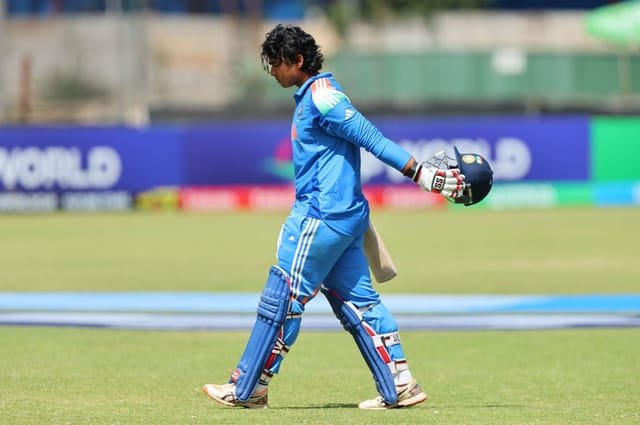
The next chapter in Vaibhav Suryavanshi‘s rapid ascent through Indian cricket began on Tuesday, June 9, in Dambulla, Sri Lanka. And like many important first chapters, it did not end the way the protagonist might have hoped. The teenage prodigy, playing his first match for India A in the opening fixture of the 2026 tri-series against Sri Lanka A, was dismissed for 14 runs off 12 deliveries before India’s innings had properly gathered momentum.
It was a short stay at the crease. It produced three boundaries, a glimpse of the timing and intent that made Suryavanshi one of the most talked-about young cricketers on the planet through his IPL 2026 campaign with the Rajasthan Royals. And it ended with a well-timed diving catch at mid-off that was, in truth, a result of the batter being beaten by craft rather than pace.
Fourteen runs off 12 balls. A decent T20 start, a disappointing List A one. The number is less important than what the dismissal itself reveals.
How the Innings Unfolded: Boundaries, Variations, and a Catch at the Rope
Suryavanshi walked out to open the innings alongside Prabhsimran Singh after skipper Tilak Varma won the toss and opted to bat first. The assignment was clear: give India A the kind of aggressive start that has become Suryavanshi’s signature across T20 formats.
The opening overs showed why the selectors were excited enough to give him an India A call-up midway through the IPL campaign. His first meaningful contribution was a sublime boundary through the off-side, finding the gap with a precision that belied his age. A delivery later, he pierced the field again for another four, establishing rhythm and suggesting the innings was building toward something significant.
The third boundary arrived at the start of the following over. At that point, Suryavanshi had scored 12 runs from a handful of deliveries and was beginning to look comfortable. The conditions in Dambulla, the format, the occasion of an India A debut: none of it seemed to be weighing on him.
Then Chamika Karunaratne entered the equation.
The right-arm pacer responded to the early boundary pressure not with pace but with variations. Cutters that changed direction off the surface. Slow bouncers that disrupted Suryavanshi’s timing. The kind of bowling that does not announce itself with obvious menace but quietly removes the batter’s reference points. Suryavanshi found himself missing contact as he tried to play deliveries he had misjudged, and the innings that had started so fluently began to stall.
The dismissal came in the next over, against Mohammad Shiraz. Suryavanshi attempted to get underneath a full-pitched delivery and lift it over the mid-off fielder, a shot that would have been perfectly executed against a slightly different trajectory. But he could not generate the elevation required, and instead of clearing the boundary the ball found Sahan Arachchige at the edge of the circle. Arachchige ran in, got his timing right, and took a diving catch just before the ball reached the ground.
India A were 16 for 2 when Prabhsimran Singh followed Suryavanshi back to the pavilion shortly after, leaving the top order rattled inside the fifth over.
The Dismissal Examined: What Karunaratne’s Variations Revealed
The manner of the dismissal is worth examining because it points to a specific developmental challenge for a batter of Suryavanshi’s profile at this stage of his career.
His exceptional IPL performances have been built on a combination of natural hand-eye coordination, fearless intent, and the ability to read length quickly and play aggressive strokes with minimal margin for error. In the T20 format, that skill set translates into extraordinary strike rates and the kind of boundary-hitting that makes crowds rise from their seats. The IPL’s best bowlers could not contain him consistently, which is a remarkable statement for a 15-year-old in his first major tournament.
But the List A format, and particularly the 50-over game against quality first-class cricketers, introduces a different set of problems. Bowlers have more overs to probe, more opportunity to set batters up across sequences of deliveries rather than individual balls, and the margin for a single misjudgment is different when you are building an innings across 50 overs rather than hitting from the first delivery in a T20 powerplay.
Karunaratne’s cutters and slow bouncers are exactly the kind of variations that target a specific vulnerability in aggressive, front-foot batting: the tendency to commit early to a shot based on the initial trajectory, before the ball’s true pace and movement have revealed themselves. A batter who has trained their instincts for T20 aggression needs to develop the patience and the adjustment capability to recognize when a bowler is using variations to invite the big shot rather than bowl them out conventionally.
Suryavanshi was caught in that adjustment process against Karunaratne, and the dismissal off Shiraz reflected the continued uncertainty from that sequence. He was trying to attack, found himself slightly unsettled by what had come before, and the shot that followed paid the price.
| Format | Experience Level | Key Demand | Suryavanshi’s Current Status |
|---|---|---|---|
| T20 / IPL | Extensive (RR, IPL 2026 breakout campaign) | Explosive hitting, pace adaptability, powerplay impact | Established, highly regarded at elite level |
| List A (50-over) | Limited (8 appearances since December 2024) | Innings building, variation reading, patience under sustained pressure | Developing, this India A call-up is part of that process |
| First-Class | Limited | Technical defense, prolonged concentration, red ball movement | Future development requirement |
The Broader Context: Eight List A Matches and a Career Still Being Built
Suryavanshi’s List A record heading into his India A debut was eight appearances in total, all of them accumulated since his debut for Bihar in the Vijay Hazare Trophy in December 2024. His most recent List A outing before the Sri Lanka A match was a 31 off 10 balls against Meghalaya in the 2025-26 Vijay Hazare Trophy, a brief but typically aggressive cameo that reinforced the pattern of his batting at this level.
Eight List A appearances by the age of 15 is not a shortage of experience. It is the natural consequence of a development pathway that has been shaped by the extraordinary acceleration of his T20 profile. The IPL call-up, the attention, the performances that generated headlines across global cricket media: all of that has created a situation where a teenager is being watched as though he is already a finished product, when the reality is that he is still in the early stages of building the range of skills that sustained international cricket requires.
The India A call-up, announced midway through the IPL campaign, reflects the BCCI’s recognition that Suryavanshi needs List A and first-class exposure at the highest available level below the senior national team. Playing for India A against quality opposition in Sri Lanka is precisely the kind of challenge that accelerates the development of the specific skills his IPL performances have not yet needed to demonstrate: patience, variation adjustment, and the ability to rebuild an innings after a difficult period.
A debut dismissal for 14 is not the story. It is the first lesson in a curriculum that has barely begun.
Why This Dismissal Should Not Be Over-Interpreted
There is a consistent temptation when covering young prodigies to read too much into individual failures. The IPL performances that made Suryavanshi a household name generated coverage that occasionally bordered on the hyperbolic, and the natural response to a disappointing debut innings from the same player is to frame it as a counterpoint to that narrative.
It is not. It is a 15-year-old learning the difference between two formats in a competitive environment, against professional bowlers who have made adjustments specifically designed to test his limitations. The fact that those limitations exist is not news. The fact that he was put in a situation where they would be probed is the entire point of the India A program.
For context, consider the List A debuts of virtually any Indian batter who subsequently went on to have a distinguished international career. Very few of them announced themselves with a composed, mature innings that suggested the full breadth of what they would eventually become. They had false starts, dismissals against variations they could not yet read, innings that ended before they should have. The difference is that those careers played out before every failure was documented, dissected, and circulated across social media within minutes of it occurring.
Suryavanshi’s development is happening under a level of scrutiny that previous generations of young Indian cricketers never faced. The appropriate response to a 14-run India A debut is to note it, contextualize it within his broader development arc, and then watch the next innings with the same curiosity and open mind that his IPL performances invited.
What Comes Next: The Tri-Series as a Learning Ground
The 2026 tri-series in Sri Lanka represents a genuine opportunity for Suryavanshi to do exactly what India A programs are designed to facilitate: accumulate competitive experience against quality opponents in conditions that differ from his domestic circuit, and build the technical and mental toolkit that the transition from junior to senior international cricket will eventually require.
He will have more opportunities in this tournament. Sri Lanka A and the third team in the competition will have their own analyses of how to bowl at him, and those analyses will probe variations, yorkers, and the specific shots that his dismissal pattern reveals. How he responds to being targeted, how he adjusts between innings and between matches, and how his shot selection evolves across the series will tell a more complete story about his development than any single innings, including the debut, can provide.
The selectors who gave him this call-up are not expecting him to score hundreds in every match. They are expecting him to compete, to learn, and to emerge from the experience as a more complete cricketer than he arrived. By that measure, a 14-run debut that ended with a lesson about variation bowling is already doing its job.
Conclusion: A First Step, Not a Verdict
Vaibhav Suryavanshi walked off the ground in Dambulla having scored 14 runs off 12 balls, looking dejected in the way that only cricketers who genuinely care about their performances can look. The dejection is appropriate. It reflects an ambition that was not satisfied by the outcome. That ambition, and the intensity that accompanies it, is exactly why he was selected for India A in the first place.
The dismissal was clean. The lesson within it was clear. And the career that surrounds this single innings is still being written by a 15-year-old who has already shown more than enough to suggest that the final chapters will be worth waiting for.
For now, the tri-series continues. The next innings is the only one that matters.
For breaking news and live news updates, like us on Facebook or follow us on Twitter and Instagram. Read more on Latest Sports on thefoxdaily.com.






COMMENTS 0