Introduction: The Number Behind the Name
In Indian Cricket, Test cap numbers carry a specific weight that few other sporting traditions replicate. To be assigned a number in the sequence of men who have represented India in Test cricket is to be placed in a lineage that includes Lala Amarnath, Vijay Hazare, Sunil Gavaskar, Kapil Dev, Sachin Tendulkar, and hundreds of others who gave their best to the sport’s oldest and most demanding format. Every number in that sequence is a career’s worth of domestic cricket, of selection debates, of near-misses and persistent belief.
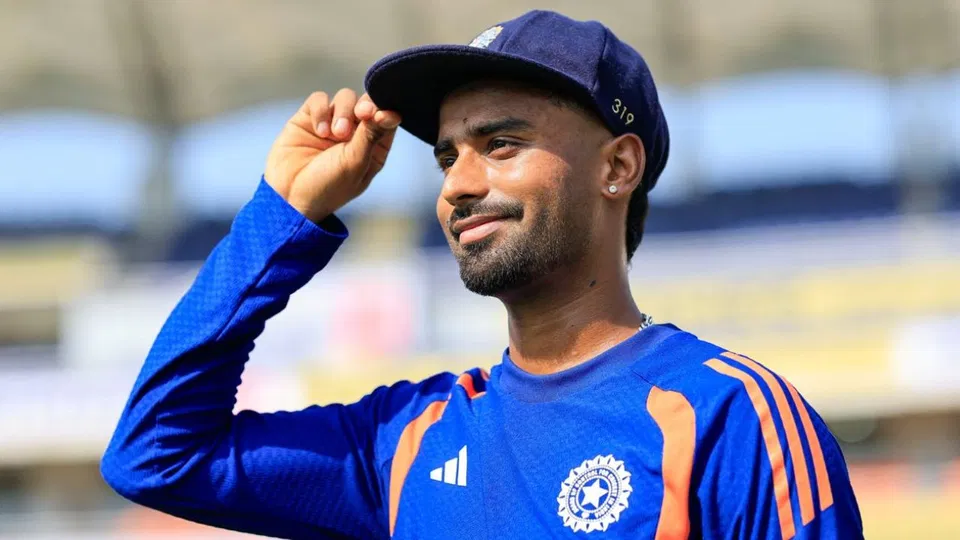
Manav Suthar is number 319. On June 6, 2026, the 23-year-old left-arm orthodox spinner from Sri Ganganagar, Rajasthan, took the field against Afghanistan to become the 319th man in India’s Test history one of the most significant milestones that cricket offers, earned through four years of first-class excellence that the broader public is only now beginning to discover.
Who is Manav Suthar? A classical spinner who has been quietly dismantling Ranji Trophy batting lineups since his debut in February 2022. What makes him special? A combination of wicket-taking ability, economy, and lower-order batting utility that gave India’s selectors exactly what they needed to fill the Jadeja-shaped gap for the Afghanistan fixture. When did this journey begin? In a district in Rajasthan where cricket was pursued with the kind of methodical commitment that produces genuine first-class cricketers rather than viral clips. Where does his story fit? In the longer narrative of Indian cricket’s domestic pipeline the system that keeps producing talent from places that television cameras rarely visit. Why does his selection matter beyond the immediate fixture? Because Suthar is the first Rajasthan cricketer to be picked for India’s Test squad in twelve years, and his journey is a case study in what sustained excellence at the right level eventually earns.
Sri Ganganagar to the National Team: A Methodical Path
Manav Jagdusakumar Suthar was born on August 3, 2002, in Sri Ganganagar a city in the northern reaches of Rajasthan, closer to the Pakistani border than to Jaipur, defined more by agricultural industry than by cricket infrastructure. It is not the kind of origin story that the talent pipeline is assumed to produce. The natural gravity of Indian cricket pulls talent toward urban centers Mumbai, Delhi, Hyderabad, Bengaluru where academies, coaching staff, and competitive exposure are concentrated.
Suthar’s development followed a different but equally rigorous path. He captained Sri Ganganagar’s district side to both Under-14 and Under-16 titles an early indication that his cricket intelligence and leadership qualities set him apart from peers at his level. He then moved systematically through the age-group ranks of Rajasthan cricket: Under-16, Under-19, Under-23, each level providing new challenges and new evidence that his abilities scaled with the quality of opposition.
There were no shortcuts. No IPL auction at 18 that changed his financial circumstances and accelerated his profile. No viral performance in a domestic final that manufactured national attention overnight. Just the patient accumulation of skill, wickets, and credibility through the kind of cricket that most fans never watch and that selectors spend their careers tracking.
The Ranji Trophy Career: Numbers That Demand Attention
Suthar made his first-class debut for Rajasthan on February 17, 2022, against Andhra Pradesh in the Ranji Trophy. The transition from age-group cricket to the senior domestic circuit is, for most spinners, a period of adjustment a phase in which the variations that worked against under-19 batters are exposed by experienced professionals who have faced every type of spin attack over hundreds of first-class appearances.
Suthar did not experience a prolonged adjustment period. In just his second Ranji Trophy season, the 2022-23 campaign, he finished as Rajasthan’s highest wicket-taker with 39 wickets in six matches at an average of 20.33. Those are not the numbers of a young spinner finding his feet. They are the numbers of a bowler already operating as the most dangerous member of his team’s attack, in a competition where seasoned batters make their livings.
The accumulation continued across his first eight first-class appearances: 44 wickets from those eight matches an extraordinary return for a spinner who, by this point, had barely turned 20. The numbers did not plateau. They grew.
| Format / Metric | Stat |
|---|---|
| First-Class Matches | 29 |
| First-Class Wickets | 129 |
| Bowling Average (FC) | 25.76 |
| Economy Rate (FC) | 2.94 runs per over |
| Five-Wicket Hauls | 6 |
| Ten-Wicket Match Hauls | 3 |
| Best Innings Figures | 8 for 33 |
| First-Class Innings Batted | 48 |
| Batting Average (FC) | 25.54 |
| First-Class Centuries | 1 (120 vs Himachal Pradesh) |
| First-Class Half-Centuries | 6 |
| First-Class Debut | February 17, 2022 vs Andhra Pradesh (Ranji Trophy) |
By the time his Test call-up arrived, Suthar had taken 129 first-class wickets in 29 matches at an average of 25.76. The economy rate of 2.94 runs per over is perhaps the most telling single figure in his bowling record. In the modern era of aggressive batting and flat pitches, a spinner who costs fewer than three runs per over across 29 first-class matches is not simply economical he is the kind of bowler that captains trust to maintain pressure across long spells and deny runs even when wickets are not immediately forthcoming.
The three ten-wicket match hauls confirm his match-winning quality. Any first-class spinner in the world can have an inspired spell. Taking ten wickets across two innings meaning sustained excellence across two different innings conditions, potentially against batters who have now seen his variations requires something deeper. Best figures of 8 for 33 suggest a bowler capable of moments of devastating mastery.
The Batter Who Lives at Number 8: An Underrated Asset
One dimension of Suthar’s game that his bowling statistics can overshadow is his contribution with the bat. In the era of the genuine all-rounder, a lower-order specialist who can hold an end, accumulate useful runs, and occasionally produce match-changing innings is an asset that teams of all formats prize and that selectors weigh carefully when squad construction requires difficult choices between otherwise comparable options.
Suthar’s first-class batting average of 25.54 from 48 innings is not lower-order cameo territory. It is the average of someone who can bat with intent and patience, who has technical foundations solid enough to survive quality bowling, and who understands their role in protecting a lower-order batting position while maximizing its value.
His single first-class century a 120 against Himachal Pradesh and six half-centuries demonstrate range. The century, in particular, suggests a batter capable of genuine innings construction rather than slog-and-hope lower-order contributions. For a team like India, whose Test batting depth has been tested during the current transition period, a debutant who bats with real first-class credibility at number eight or nine is more valuable than his position in the lineup suggests.
India A and the Performances That Sealed the Selection
The pathway from domestic excellence to India A recognition to Test selection follows a pattern that Indian cricket’s selectors have refined over decades. India A fixtures — particularly against touring sides and in multi-day tournaments designed to simulate Test conditions serve as the definitive proving ground for players being considered for the senior national team. Success against quality opposition in those environments carries a weight that even the best Ranji Trophy returns
Suthar passed those tests with clear authority. In the 2023 ACC Emerging Teams Asia Cup in Sri Lanka, he finished as the tournament’s joint second-highest wicket-taker with 10 scalps performing in conditions outside India, against international opposition, and maintaining the standards he had establ
More significantly for Test selection purposes, his 7 for 49 in the Duleep Trophy one of Indian domestic cricket’s most prestigious red-ball tournaments, played between regional sides demonstrated the capacity to perform in a specifically Test-oriented context against quality batters who had specifically prepared for multi-day cricket. The five-wicket haul against Australia A in 2025 closed the remaining gap in the evidence file: he could trouble high-quality batters from the most competitive cricketing nation in the world.
The Gujarat Titans Chapter: Learning at the Highest Level
Suthar’s white-ball journey through the Indian Premier League added a different dimension to his development one that was less about immediate on-field impact and more about the education that comes from operating in proximity to the best players in the world.
He first joined the Gujarat Titans as a net bowler in 2023, an arrangement that gave him access to training environments, tactical conversations, and the daily standard of elite cricket without the pressure of match responsibility. For a young spinner still developing his craft, bowling to international batters in practice sessions provides a specific and invaluable education the kind that no domestic match can fully replicate.
The franchise recognized his development and signed him for competitive appearances, with Suthar making his IPL debut in 2024 against Royal Challengers Bengaluru. Gujarat Titans valued him sufficiently to retain him for both the 2025 and 2026 seasons a statement of confidence that carries commercial and developmental weight simultaneously.
His IPL 2026 numbers two wickets in three matches at an economy of 11.33 are modest by T20 standards, and the management has been transparent about viewing his T20 exposure as a learning platform rather than evidence of white-ball mastery. In T20 cricket, left-arm orthodox spin is a target-rich environment for aggressive batters. The value of IPL exposure for Suthar lies in what it has taught him about reading batters, adjusting line and length in real time, and competing under pressure education that transfers to red-ball cricket in ways that do not always appear in the economy rate column.
Twelve Years: The Rajasthan Wait That Finally Ended
Suthar’s selection carries a significance that extends beyond his individual career. Before his call-up for the Afghanistan Test, no Rajasthan cricketer had been selected for India’s Test squad in twelve years. That gap is not simply a statistical curiosity. It represents twelve years of Rajasthan cricketers performing in the Ranji Trophy without earning the recognition that their domestic efforts might have warranted twelve years in which the state’s contributions to Indian cricket were confined to the domestic circuit rather than elevated to the national stage.
For the cricketing community in Rajasthan, and specifically in Sri Ganganagar, Suthar’s debut represents both vindication and inspiration. The message his selection sends to young cricketers in the state that the Ranji Trophy route, pursued with sustained excellence, can still lead to a Test cap is one of the most valuable things a selection decision can communicate. Not every path to international cricket requires an IPL auction or a viral moment. Some require something simpler and more durable: the willingness to bowl a thousand overs in places nobody is watching and to keep improving with every one of them.
What India Have Found in Manav Suthar
The tactical rationale for Suthar’s selection is straightforward: India needed to field three spin options on a surface expected to turn, and Suthar as a classical flight-and-loop orthodox spinner who rarely leaks runs and offers genuine batting value fit the brief precisely. With Ravindra Jadeja rested and Ravichandran Ashwin retired, a vacancy existed for a left-arm spin option of proven first-class quality, and Suthar’s file made the case comprehensively.
But beyond the immediate tactical solution, India may have found something more durable. A 23-year-old spinner with 129 first-class wickets, a bowling average of 25 and an economy rate under three, genuine batting ability, and the demonstrated capacity to perform against high-quality opposition in multi-day cricket is not a developmental prospect. He is a cricketer who has already arrived at a level of first-class competence that earns consistent selection consideration. The Test arena will test him in new ways the scrutiny, the preparation quality of international batters, the adjustment period that almost every debutant experiences but the foundational skills are demonstrably in place.
Conclusion: Cap 319 and the Journey That Earned It
On June 6, 2026, at Mullanpur, Manav Suthar became India’s 319th Test cricketer. The number is not arbitrary it represents everyone who came before him in that lineage, and the standard of what it means to be trusted with the white trousers and the cap of India’s senior Test team.
His journey from Sri Ganganagar’s district grounds to that milestone followed no shortcuts and admitted no detours. It was built from Ranji Trophy wickets taken in front of sparse crowds in February, from Duleep Trophy performances that made selectors write his name in the relevant column, from net bowling sessions at Gujarat Titans where international batters taught him things that coaching manuals cannot. It was built, above all, from the willingness to keep bowling on surfaces that didn’t always help, against batters who had nothing to lose and everything to gain from hitting him for six.
India’s 319th Test cricketer is 23 years old, from Rajasthan’s northern frontier, and already has the first-class record to suggest he belongs. The Test arena will tell the rest of the story.
Welcome to the cap, Manav Suthar. You earned number 319 the old way and the old way is the best way.
For breaking news and live news updates, like us on Facebook or follow us on Twitter and Instagram. Read more on Latest Sports on thefoxdaily.com.






COMMENTS 0