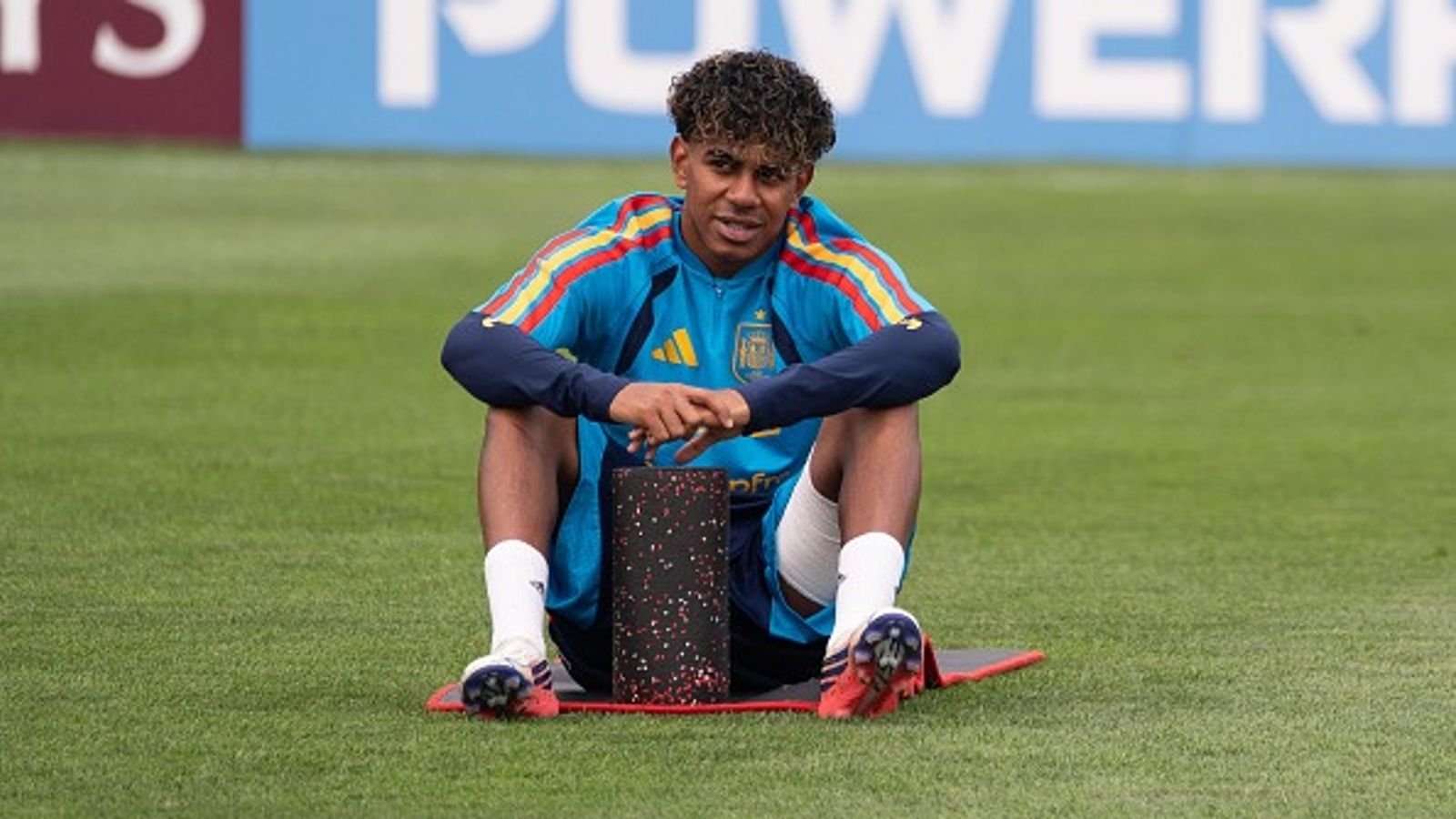
As anticipation builds for one of the most anticipated FIFA World Cup finals in recent history, a seemingly routine training session generated headlines across the football world. Spain’s rising superstar Lamine Yamal was spotted training separately from his teammates in New Jersey, immediately triggering speculation about his fitness ahead of the blockbuster clash against Lionel Messi’s Argentina.
With millions of fans eagerly awaiting the final, images of Spain’s most influential attacking player working away from the main group naturally raised alarm bells. Social media quickly filled with concerns that Spain could be facing a devastating injury setback just days before the biggest match in international football.
The reality, however, is far less dramatic and far more interesting.
Rather than signaling an injury crisis, Yamal’s individualized training session highlights the increasingly sophisticated methods elite national teams use to manage player workloads during major tournaments. In fact, Spain’s handling of the teenager could ultimately increase their chances of lifting the FIFA World Cup trophy.
Why Was Lamine Yamal Training Separately?
The primary reason behind Yamal’s separate training session was recovery management rather than injury treatment.
Spain’s coaching and medical staff opted to place the teenager on a customized recovery program following an intense FIFA World Cup semifinal against France. During that match, Yamal endured a physically demanding battle against some of Europe’s strongest defenders and covered significant distances both offensively and defensively.
Modern football places enormous physical demands on attacking players, particularly wingers. Players in Yamal’s position are expected to:
- Press opponents aggressively without possession.
- Make repeated high-speed sprints.
- Track back defensively.
- Create chances in transition.
- Maintain technical quality under pressure.
For a player who has been central to Spain’s World Cup campaign, accumulated fatigue becomes a serious consideration. Spain’s medical department therefore chose a low-intensity recovery session designed to maximize freshness ahead of the final.
Was Lamine Yamal Injured?
Based on information released by Spain’s football authorities, there is no indication that Yamal suffered a serious injury.
The separate session appears to have been precautionary rather than corrective.
Elite teams often isolate key players from full training immediately after knockout matches to reduce muscle fatigue, minimize injury risk, and improve recovery efficiency. This approach has become increasingly common in international tournaments where recovery windows are short and match intensity is extremely high.
While Yamal experienced normal post-match soreness following the semifinal, there were no reports suggesting structural damage, ligament problems, or muscular tears.
Spain remains confident that he will be available for the World Cup final against Argentina.
Why Spain Cannot Afford to Lose Yamal Before the Final
The concern surrounding Yamal’s fitness demonstrates just how important he has become to Spain’s system.
At only 18 years old, he has evolved from a promising youngster into one of the tournament’s defining players.
His ability to eliminate defenders in one-on-one situations has given Spain a dimension that few teams possess. Opponents often commit multiple defenders to contain him, creating space elsewhere on the pitch.
Against Argentina, those qualities could be particularly important.
Argentina’s defensive structure is among the most disciplined in international football. Breaking down compact defensive blocks often requires individual brilliance, and Yamal has consistently shown the ability to produce moments that change matches.
Spain’s coaching staff understands that having him at 100 percent fitness could significantly influence the outcome of the final.
The Physical Toll of the France Semifinal
The semifinal against France was arguably Spain’s most physically demanding match of the tournament.
France’s athleticism, defensive aggression, and tactical discipline forced Spain’s attackers to work relentlessly throughout the contest.
Yamal spent much of the game battling experienced defenders, absorbing challenges, accelerating into space, and carrying Spain’s attacking threat.
While spectators often focus on goals and assists, sports scientists monitor a different set of statistics:
- Total sprint distance.
- High-intensity runs.
- Acceleration loads.
- Deceleration impacts.
- Muscular stress levels.
- Recovery indicators.
These metrics help determine whether a player should participate in full training or follow an individualized recovery plan.
Spain’s decision suggests the staff prioritized long-term performance over short-term training intensity.
The Pedro Porro Situation Explained
Yamal was not the only Spanish player training separately.
Defender Pedro Porro also followed an individualized program, although his situation appears slightly different.
Reports indicate Porro has been managing a minor hamstring issue during the latter stages of the tournament. While not considered serious, hamstring problems require careful monitoring because they can worsen rapidly if overloaded.
Spain’s medical team appears determined to ensure that no player enters the final carrying avoidable physical risks.
The presence of both Yamal and Porro in recovery sessions highlights the broader strategy rather than an isolated concern.
How Modern Sports Science Is Changing World Cup Preparation
One of the most overlooked stories of modern football is the growing influence of sports science.
Twenty years ago, players often trained intensely regardless of fatigue levels. Today, elite national teams use advanced technology to make data-driven decisions.
Every training session is monitored through GPS tracking systems, heart-rate measurements, recovery analytics, and biomechanical assessments.
These tools allow coaching staffs to identify potential injury risks before symptoms become serious.
The decision to reduce Yamal’s workload reflects this modern philosophy.
Instead of pushing players through exhaustion, teams now focus on optimizing physical condition for match day.
| Traditional Approach | Modern Recovery Approach |
|---|---|
| Maximum training volume | Optimized workload management |
| Limited recovery monitoring | Real-time performance tracking |
| Reactive injury treatment | Preventative injury management |
| Uniform training programs | Individualized player plans |
Spain’s handling of Yamal is a perfect example of how elite football preparation has evolved.
What This Means for Spain’s World Cup Final Chances
From a tactical perspective, the recovery strategy could benefit Spain significantly.
Freshness often becomes the deciding factor in World Cup finals. At this stage of a tournament, physical and mental fatigue can be just as influential as tactical planning.
Argentina enters the final with extensive experience, leadership, and momentum. Spain counters with technical quality, youthful energy, and one of the tournament’s most dynamic attacking systems.
Ensuring Yamal enters the match fully recovered increases Spain’s chances of maintaining their high-tempo style throughout the contest.
The final may ultimately be decided by small margins, making every recovery decision critically important.
The Messi vs Yamal Narrative Adds Another Layer
One reason Yamal’s fitness has attracted such widespread attention is the symbolic significance of the final itself.
The match represents more than Argentina versus Spain.
It also showcases two generations of football greatness.
Lionel Messi, one of the greatest players in football history, is seeking another historic achievement late in his career. Across the field stands Yamal, widely viewed as one of the sport’s brightest young stars and a potential future Ballon d’Or contender.
The contrast between football’s established icon and its emerging superstar has become one of the defining storylines of the tournament.
Fans naturally want both players available at their best.
A Unique Insight: Spain’s Biggest Victory May Have Already Happened
Perhaps the most significant takeaway from this episode is not about Yamal’s fitness but about Spain’s squad management.
Major tournaments are often won not only by the most talented teams but by those that manage physical workloads most effectively.
Historically, many World Cup favorites have entered finals carrying accumulated fatigue, injuries, or burnout from previous rounds.
Spain appears determined to avoid that mistake.
By prioritizing recovery over public perception, the coaching staff is demonstrating a long-term championship mindset.
In modern football, sometimes the smartest training session is the one a player does not participate in.
Conclusion
Lamine Yamal’s separate training session ahead of the FIFA World Cup 2026 final is not a sign of panic for Spain. Instead, it reflects a carefully planned recovery strategy designed to ensure one of the tournament’s most influential players reaches the final in peak condition.
Following a physically demanding semifinal against France, Spain’s medical and coaching staff opted for a precautionary approach, reducing workload while allowing the teenager’s body to recover fully.
With no major injury concerns reported and expectations high that he will be available against Argentina, Spain can remain optimistic. In fact, the decision may prove to be one of the smartest moves of their World Cup campaign.
As football prepares for a potentially historic showdown between Lionel Messi’s Argentina and a talented Spanish side led by the next generation, all eyes will remain on Yamal. If Spain lifts the trophy, this carefully managed recovery period could be remembered as a small but crucial step on the road to World Cup glory.
For breaking news and live news updates, like us on Facebook or follow us on Twitter and Instagram. Read more on Latest Sports on thefoxdaily.com.






COMMENTS 0