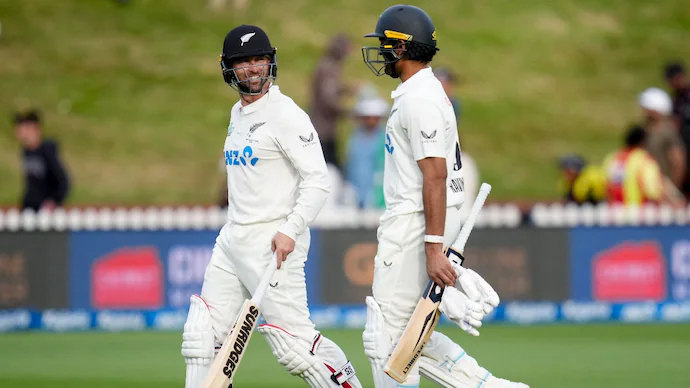
New Zealand face a difficult final-day challenge in the first Test against India, with Rachin Ravindra admitting that the hosts are firmly on the back foot after India’s record-breaking batting performance. The visitors declared at 720 for nine on Day 4, leaving New Zealand with a substantial deficit and limited time to keep the match alive.
India established a 352-run first-innings lead after dismissing New Zealand for 368. The hosts began their second innings with a difficult task ahead and reached 119 for two at stumps on Sunday. Devon Conway remained unbeaten on 59, while Ravindra was not out on 27, leaving New Zealand 233 runs behind.
With 90 overs scheduled for the final day, New Zealand’s immediate priority is to spend as much time as possible at the crease. Ravindra acknowledged India’s dominant position and said his team must concentrate on batting rather than looking too far ahead at the possibility of saving the Test.
“We are pretty behind the game. India batted well. It’s about batting as long as possible for us,” Ravindra said after the day’s play.
The situation leaves New Zealand needing a determined effort from their remaining batters. India, meanwhile, will look to take wickets early and maintain the pressure as they attempt to secure victory in the opening Test.
Ravindra wants New Zealand to take the final day ball by ball
New Zealand have little room for error after losing two wickets in their second innings. Although Conway and Ravindra have provided some resistance, the hosts still need to overcome a 233-run deficit before they can seriously consider their chances of saving the match.
Ravindra does not want his team to become distracted by the larger task. With a full day’s play remaining, he believes the players should focus on surviving each delivery and building their innings gradually.
“Saving the game is looking quite far ahead so we would take it ball by ball. It’s 90 overs on final day,” he said.
The approach reflects the demands of the situation. New Zealand cannot afford to lose wickets in quick succession, particularly with India having enough time to attack with both pace and spin. A long partnership could make the difference between taking the match deep and handing India an early opportunity to finish the contest.
For Ravindra, the challenge will be to combine patience with the attacking instincts that have made him an important part of New Zealand’s batting line-up. The hosts will need to assess the conditions carefully, avoid unnecessary risks and make India work for every wicket.
Ravindra backs Devon Conway to score big
One of New Zealand’s biggest hopes heading into the final day will be Devon Conway. The left-handed opener has already produced a half-century in the second innings and was unbeaten on 59 when play ended on Day 4. His partnership with Ravindra will be particularly important as the hosts attempt to reduce the deficit.
Ravindra expressed strong confidence in Conway’s ability, pointing out that the batter often makes substantial contributions when he spends enough time at the crease. He also made it clear that he remains one of Conway’s biggest supporters.
“I am Dev’s biggest supporter. Whenever he bats a good number of balls he scores,” Ravindra said.
Conway’s presence gives New Zealand a valuable opportunity to build a long partnership. His unbeaten 59 has already provided some stability, but the next phase of his innings will be crucial. Turning the half-century into a much bigger score would help the hosts consume time and put pressure back on India’s bowling attack.
Ravindra will also have an important role to play at the other end. Although he is naturally an attacking batter, the circumstances require him to balance scoring opportunities with the need to protect his wicket. New Zealand will hope that both left-handers can maintain their concentration through the opening session and beyond.
Ravindra calls the high-scoring pitch a good advertisement for Test cricket
The Basin Reserve surface has produced a remarkable amount of batting success throughout the first Test. New Zealand’s Glenn Phillips and Henry Nicholls scored centuries in the first innings, while India’s KL Rahul and Rishabh Pant also reached hundreds during the visitors’ enormous total.
Across the first two innings, the teams accumulated 1,088 runs, highlighting how favourable the conditions have been for batters. The pitch has not provided the kind of assistance that bowlers might traditionally expect in Wellington, but Ravindra does not believe that should automatically be considered a negative for the game.
He pointed to the quality of the batting performances from both teams and suggested that the match had still offered an entertaining display of Test Cricket.
“Don’t think it is a negative thing to see Glenn Phillips, Nicholls, Rahul, Pant score hundreds. It might not be a typical Welly wicket where we stand 30 yards from wicket but anything is a good advert for Test cricket,” he said.
The comments underline Ravindra’s view that a high-scoring contest can still provide an engaging Test match. While bowlers have had to work hard for opportunities, the centuries from both sides have demonstrated the quality of batting on display.
India’s declaration at 720 for nine also means the final day could still produce an interesting contest. New Zealand’s ability to survive will depend on how long their batters can remain at the crease and whether the conditions begin to offer more assistance to the bowlers.
Ravindra acknowledges Jasprit Bumrah’s intensity
Ravindra also discussed the challenge of facing India’s pace spearhead Jasprit Bumrah. The fast bowler has continued to maintain pressure on New Zealand, and his intensity was particularly noticeable during his final over of Day 4.
Even with India holding a substantial advantage, Bumrah remained fully focused on the task of taking wickets. Ravindra recognised that competitive attitude as an important part of Test cricket.
“Bumrah is always pretty switched on. That’s Test cricket,” he said.
Bumrah’s ability to remain aggressive throughout long spells makes him a significant threat to New Zealand’s hopes. His pace, control and ability to create pressure can make it difficult for batters to settle, particularly when they are trying to protect their wickets rather than score quickly.
New Zealand will need to manage his spells carefully. Conway and Ravindra must be prepared to defend against the challenging deliveries while taking advantage of scoring opportunities when they appear. The longer they remain together, the more pressure they can place on India’s bowling unit.
Could the Basin Reserve pitch offer more assistance to spinners?
The final-day conditions could also influence how the contest develops. With the pitch potentially becoming drier, New Zealand may have to deal with greater assistance for spin bowling. Ravindra acknowledged the possibility but was unwilling to make a definite prediction about how the surface would behave.
“I don’t have a crystal ball gaze but if it’s a bit more windy it might get drier and might turn. Let’s see,” he said.
Wind and changing surface conditions could affect the amount of turn available to the spinners. However, the actual behaviour of the pitch will only become clear as the final day’s play progresses.
India will be keen to use any assistance available to them. With a sizeable lead already secured, the visitors can attack without needing to chase quick runs. New Zealand, on the other hand, must remain alert to changes in pace, bounce and turn while attempting to bat through as many overs as possible.
India in control as New Zealand prepare for a survival battle
India enter the final day in a commanding position after declaring on 720 for nine and taking a 352-run first-innings lead. New Zealand’s second-innings score of 119 for two has kept the contest alive, but the hosts still face a significant challenge with 233 runs separating them from India’s total.
Conway’s unbeaten half-century and Ravindra’s presence at the crease provide New Zealand with a platform. However, they will need more substantial contributions from the remaining batting line-up if they are to deny India victory.
The first session could prove especially important. If Conway and Ravindra can survive the opening period without losing their wickets, New Zealand will have a better opportunity to extend the match. Early breakthroughs, however, would give India a clear path towards putting the hosts under even greater pressure.
Ravindra’s message is straightforward: New Zealand must focus on batting for as long as possible and approach the challenge one delivery at a time. With 90 overs scheduled, the hosts know that the task is demanding, but their immediate focus remains on survival rather than looking too far ahead.
India will start the final day believing they are close to securing a victory in the opening Test. New Zealand’s hopes rest heavily on Conway, Ravindra and the batters still to come, who must produce a disciplined performance to keep the visitors waiting.
For breaking news and live news updates, like us on Facebook or follow us on Twitter and Instagram. Read more on Latest Cricket on thefoxdaily.com.






COMMENTS 0