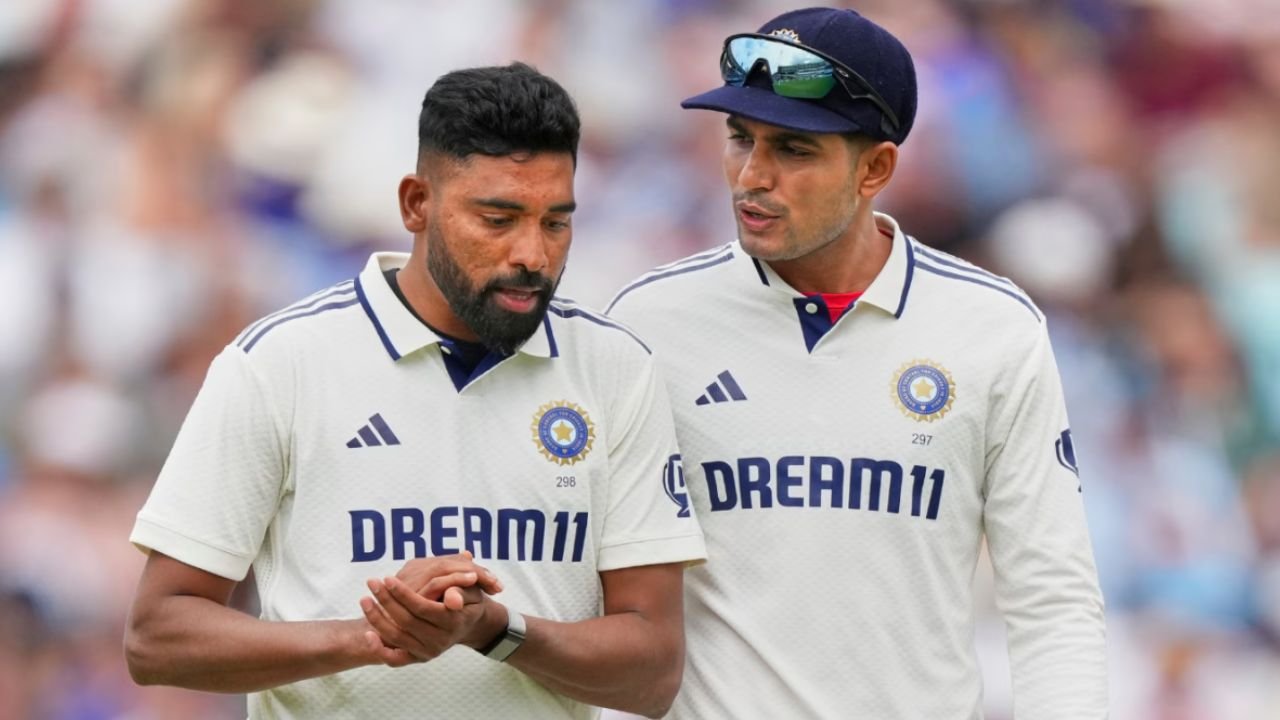
India captain Shubman Gill has defended the decision to leave Mohammed Siraj out of the playing XI for the first Test against New Zealand in Wellington, explaining that the selection was based on the bowling combination and form the team management wanted. Gill also admitted that informing Siraj, one of his close friends, that he would miss the match was particularly difficult.
Siraj’s omission became one of the biggest talking points of the series opener, especially given his experience in overseas conditions and his record in South Africa, England, New Zealand and Australia. Several former Indian cricketers and commentators questioned the decision, arguing that a fast bowler with his ability to deliver long spells and create pressure should have been part of the attack.
However, Gill stood by the team’s selection and maintained that including Siraj would not have changed the final outcome. India had a strong opportunity to secure victory after building a substantial first-innings lead, but New Zealand’s determined batting on the final day ensured that the contest ended in a draw.
India and New Zealand share the spoils in Wellington
India posted 720 for nine declared in their first innings, recording their highest Test total in New Zealand. The visitors secured a commanding lead of 352 runs after dismissing the hosts for 368.
Jasprit Bumrah led India’s bowling effort in New Zealand’s first innings, claiming four wickets as the hosts initially struggled against the visitors’ attack. New Zealand were reduced to 70 for five at one stage, putting India in a strong position to take control of the match.
However, Henry Nicholls and Glenn Phillips produced a crucial 216-run partnership that helped New Zealand recover. Their resistance allowed the hosts to reach 368 and prevented India from securing an even bigger first-innings advantage.
India responded with an imposing batting performance. KL Rahul and Rishabh Pant scored centuries, while Yashasvi Jaiswal, Devdutt Padikkal and Shubman Gill made valuable contributions. The visitors eventually declared at 720 for nine, giving themselves four sessions to bowl New Zealand out and pursue a victory.
New Zealand, however, showed considerable determination in their second innings. Daryl Mitchell and Glenn Phillips played important roles in resisting India’s bowling attack on the final day. The hosts finished on 239 for five after batting through the full 120 overs, securing a draw.
The result meant India could not convert their 352-run first-innings lead into a win, despite having created a strong position during the match.
Gill says Siraj’s inclusion would not have changed the result
Following the drawn Test, Gill was asked whether selecting Mohammed Siraj and Ravindra Jadeja could have made a difference to the outcome. The Indian captain gave a direct response, indicating that he did not believe their inclusion would have changed the result.
“I don’t think so,” Gill said.
His response reflected the team’s confidence in the combination selected for the Wellington Test. India had opted for Washington Sundar, with the off-spinner preferred as the management looked to counter New Zealand’s left-handed batter-heavy line-up.
Siraj’s absence was nevertheless surprising because of his experience in overseas conditions. The Hyderabad-born fast bowler had established himself as an important member of India’s Test attack, particularly through his ability to maintain pressure with long spells and generate movement in different conditions.
The selection decision attracted additional attention because the Wellington surface was expected to offer assistance to seam bowlers. With India choosing four fast bowlers alongside Sundar, the management had to make difficult decisions about which players would form the final attack.
Siraj is a great player and a good friend, says Gill
Gill acknowledged Siraj’s quality and his contribution to Indian Cricket while explaining why the decision to leave him out was not easy. The captain made it clear that his personal relationship with the fast bowler did not influence the final selection call.
“Siraj is a great player and a great bowler who has done very well for India. Before all of that, he is a good friend of mine. Leaving him out was a very tough decision for me as well. But you have to see which bowlers are in form.
“I had this conversation with him before the match and told him that he would be missing this match. He understood the logic behind it and why someone else was picked,” Gill said.
Gill’s comments revealed that the decision had been communicated to Siraj before the start of the Test. Rather than leaving the fast bowler uncertain about his place, the captain spoke to him directly and explained the reasoning behind the selection.
The situation also highlighted the personal challenges that can accompany leadership in international cricket. Captains often have to make decisions involving close teammates and friends, but they are ultimately responsible for choosing the combination they believe gives the team the best opportunity to succeed.
For Gill, leaving out a player with Siraj’s experience was a difficult call. Nevertheless, he maintained that the management had to consider current form and the balance of the bowling attack rather than reputation alone.
Why Siraj’s overseas record made the omission surprising
One of the main reasons behind the reaction to Siraj’s omission was his record in SENA countries: South Africa, England, New Zealand and Australia. These conditions can present different challenges for visiting batters and bowlers, making experience in those countries particularly valuable.
Siraj had been India’s leading wicket-taker during the five-Test series in England last year, which ended in a 2-2 draw. He claimed 23 wickets across the series, demonstrating his ability to handle the demands of an extended overseas campaign.
His performances in England strengthened his reputation as a bowler capable of operating for long periods and maintaining pressure even when conditions became challenging. His aggression, consistency and willingness to bowl demanding spells had made him a regular option in India’s overseas Test plans.
However, Siraj’s more recent returns had also become part of the selection discussion. He had taken only 14 wickets in his previous 12 Test matches, although much of that period involved subcontinental conditions.
The team management considered those recent numbers while assessing the available bowling options. The decision to select Sundar suggested that India wanted an additional spin option capable of challenging New Zealand’s left-handed batters.
That approach, however, did not convince everyone. Critics argued that Siraj’s overseas record and experience should have carried considerable weight, particularly in a match where India needed to take 20 wickets to secure victory.
Former India cricketers question Siraj’s exclusion
Several former Indian cricketers and commentators expressed disappointment after Siraj was left out of the Wellington Test. The criticism became a major talking point during the match, with questions raised about whether India’s management had overlooked one of its most experienced overseas fast bowlers.
Former India captain Sunil Gavaskar was among the most vocal critics. He questioned how a bowler who had regularly featured in India’s overseas attack could suddenly be left outside the preferred four. Gavaskar said Siraj had never let India down and admitted that the decision had baffled him.
Former India head coach Ravi Shastri also questioned the selection. He highlighted Siraj’s experience, aggression and ability to create opportunities with the ball, suggesting that those qualities made his exclusion difficult to understand.
Former India spinner Ravichandran Ashwin described the decision as “very harsh”. His reaction reflected the view that Siraj’s experience and previous contributions deserved greater consideration when the team management finalised its bowling combination.
Commentator Harsha Bhogle said he was “flabbergasted and disappointed” by the decision. Former India captain Ajinkya Rahane and Dinesh Karthik also expressed surprise at Siraj’s absence from the playing XI.
The criticism gathered further momentum after New Zealand recovered from 70 for five in the first innings. Nicholls and Phillips combined for a 216-run partnership, demonstrating how difficult it could be for India to maintain pressure once the initial breakthroughs had been made.
Although the partnership did not prove that Siraj’s inclusion would have changed the result, it gave critics another reason to question the team’s selection strategy. The management, meanwhile, maintained confidence in the combination it had chosen.
India’s bowling workload becomes a factor
The Wellington Test also placed considerable demands on India’s bowling attack. Bumrah was the leading wicket-taker in New Zealand’s first innings, while Akash Deep, Anshul Kamboj and Prasidh Krishna contributed across different stages of the contest.
On the final day, India’s bowlers struggled to find the breakthroughs required to dismiss New Zealand. Mitchell and Phillips remained at the crease for long periods, making it increasingly difficult for the visitors to force a result.
Gill later explained that the fast bowlers had completed heavy workloads and that the team needed to consider their recovery ahead of the next match. With the second Test scheduled to begin only three days later, managing the physical demands on the pace attack became an important consideration.
The drawn result therefore left the team management with two connected issues to assess: whether the bowling combination was suitable for the next Test and how to manage the workload of the frontline fast bowlers.
Will Siraj return for the second Test?
India will have another selection decision to make ahead of the second Test against New Zealand, scheduled to begin at Hagley Oval in Christchurch on November 27. Siraj and Jadeja remain available for selection, giving the management additional options as it considers changes to the playing XI.
Siraj’s experience in overseas conditions could make him an important option for the next match, particularly after the criticism surrounding his omission in Wellington. His ability to bowl long spells and generate pressure may be relevant as India looks to strengthen its attack.
At the same time, the management will have to consider the performances of the players who featured in the opening Test, the conditions expected in Christchurch and the workload accumulated by the pace bowlers.
Gill’s comments suggest that the first Test selection was based on a planned combination rather than a lack of confidence in Siraj’s ability. The captain’s admission that the decision was personally difficult also underlined the challenge of balancing friendships with the responsibilities of leadership.
India’s failure to win despite a 352-run first-innings lead will ensure that the bowling combination remains under discussion. Whether Siraj returns for the Christchurch Test will be one of the key selection questions as India looks to respond after the Wellington draw.
For breaking news and live news updates, like us on Facebook or follow us on Twitter and Instagram. Read more on Latest Cricket on thefoxdaily.com.






COMMENTS 0