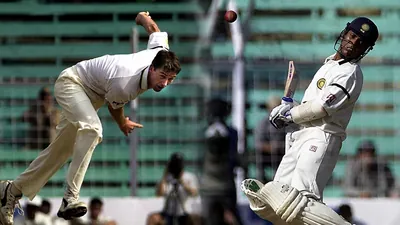
Shiv Sunder Das once appeared to be the answer to one of Indian Cricket’s most persistent questions: who could provide stability at the top of the Test batting order after Sunil Gavaskar? By early 2002, Das had played 18 Tests, scored 1,202 runs at an average of 40.06 and established himself as a technically reliable opening batter.
His journey had been remarkable. Das made his first-class debut for Orissa as a teenager, progressed through domestic cricket, entered the National Cricket Academy and eventually earned an India call-up. His early Test performances included a century against Zimbabwe and important contributions against several strong opponents.
Yet his international career changed dramatically during India’s 2002 tour of the West Indies. Across five Tests, Das managed only 124 runs at 15.50. He subsequently lost his place, and while he responded with a remarkable 250 against Essex in England, the emergence of Virender Sehwag as a Test opener left him without a route back into the Indian XI.
Das eventually finished with 23 Test appearances and 1,326 runs, including two centuries. His international numbers were respectable, but they tell only part of the story. His career is also a fascinating example of how timing, team balance and the emergence of an exceptional player can completely alter an athlete’s trajectory.
Shiv Sunder Das was identified as a special talent early
Das came from Orissa, now Odisha, and entered first-class cricket unusually young. He made his debut while he was only 16 years old, facing Madhya Pradesh.
His first match immediately offered a glimpse of his temperament. After scoring only nine in the first innings, Das responded with 98 in the second. That ability to recover from an early setback would become an important feature of his cricketing journey.
By the end of the 1990s, his domestic performances had pushed him firmly into national consideration. During the 1999-2000 first-class season, he scored 799 runs at an average of 49.93.
Those performances helped him earn a place in the first intake of the National Cricket Academy. He was also among the inaugural recipients of the Border-Gavaskar scholarship, which took him to the Australian Cricket Academy alongside Mohammad Kaif and S Sriram.
India’s opening problem created an opportunity
When Das made his Test debut against Bangladesh in November 2000, India’s opening combination had not yet become a settled part of the batting order.
The opening position had carried enormous historical importance for India because of Gavaskar’s extraordinary career. Replacing a player of that stature was never going to be straightforward, and several combinations were tried over the years.
Das offered something selectors were looking for: technical discipline combined with the ability to occupy the crease for long periods.
The breakthrough century against Zimbabwe
Das did not need many matches to announce himself. In only his third Test, against Zimbabwe in Nagpur, he scored 110 from 175 deliveries.
The century was important not simply because it was his first. It demonstrated that Das could convert an opportunity into a substantial Test innings, strengthening the argument that he could become a long-term option at the top of India’s order.
After his first eight Tests, Das had scored 635 runs at close to 50. That was the kind of start that naturally encouraged expectations around his future.
Gavaskar and Tendulkar offered Das valuable advice
One of the most interesting chapters of Das’s early career came during India’s Test against Australia in Chennai in 2001.
Before the innings, former India captain Sunil Gavaskar advised Das to adjust his guard from middle stump towards leg. Meanwhile, Sachin Tendulkar encouraged him to trust his natural game rather than become overwhelmed by the quality of Australia’s bowling attack.
Das responded with 84 and shared a 123-run opening partnership with Sadagoppan Ramesh.
The partnership was significant because it became India’s first century opening stand in 12 Tests. It also provided evidence that Das could handle elite opposition while maintaining the composure expected from a Test opener.
2001 was the peak of Das’s Test career
The calendar year 2001 represented the strongest sustained period of Das’s international career.
He scored 830 Test runs during the year and produced eight half-centuries. His performances were particularly impressive during India’s series in Zimbabwe.
Das scored 30 and an unbeaten 82 in the first Test before following that with 57 and 70 in the second. His 239 runs across the series came at an average close to 80, earning him the Player of the Series award.
He also produced important innings in Sri Lanka and South Africa. His scores included 59 and 68 in the final Test against Sri Lanka and 62 against South Africa in Bloemfontein.
The hidden weakness in a productive year
There was, however, an interesting contradiction in Das’s statistics.
Although he scored eight half-centuries during 2001, he did not make a century in the calendar year. This reflected a broader pattern that would become important later in his career.
Das could consistently get starts, but converting those starts into very large innings was less frequent. Across his Test career, he passed fifty 11 times but converted only two of those scores into hundreds.
That conversion rate did not make him a poor batter, but it did provide an important distinction between being a dependable opener and becoming an indispensable one.
After 18 Tests, Das appeared to have secured his place
By early 2002, Das had accumulated 1,202 runs from 18 Tests at 40.06.
Perhaps even more revealing was how often India changed his opening partner. Das had already opened with seven different players, making him the relatively stable component in an otherwise unsettled position.
That context makes what happened next even more dramatic.
Instead of gradually losing his place because of years of declining performances, Das experienced a sudden collapse in form during the 2002 series in the West Indies.
The five-Test West Indies series changed everything
Das’s performances during the series were a major turning point. Across eight innings, he scored 33, 10, 0, 0, 35, 3, 33 and 10.
His aggregate was only 124 runs at 15.50.
There was no half-century to interrupt the poor run and no major innings capable of restoring confidence. After having appeared secure in the side, Das suddenly found himself outside India’s plans.
Five difficult Tests effectively changed the direction of his international career.
Virender Sehwag emerged at exactly the wrong time for Das
The biggest twist in the story was not simply Das’s poor form. It was what happened while he was out of the team.
India already had an extremely strong middle order featuring Rahul Dravid, Sachin Tendulkar, Sourav Ganguly and VVS Laxman. Virender Sehwag was another exciting batting talent, but finding a permanent place for him in that middle order was difficult.
The solution was unconventional: move Sehwag to the top of the order.
At first, it could have been viewed as an experiment. But Sehwag quickly demonstrated that he was capable of transforming the role.
He scored 84 at Lord’s and followed it with 106 at Trent Bridge. Within only two Tests, India’s experiment was beginning to look like a long-term answer.
This was devastatingly bad timing for Das. He needed another opportunity as an opener at precisely the moment Sehwag was demonstrating that he could redefine what India expected from the position.
Das scored 250 in England—but still could not return
Perhaps the most remarkable part of the story came after Das had already lost his place.
Playing for an Indian side against Essex at Chelmsford, Das produced a monumental 250 from 380 balls. His innings contained 32 fours and four sixes.
Under normal circumstances, such an innings would have been an obvious statement to the national selectors. It showed that Das remained capable of batting for an extended period and producing an enormous score in English conditions.
There was also a potential opening available because Wasim Jaffer had been struggling.
Yet India’s selection problem was no longer simply about finding a specialist opener.
Why Sanjay Bangar was preferred
India selected Sanjay Bangar for the Headingley Test rather than bringing Das back into the XI.
The reasoning was tactical. Bangar could open the innings while also contributing useful seam bowling, giving captain Sourav Ganguly and coach John Wright greater balance in the playing XI.
Bangar scored 68 at Headingley, while India won the Test by an innings.
That result made the selection decision look even more effective from a team-management perspective.
Sehwag and Bangar then produced a huge opening stand
The situation became even more difficult for Das soon afterward.
Sehwag and Bangar put together a 201-run opening partnership against the West Indies in Mumbai. Sehwag’s development as a Test opener was now moving rapidly.
This was the key strategic change that effectively closed Das’s path back into the Test side.
India had discovered that Sehwag could provide something different at the top of the order. Instead of simply trying to reproduce the traditional defensive model of an opener, Sehwag brought extraordinary attacking intent.
Das was competing for a position that had changed while he was away from the team.
His Test career ended at only 24
Das’s final Test came at Sabina Park in May 2002. He was only 24 years old.
He remained around the national setup for some time and was included in subsequent squads, including India’s tour of New Zealand. However, another Test opportunity never arrived.
His final Test record stood at 23 matches, 1,326 runs, an average of 34.89 and two centuries.
Those figures may appear ordinary when viewed without context. But the first 18 Tests tell a different story. At that stage, Das was averaging more than 40 and appeared to have established himself as India’s dependable opening option.
Das continued scoring heavily after India moved on
Losing his Test place did not mean Das stopped being a productive cricketer.
He continued to accumulate runs in domestic cricket and produced several enormous innings. In January 2002, he had already scored 253 against Bengal and shared a massive 456-run partnership with Sanjay Raul.
Several years later, he reached another remarkable milestone by scoring 300 not out against Jammu and Kashmir during the 2006-07 Ranji Trophy season.
His eventual first-class record demonstrated the scale of his ability outside international cricket. Das played 180 first-class matches and scored 10,908 runs, including 24 centuries and 52 fifties.
Shiv Sunder Das career statistics
| Category | Record |
|---|---|
| Test matches | 23 |
| Test runs | 1,326 |
| Test average | 34.89 |
| Test centuries | 2 |
| Test fifties | 11 |
| First-class matches | 180 |
| First-class runs | 10,908 |
| First-class centuries | 24 |
| First-class fifties | 52 |
| Highest first-class score | 300 not out |
The unique lesson from Das’s career
Das’s story is not simply about a player who lost form. It is about timing and changing team strategy.
If Das had experienced his difficult West Indies series at a different point in India’s history, his career might have developed differently. But his loss of form coincided with the emergence of Sehwag, whose aggressive style changed the team’s approach to opening.
That combination created an unusually difficult situation. Das had to recover his form while competing against a player who was not merely replacing him but changing the definition of the position itself.
This is perhaps the most overlooked aspect of his career. Das did not simply lose a place to another specialist opener. India’s batting strategy evolved around Sehwag.
Why the 250 against Essex remains such a fascinating innings
Das’s 250 for India against Essex deserves special attention because of its timing.
He had just lost his Test place and responded with an innings of extraordinary scale. From an individual perspective, it was almost the perfect response: score heavily, demonstrate endurance and force selectors to reconsider.
But selection is not determined by individual performance alone. Team balance, tactical requirements and the form of other players also matter.
India’s decision to select Bangar proved successful in the immediate sense because he contributed with the bat and India won at Headingley. Meanwhile, Sehwag’s rapid development meant that the door became increasingly difficult for Das to reopen.
Das’s career shows how quickly cricket can change
In early 2002, Das looked like one of India’s most dependable opening options. By the end of the year, his international future had effectively disappeared.
The speed of that change is what makes his career particularly memorable.
One difficult series can damage a player’s position, but it usually takes more than poor form alone to permanently close the door. In Das’s case, the arrival of Sehwag created an additional problem: India had discovered an alternative that offered a radically different style of opening.
Sehwag would go on to become one of Test cricket’s most destructive opening batters. His success made it increasingly difficult for the team to return to the previous formula.
Conclusion: The opener who lost his place just as India’s cricket changed
Shiv Sunder Das remains one of Indian cricket’s more intriguing unfinished stories. He entered international cricket with considerable promise, produced a century in only his third Test and became a dependable presence at the top of India’s order.
After 18 Tests, he had 1,202 runs at 40.06 and appeared to have solved a problem that had troubled India for years. But a five-Test slump in the West Indies changed his position, and the rise of Virender Sehwag transformed the opening role itself.
Even a remarkable 250 against Essex could not restore Das to the Test XI. His final international record stopped at 23 Tests, but his domestic career continued for years and ultimately produced more than 10,000 first-class runs.
The biggest lesson from Das’s career is that sporting careers are shaped by more than talent. Form, timing, selection strategy and the emergence of exceptional teammates can all determine how long a player remains at the highest level.
Das had the ability to build a substantial Test career. What he did not have was the timing required to survive one difficult period when Indian cricket was simultaneously discovering a completely new way to open the innings.
For breaking news and live news updates, like us on Facebook or follow us on Twitter and Instagram. Read more on Latest Cricket on thefoxdaily.com.






COMMENTS 0