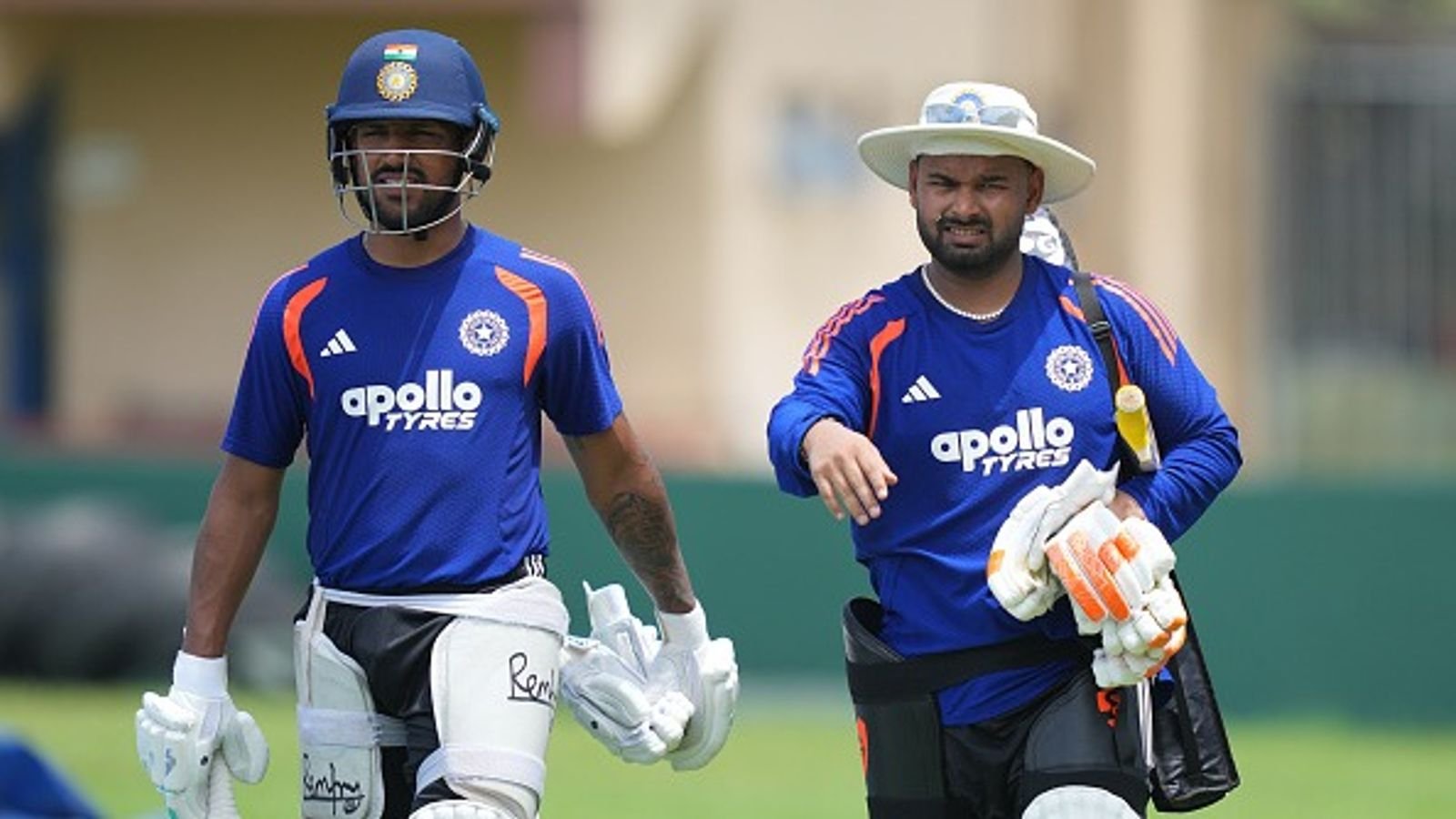
Dhruv Jurel’s Test place has come under serious scrutiny ahead of India’s first Test against Sri Lanka in Galle. The young wicketkeeper-batter has received backing during the early stages of his international career, but his recent red-ball returns have created a difficult selection question for the Indian team management.
According to the report, the BCCI and team decision-makers want Jurel to improve his batting if he is to retain a place in the Test XI. The pressure is particularly significant because Rishabh Pant remains India’s first-choice wicketkeeper, meaning Jurel cannot depend primarily on his work behind the stumps to secure his place.
The situation becomes even more interesting because Sarfaraz Khan has been included in India’s squad. His presence gives the selectors a genuine alternative if Jurel fails to turn his opportunities into substantial scores.
India’s two-Test series against Sri Lanka, beginning in Galle on August 15, therefore arrives at an important stage of Jurel’s young career. His immediate challenge is straightforward: produce runs, demonstrate consistency and prove that he offers enough value as a batter to justify his place in the XI.
Why Dhruv Jurel’s Test position is suddenly under pressure
Jurel’s situation is not the result of one poor innings. It is the product of a longer period in which his red-ball batting has failed to maintain the level expected from a player competing for a place in India’s Test middle order.
His most significant recent success came with a career-highlight 125 against the West Indies last October. Since then, however, his reported scores have included 44, 6, 14, 13, 0, 2 and an unbeaten 19.
Those numbers tell an important story. The problem is not necessarily that Jurel has failed in every innings. Rather, he has struggled to convert opportunities into the substantial scores that can provide selectors with confidence over the long term.
For a young player, consistency becomes particularly important once the initial period of opportunity has passed. Selection committees can tolerate failures while assessing a player’s potential, but repeated low scores eventually force a comparison with other available options.
That is the position Jurel now finds himself in.
The biggest problem: Jurel cannot rely on wicketkeeping to secure his place
The selection equation surrounding Jurel is different from that of a traditional wicketkeeper-batter. If Jurel were India’s primary wicketkeeper, his batting could be assessed alongside his glovework. But with Pant firmly established as the first-choice wicketkeeper, Jurel’s selection becomes much more dependent on his batting.
This changes the value calculation for the team.
Jurel effectively needs to convince the selectors that his presence strengthens the batting lineup even when Pant is already behind the stumps. That means his batting performances have to compete with those of specialist middle-order candidates.
In simple terms, Jurel is not merely competing with other wicketkeepers. He is competing for a batting position.
That distinction could become decisive during the Sri Lanka series.
Rishabh Pant’s presence makes Jurel’s role complicated
Rishabh Pant’s return to India’s Test setup has naturally changed the opportunities available to Jurel. Pant brings an established record, aggressive batting ability and experience at the highest level.
As a result, India do not necessarily need to select Jurel solely for wicketkeeping cover when Pant is fit and available.
Jurel’s best route into the XI is therefore to establish himself as a reliable middle-order batter who can also provide wicketkeeping depth. That is a much more demanding proposition because the competition is no longer limited to players with gloves.
It also explains why his current batting slump has attracted greater attention. Every low score raises the question of whether India would gain more by selecting another specialist batter.
Sarfaraz Khan has changed the selection equation
Sarfaraz Khan is arguably the most important factor behind the increased scrutiny on Jurel. His inclusion gives India another recognised batting option at a time when Jurel’s red-ball form is under examination.
When there is no obvious alternative, selectors can continue backing a young player through a difficult period. The situation becomes more complicated when another batter is available and capable of competing for the same role.
Sarfaraz’s presence therefore creates genuine selection pressure rather than merely media speculation.
The key question for India is not simply which player has the better reputation. It is which batter provides the best balance to the XI in the conditions in Sri Lanka.
That could involve considering technique against spin, ability to occupy the crease, experience, recent form, left-right combinations and the overall construction of the middle order.
Jurel’s recent innings explain the concern
The reported sequence of Jurel’s recent scores provides useful context for the selection debate.
| Period or match context | Reported score | Selection significance |
|---|---|---|
| Against West Indies | 125 | Career-defining performance and strong evidence of potential |
| Subsequent red-ball outings | 44, 6, 14, 13, 0, 2, 19* | Inconsistent returns increased pressure on his place |
| Afghanistan one-off Test | 19 | Missed an opportunity to make a strong statement |
| Sri Lanka warm-up fixture | 1 and 17 | Added to concerns ahead of the Test series |
The numbers should not be interpreted as proof that Jurel lacks Test quality. His 125 demonstrates that he can produce a major innings. The concern is whether he can reproduce that level consistently enough to justify continued selection.
Why the Sri Lanka series is particularly important
India’s two-Test series against Sri Lanka is part of the ICC World Test Championship 2025-27 cycle, increasing the importance of every selection decision.
Test Cricket rewards players who can contribute across long periods, and teams cannot afford to carry too many passengers in a two-match series. India will want their middle order to provide stability, particularly if Sri Lanka’s spinners create difficult batting conditions.
For Jurel, that makes the timing of the series particularly significant. A strong performance could immediately change the narrative around his form. Conversely, another sequence of low scores could give the selectors a compelling reason to examine Sarfaraz as an alternative.
The first Test at Galle, starting on August 15, therefore offers Jurel an opportunity to answer the selection debate with performances rather than statements.
Galle could test Jurel’s batting in a different way
The conditions in Sri Lanka can place different demands on a batter compared with Test cricket in India or overseas environments dominated by pace.
Players need to be comfortable against spin, capable of rotating the strike and patient enough to wait for scoring opportunities. Footwork and shot selection become particularly important as the innings develops.
For Jurel, this could actually provide an opportunity. A technically disciplined innings in Galle would offer a different kind of evidence to selectors than a quick cameo.
His ability to occupy the crease for a long period could be just as valuable as the number of boundaries he scores.
Why one big score could change the conversation
Jurel’s selection problem is serious, but it is far from irreversible. Cricket careers can change rapidly, especially when a player is still young.
A substantial innings in the first Test could immediately reduce the pressure surrounding him. A score of significant value would demonstrate that his recent struggles are not representative of his overall red-ball ability.
More importantly, it would give the team management a reason to continue investing in him.
This is one of the advantages young players have compared with established veterans: selectors are often willing to look at long-term potential if they see signs of improvement. Jurel needs to provide those signs now.
Comparison: Jurel’s challenge versus Sarfaraz’s opportunity
| Factor | Dhruv Jurel | Sarfaraz Khan |
|---|---|---|
| Primary selection challenge | Needs stronger batting consistency | Needs to convert selection opportunity into performances |
| Role | Wicketkeeper-batter/specialist batting option | Specialist middle-order batting option |
| Current advantage | Existing backing and familiarity with the setup | Pressure-free opportunity to challenge for a place |
| Immediate requirement | Produce substantial Test runs | Show that his batting merits selection |
This comparison reveals why the situation is more nuanced than simply saying one player is replacing another. India have to determine which combination gives them the strongest XI for the conditions and the series.
The right-handed middle-order argument may not be enough anymore
Jurel’s continued selection has reportedly been helped by India’s desire for a right-handed batter in the middle order and reluctance to bring back other options.
However, batting combinations are only one part of Test selection. If a player is repeatedly unable to convert opportunities, the theoretical advantage of a particular batting combination can become less important than actual production.
This is where Jurel’s performances in Sri Lanka could become decisive.
If he delivers runs, the right-handed middle-order argument becomes easier to justify. If he continues to struggle, the selectors will have to consider whether maintaining that combination is worth sacrificing current batting form.
Mohammad Kaif’s backing of Sarfaraz adds another layer
Former India cricketer Mohammad Kaif has reportedly backed Sarfaraz over Jurel for the Sri Lanka tour. While an ex-player’s opinion does not determine selection, it reflects the broader debate surrounding India’s middle order.
The growing discussion is significant because selection pressure often increases when analysts, former players and supporters can point to a realistic alternative.
For Jurel, the answer should not be to respond to criticism verbally. The strongest response would be a long Test innings that makes the selection argument considerably harder to challenge.
Jurel’s biggest task is converting starts into impact
The numbers suggest that Jurel’s issue is not simply getting onto the field. He has already received opportunities and has demonstrated that he can score heavily.
The bigger question is conversion.
A batter can survive difficult spells and still fall short of a meaningful score. Test teams need players who can turn promising positions into innings that influence the match.
Jurel’s 125 against the West Indies proves that he has the ability. The challenge is making performances of that scale less exceptional and more representative of his Test batting.
What India should expect from Jurel in Sri Lanka
- Consistency: India need Jurel to avoid another run of single-digit scores.
- Patience: Conditions in Sri Lanka may reward batters who are prepared to build an innings rather than attack immediately.
- Spin management: Jurel’s ability to handle quality spin will be an important part of his evaluation.
- Partnership building: Contributing to substantial middle-order partnerships could strengthen his case significantly.
- Match impact: A meaningful score in a winning cause would provide stronger evidence than isolated runs.
What happens if Jurel fails again?
If Jurel struggles again, the selection debate will become considerably harder to ignore. India would then have to decide whether continued backing is justified or whether Sarfaraz deserves an extended opportunity.
That does not mean one poor innings would automatically end Jurel’s Test career. Selection decisions are rarely based on a single score. However, when a player is already under scrutiny and another option is available, another failure can accelerate a change.
The key issue is the pattern. If Jurel produces another low score after a series of disappointing returns, the selectors would have a larger body of evidence to consider.
That is why the upcoming Test is so important. Jurel is not merely trying to score runs; he is trying to change the direction of the selection conversation.
What happens if Jurel delivers?
The opposite scenario is equally important. If Jurel scores a century or produces a substantial match-defining innings, the pressure could disappear almost immediately.
His previous 125 already provides evidence that he can perform at that level. Another significant innings would suggest that his recent struggles were a temporary dip rather than a permanent decline.
It could also allow the team management to continue developing him without making an immediate change to the middle order.
In that sense, the Sri Lanka series represents an opportunity as much as a threat.
The bigger picture for India’s Test middle order
India’s selection dilemma involving Jurel and Sarfaraz reflects a broader challenge facing any successful Test side: maintaining a strong balance between long-term development and immediate performance.
Young players need opportunities to establish themselves, but international cricket is ultimately performance-driven. Once several alternatives are available, the margin for prolonged inconsistency becomes smaller.
India also need to consider the age profile and future structure of their Test batting unit. Giving Jurel enough opportunities to develop could be valuable, but those opportunities must be supported by evidence that his batting is progressing.
That makes his current situation important beyond the Sri Lanka series itself.
Future outlook: Jurel still controls his own answer
Despite the growing pressure, Jurel’s situation should not be viewed as the end of his Test career. He is still young, has already produced a major Test hundred and remains part of India’s plans.
What has changed is the level of competition around him.
With Pant established as the wicketkeeper and Sarfaraz available as a specialist batter, Jurel has less room for prolonged inconsistency. His best response is therefore straightforward: score runs and make the selectors want to keep him in the XI.
The upcoming Test in Galle could provide the perfect stage for that response. One major innings will not erase every recent failure, but it could restore confidence and create momentum heading into the second Test.
Conclusion: Dhruv Jurel’s Test future may depend on his bat
Dhruv Jurel’s Test spot is under increasing pressure because his recent red-ball batting returns have not matched the expectations surrounding him. With Rishabh Pant occupying the primary wicketkeeping role and Sarfaraz Khan providing another middle-order option, Jurel’s value with the bat has become more important than ever.
The reported warning from the BCCI and team decision-makers underlines the central issue: Jurel needs to produce meaningful runs if he wants to remain a regular part of India’s Test XI.
His 125 against the West Indies demonstrates that he possesses the ability to play a major Test innings. The challenge now is consistency. The upcoming two-Test series against Sri Lanka gives him an immediate opportunity to prove that his recent slump is temporary.
For Jurel, the message is clear. His gloves may keep him in India’s wider Test plans, but with Pant ahead of him, his bat will have to do the heavy lifting for his place in the playing XI.
For breaking news and live news updates, like us on Facebook or follow us on Twitter and Instagram. Read more on Latest Cricket on thefoxdaily.com.






COMMENTS 0