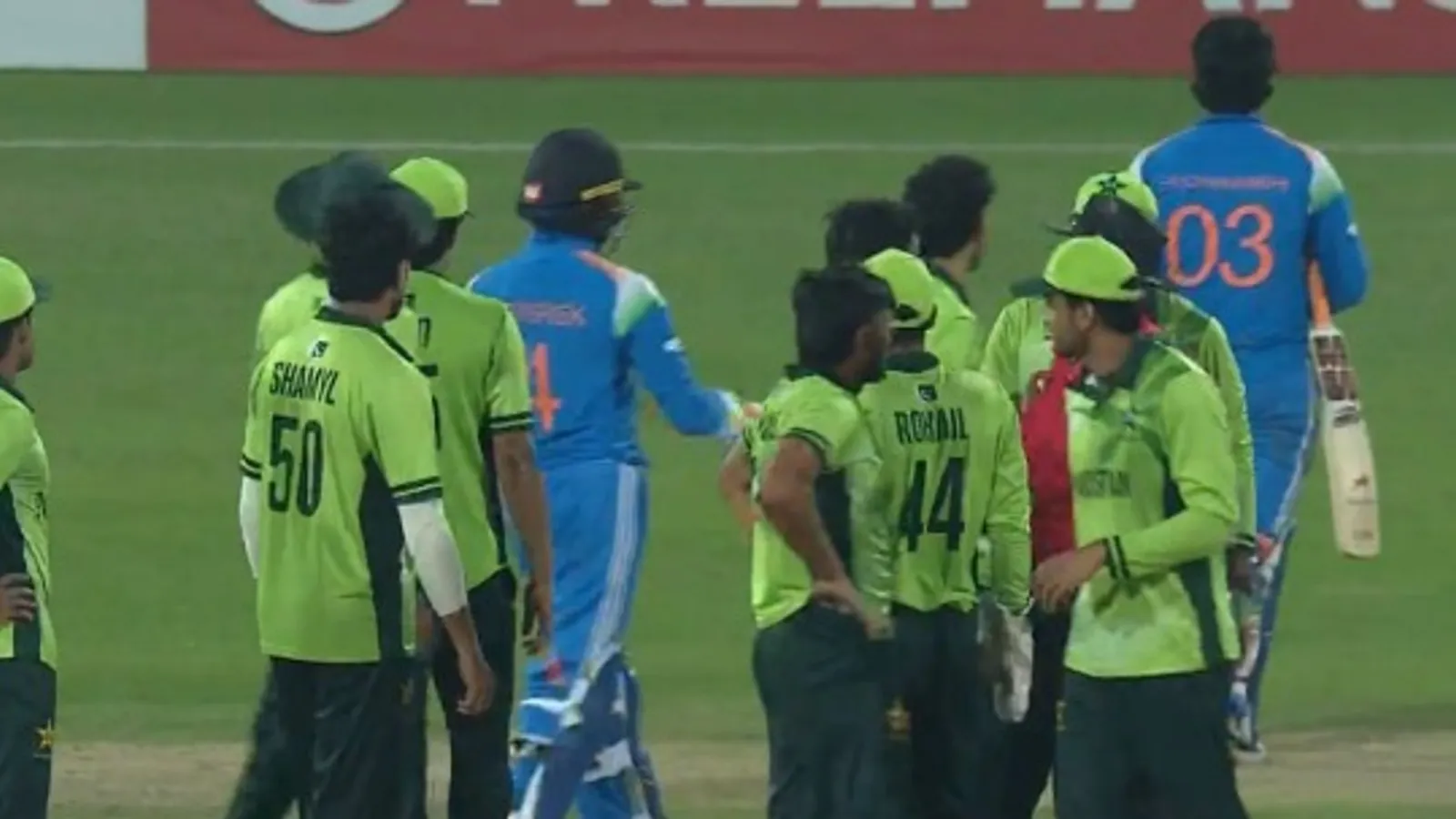
India A suffered a 48-run defeat against Pakistan A in a high-scoring Group B encounter at the ACC Men’s Asia Cup Rising Stars 2026 in Doha on November 22. Despite a determined century from captain Tilak Varma and a fighting half-century from Shahbaz Ahmed, India A were bowled out for 265 while chasing a challenging target of 314.
Pakistan A, also known as Pakistan Shaheens, had earlier posted 313 in 49.2 overs after choosing to bat first. Half-centuries from Maaz Sadaqat, Hasan Nawaz and Farhan Yousaf helped them build a formidable total, while their bowlers held their nerve during the closing stages to secure an important victory.
India A appeared to be heading towards a heavy defeat after slipping to 129/6 in the chase. However, a remarkable seventh-wicket partnership between Tilak and Shahbaz briefly brought the visitors back into contention. Their century stand revived hopes of an unlikely comeback, but Pakistan’s disciplined death bowling eventually ended the resistance.
India A fall short despite Tilak Varma’s century
India A entered the chase with a target of 314, but their pursuit quickly became complicated as wickets fell at regular intervals. Although the batting line-up included several players with international experience, the team struggled to build partnerships during the opening stages.
Opener Vaibhav Sooryavanshi was dismissed for 11, while Rinku Singh and Suryansh Shedge also departed after scoring in single digits. The early setbacks placed additional responsibility on the middle order to keep the chase alive.
Abhishek Sharma provided the strongest start among India’s top-order batters. He attacked the Pakistan bowlers with confidence, scoring 70 from just 42 deliveries and hitting several boundaries. His innings helped India A reach 93/2 and kept the required run rate within reach during the early part of the chase.
However, Abhishek’s dismissal triggered a collapse. More wickets followed, and India A slipped to 129/6, leaving the team in a difficult position with a substantial target still to achieve.
Captain Tilak Varma also struggled to find his timing initially. He scored only eight runs from his first 36 deliveries before managing his first boundary. His slow start increased the pressure on the chase, particularly as wickets continued to fall at the other end.
Shahbaz Ahmed sparks a remarkable recovery
With India A reduced to 129/6, Shahbaz Ahmed joined Tilak at the crease at No. 8. The pair needed a substantial partnership to give the team any realistic chance of reaching the target.
Shahbaz immediately brought a change in momentum. His aggressive approach, including two early sixes, helped put pressure back on the Pakistan bowlers. His willingness to attack appeared to give Tilak more freedom to settle into his innings and gradually improve his scoring rate.
Tilak began finding gaps and playing boundaries more regularly, while Shahbaz continued to score at a brisk pace. Their seventh-wicket partnership eventually crossed the century mark, giving India A renewed hope of completing an unlikely chase.
Tilak reached his half-century after facing 95 deliveries, reflecting the difficult start he had endured. Shahbaz, meanwhile, brought up his fifty from just 41 balls, providing the attacking momentum India needed.
Shahbaz also took on Pakistan’s standout fast bowler Ali Raza, striking two towering sixes. Raza had earlier delivered an impressive opening spell of five overs, conceding 18 runs and taking one wicket.
As the partnership developed, the required rate remained below nine runs per over. With 91 runs needed from the final 10 overs, India A appeared to have a genuine opportunity to challenge Pakistan’s total.
The growing pressure was visible in the Pakistan camp, with captain Abdul Samad frequently gathering his bowlers for discussions in the middle. However, Pakistan responded at a crucial stage by tightening their bowling and restricting India’s scoring opportunities.
Pakistan bowlers regain control in the closing overs
Pakistan’s bowlers produced a disciplined performance during the death overs, going 30 consecutive deliveries without conceding a boundary. The extended period without a four or six increased the pressure on the Indian batters and pushed the required rate towards 11 runs per over.
With the equation becoming increasingly difficult, Shahbaz attempted to accelerate the scoring but was caught in the 44th over for 56. His dismissal ended the partnership that had given India A their best opportunity to recover.
Pakistan struck again immediately. Ali Raza dismissed Vipraj Nigam on the very next delivery, uprooting his off stump with a sharp delivery. Raza celebrated the breakthrough as Pakistan moved closer to victory.
Mohammad Imran then removed Harshit Rana in the following over, leaving India A with their final wicket and little room for another recovery.
Tilak continued fighting and completed a resilient century, reaching 100 before being dismissed as the last batter in the final over. His effort was not enough to take India A across the finish line, as the team was bowled out for 265, falling 48 runs short.
Ali Raza finished with three wickets for 56 runs, while Hasan Nawaz also claimed three wickets, conceding 45 runs. Their contributions proved decisive in preventing India A from completing the chase.
Pakistan A post 313 after strong batting contributions
Earlier, Pakistan A had built a strong platform after deciding to bat first and scoring 313 in 49.2 overs. Maaz Sadaqat, Hasan Nawaz and Farhan Yousaf all produced half-centuries, while Mohammad Imran added valuable runs towards the end of the innings.
The toss itself produced an unusual moment before the match began. India A captain Tilak Varma tossed the coin while Pakistan skipper Abdul Samad called heads. The match referee initially declared tails, but both captains examined the coin after Samad raised concerns about the decision.
Officials subsequently reversed the call, awarding the toss to Pakistan. Samad chose to bat first, believing the surface was slightly dry.
As had been seen in recent India-Pakistan fixtures, neither captain exchanged a handshake after the toss formalities were completed.
Pakistan openers provide an aggressive start
Pakistan’s opening batters began aggressively, putting India’s new-ball bowlers under pressure from the start. The pair raced to 65 runs inside the first seven overs, giving their team an excellent foundation.
Shamyl Hussain led the early attack, scoring 33 from 23 deliveries with four fours and two sixes. His aggressive strokeplay helped Pakistan establish momentum during the powerplay.
Fast bowler Harshit Rana was involved in several heated exchanges with the Pakistan openers as they continued to score freely. The first breakthrough came in the eighth over when Shamyl chipped an Ayush Badoni delivery towards short third.
Rana responded with an animated send-off after the dismissal. Five deliveries later, he struck again, trapping wicketkeeper Rohail Nazir leg before wicket for a duck. Pakistan had lost two wickets at 67, giving India A an opportunity to slow the scoring.
Maaz Sadaqat and Hasan Nawaz rebuild the innings
After the early wickets, Maaz Sadaqat and Hasan Nawaz stabilised Pakistan’s innings with a 54-run partnership for the third wicket. Their stand helped the team recover from the brief setback and rebuild a competitive total.
Maaz continued his impressive tournament form, registering his second consecutive half-century. He scored 59 from 63 deliveries, hitting six fours and one six before being caught off Suryansh Shedge in the 20th over.
Hasan then took greater responsibility for accelerating the innings. He reached his half-century from 43 balls, including a six off Vipraj Nigam that helped him reach the milestone.
Hasan combined with captain Abdul Samad to add 65 runs for the next wicket. Samad contributed 28 from 35 deliveries before being run out in the 31st over through a sharp piece of combined fielding involving Rinku Singh and wicketkeeper Kumar Kushagra.
Hasan continued to score fluently after Samad’s dismissal and became Pakistan’s leading scorer. He eventually departed for 79 from 82 balls, hitting five fours and four sixes. Ayush Badoni took the catch off Shedge’s bowling, leaving Pakistan at 230/5 in the 39th over.
Farhan Yousaf and Mohammad Imran lift Pakistan beyond 300
Pakistan maintained their scoring momentum during the final overs through Farhan Yousaf. The batter scored 56 from 48 deliveries, including four fours and two sixes, ensuring that the innings did not lose momentum after Hasan’s dismissal.
Mohammad Imran provided further acceleration with a quick 23 from just 14 balls, striking two sixes. Their contributions helped Pakistan move beyond the 300-run mark in the 47th over.
Farhan eventually fell after top-edging a ramp shot to wicketkeeper Kumar Kushagra off Prince Yadav. Prince later dismissed Ali Raza for two runs as India A completed the innings by bowling Pakistan out for 313 in 49.2 overs.
The total gave Pakistan a challenging target, particularly after their bowlers had already shown their ability to take wickets during the early stages of India’s chase.
India A and Pakistan A prepare for their next matches
The 48-run victory gives Pakistan A an important result in Group B of the ACC Men’s Asia Cup Rising Stars 2026. Their batting depth, built around three half-centuries, and their ability to defend the total under pressure proved decisive.
India A will take on the United Arab Emirates on November 24 as they look to respond to the defeat and strengthen their position in the competition. Pakistan A will face Nepal on the same date, aiming to carry their winning momentum into the next fixture.
For India A, Tilak’s century and Shahbaz’s aggressive half-century offered positives despite the result. However, the early batting collapse and Pakistan’s control during the final overs proved too difficult to overcome. The match highlighted how a strong recovery partnership can revive a chase, but also how quickly disciplined death bowling can turn the contest back in the fielding team’s favour.
For breaking news and live news updates, like us on Facebook or follow us on Twitter and Instagram. Read more on Latest Cricket on thefoxdaily.com.






COMMENTS 0