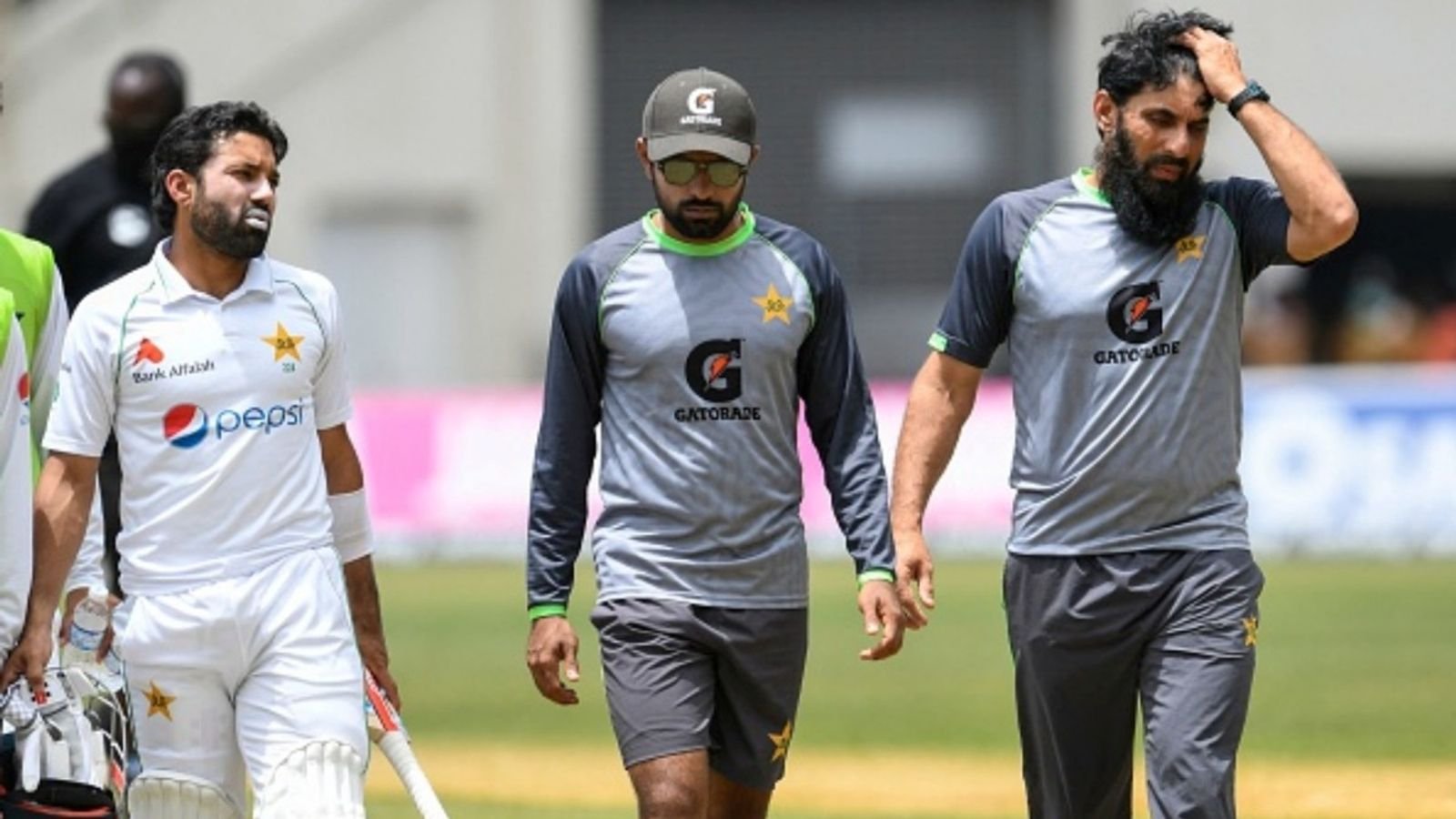
Misbah-ul-Haq resigns as Pakistan selector at a moment when the Pakistan Cricket Board is already under intense pressure over its handling of the national Test team. The former Pakistan captain has stepped down from the national selection committee and also left his position as batting consultant at the National Cricket Academy in Lahore.
The timing is particularly significant. Misbah’s decision came only a day after the PCB made sweeping changes to Pakistan’s Test squad following a heavy defeat at Lord’s. Seven players were dropped, five uncapped players were added, coaching responsibilities were reshuffled and selectors were asked to explain the inclusion of senior batters Imam-ul-Haq and mohammad Rizwan.
However, one important detail remains unresolved: the PCB has not yet formally accepted Misbah’s resignation from either role.
That uncertainty reflects the larger problem surrounding Pakistan cricket. The issue is no longer simply about which players should be selected. It is increasingly about whether the team has a stable cricketing structure capable of making long-term decisions instead of reacting to individual results.
Why did Misbah-ul-Haq resign from the Pakistan selection committee?
Misbah-ul-Haq’s resignation came less than 24 hours after the PCB announced a dramatic overhaul of Pakistan’s Test setup. Although the board has not publicly confirmed a single reason for his departure, the timing makes the sequence of events impossible to ignore.
The selection committee had been placed under pressure after Pakistan suffered a 194-run defeat at Lord’s. Instead of making a limited adjustment, the PCB responded with a major restructuring of the squad and coaching setup.
Misbah was one of the members of the selection committee alongside Aaqib Javed, Sarfaraz Ahmed and Asad Shafiq. The committee was also asked to provide a written explanation regarding the selection of Imam-ul-Haq and Mohammad Rizwan.
Misbah’s decision to leave the selection role therefore arrives while the committee itself is being questioned by the board. His simultaneous departure from the batting consultant position at the National Cricket Academy makes the development even more important.
For Pakistan cricket, the immediate question is not just who replaces Misbah. It is whether another change at the selection level will provide stability or create another layer of uncertainty.
Pakistan dropped seven players after the Lord’s defeat
The PCB’s reaction to the Lord’s result was unusually extensive. Seven players were removed from the Test squad as Pakistan attempted to reset its team before the final Test against England.
Imam-ul-Haq, Mohammad Rizwan, Salman Agha, Ali Usman, Aamer Jamal, Awais Zafar and Khurram Shahzad were dropped.
At the same time, Saim Ayub and Abdullah Fazal were recalled. The selectors also brought five uncapped players into the squad: Arafat Minhas, Mohammad Imran Jnr, Saad Baig, Mohammad Imran Randhawa and Razanullah.
The scale of the changes immediately raised questions about selection strategy. Replacing experienced players with several uncapped cricketers can create opportunities, but doing so in the middle of an international series also carries significant risks.
A Test team requires familiarity with conditions, roles and combinations. Introducing several inexperienced players simultaneously can make it harder for a new-look side to establish consistency, particularly against an England team playing at home.
Why the Imam-ul-Haq and Mohammad Rizwan controversy matters
One of the most unusual elements of the latest Pakistan cricket crisis is the PCB’s decision to seek an explanation from the selectors over the inclusion of Imam-ul-Haq and Mohammad Rizwan.
The selection committee was reportedly given 24 hours to provide a written explanation. That move effectively placed the selectors under direct scrutiny for decisions that had previously fallen within their responsibilities.
It also highlights a wider question about accountability inside Pakistan cricket. If selectors are appointed to choose the national squad, where should responsibility sit when those decisions produce disappointing results?
Selection naturally attracts debate, particularly when senior players fail to deliver. But constantly changing selection personnel or questioning decisions immediately after defeats can make it difficult to establish a coherent selection philosophy.
That is particularly important for Pakistan because the team needs to balance experienced international players with emerging talent. Dropping established names may be justified in individual cases, but the process needs to be connected to a clear long-term plan.
Coaching changes have made the situation even more complicated
The selection shake-up did not happen in isolation. The PCB also made major changes to the coaching structure following the Lord’s defeat.
Head coach Sarfaraz Ahmed and bowling coach Umar Gul were removed from their positions. White-ball head coach Mike Hesson was then given responsibility for the Test team as well, while Ashley Noffke was brought in as the replacement for Gul.
That means Pakistan’s Test team is entering the next phase of the series with changes in both personnel and coaching leadership.
Changing coaches can sometimes provide a short-term psychological boost. Players may respond positively to a fresh voice, different tactical ideas and renewed competition for places.
But repeated changes can also produce the opposite effect. Players may become uncertain about their roles, coaches may have limited time to implement their systems and selectors may continually adjust squads according to immediate results.
This is precisely where the criticism from former Pakistan coach Mickey Arthur becomes relevant. Arthur described the recent decisions as extremely poor and argued that repeated chopping and changing of players, coaches and selectors has contributed to instability.
Pakistan’s biggest problem may be instability rather than talent
Pakistan have never been short of cricketing talent. Their history includes world-class batters, fast bowlers, spinners and all-rounders capable of changing matches.
The more difficult challenge has often been turning that talent into sustained team performance.
A successful Test side normally develops through continuity. Players understand their roles, combinations become familiar and the team learns how to respond to difficult situations together.
Pakistan’s latest changes move in the opposite direction. Seven players have been dropped, five uncapped players have been added, the coaching staff has changed and now a senior selector has resigned.
That does not automatically mean every decision is wrong. Some players may genuinely need to make way for younger options, and some coaching appointments may prove successful.
The bigger concern is whether all these decisions form part of one strategy.
Experience versus youth: Pakistan are taking a major gamble
The inclusion of five uncapped players could eventually become one of the most important developments in Pakistan cricket. Young players need opportunities, and Test cricket can be the ideal environment for identifying the next generation of international performers.
But timing matters.
Introducing inexperienced players after a heavy defeat can put enormous pressure on them. Instead of entering international cricket in a stable environment, they could be asked to perform while the team itself is undergoing structural change.
That creates a difficult comparison between Pakistan’s old and new approach.
| Approach | Potential benefit | Major risk |
|---|---|---|
| Retain experienced players | Greater familiarity and match experience | Limited opportunities for emerging talent |
| Introduce young players gradually | Builds future depth while maintaining stability | Requires patience from selectors and fans |
| Make wholesale changes | Creates immediate competition and a fresh squad | Can damage continuity and increase pressure |
The third approach is effectively what Pakistan have chosen at this stage. The results will determine whether the gamble becomes a successful rebuild or another example of short-term decision-making.
Misbah’s departure is bigger than one selector leaving
Misbah-ul-Haq occupies an unusual position in Pakistan cricket because of his experience as both a former captain and a coach. His international career was built around discipline, patience and leadership, making his presence within the selection structure significant.
His departure therefore removes another experienced voice from a system already undergoing considerable change.
There is also a symbolic element. Misbah previously led Pakistan during a period when the team developed a reputation for greater structure in Test cricket. His involvement in selection and batting development represented continuity between Pakistan’s recent cricketing history and its current setup.
That continuity is now under pressure.
The PCB may eventually accept his resignation and appoint another selector, or the board could attempt to find a different arrangement. Either way, the immediate challenge will be restoring clarity over who is responsible for selection decisions.
What does this mean for Babar Azam?
Despite the sweeping changes around him, Babar Azam was not removed from the captaincy. That decision is also significant because it shows that the PCB has chosen to target the wider structure rather than completely restart the leadership group.
Keeping Babar means the board appears willing to give the captain an opportunity to respond on the field while changing other parts of the setup.
That approach could work if the new coaching structure provides Babar with a clearly defined role and a stable group of players around him.
However, captaincy becomes increasingly difficult when a player is expected to lead a constantly changing team. A captain needs clarity over selection, tactical direction and player roles.
The final Test against England will therefore be important not only for the result but also for understanding whether the new structure can function effectively.
Pakistan’s World Test Championship position increases the pressure
The timing of the changes is particularly concerning because Pakistan’s position in the World Test Championship cycle is already poor.
Pakistan remain at the bottom of the WTC 2025-27 points table and are ranked eighth in the Test rankings, ahead of only the West Indies.
That makes every remaining Test increasingly important. A rebuilding process is easier to sell when a team has time to experiment, but Pakistan cannot afford endless experimentation if it wants to improve its position in the championship cycle.
The team therefore faces two objectives that can sometimes conflict: developing new players and winning immediately.
The best cricket boards usually try to solve that problem through gradual transition. Pakistan’s latest squad changes represent a much more dramatic approach.
Why the Edgbaston Test could become a defining moment
The third and final Test against England at Edgbaston now carries additional significance. Pakistan will arrive with a drastically altered squad and a new coaching arrangement.
The result will not necessarily prove whether the PCB’s changes were correct. One Test is too small a sample to judge a complete rebuilding strategy.
However, the match can reveal whether the new players are ready for the responsibility being placed on them and whether the coaching group can quickly establish a competitive structure.
If Pakistan perform strongly, the PCB could argue that bold changes were necessary. If they struggle again, criticism of the board’s decision-making process is likely to become even louder.
Either way, the match will be watched as much for Pakistan’s new direction as for the scoreboard.
The bigger lesson for Pakistan cricket
The Misbah-ul-Haq resignation story is ultimately part of a much larger debate about how Pakistan cricket should be managed.
Changing players after poor performances is normal. Replacing coaches is also normal. Even selectors can be replaced when a board believes its strategy is not working.
The danger appears when all those changes happen simultaneously without a clearly communicated long-term plan.
Pakistan have the talent to build a competitive Test team. What they need most is consistency in decision-making. Young players need time to develop, experienced players need clearly defined expectations and coaches need enough authority to implement their ideas.
The PCB’s latest actions could still become the starting point for a successful rebuild. The inclusion of uncapped players may uncover future stars, while the new coaching structure could eventually produce greater tactical clarity.
But for that to happen, the board will need to resist the temptation to make another round of major changes after the next disappointing result.
What happens next after Misbah-ul-Haq’s resignation?
The immediate priority is resolving Misbah’s status. The PCB has not yet accepted his resignation, leaving his formal position in the selection committee and at the National Cricket Academy temporarily uncertain.
The board must also deal with the selectors’ requested explanation and prepare the revamped Test group for the final match against England.
Beyond that, the bigger task is creating a selection policy that can survive both victories and defeats.
Pakistan cricket does not need to choose between experience and youth. It needs a system that knows when to use each. The five uncapped players can be part of that solution, but only if they are given a structured pathway rather than being treated as emergency replacements.
Misbah-ul-Haq’s resignation has therefore arrived at a critical crossroads. The PCB can view it simply as another personnel change, or it can use the moment to examine why its cricketing structure has reached this level of instability.
The answer could determine whether Pakistan’s latest Test shake-up becomes the beginning of a genuine rebuild or simply another chapter in the cycle of constant change.
Conclusion: Pakistan need a plan, not another reaction
Misbah-ul-Haq resigning as Pakistan selector has intensified an already turbulent period for Pakistan cricket. His departure follows a major Test squad overhaul, coaching changes and questions over the selection of senior players.
The PCB now has an opportunity to turn the crisis into a reset. But a reset only works when it is supported by patience, clear responsibilities and a consistent selection philosophy.
Pakistan’s immediate challenge is England. Its bigger challenge is building a Test team capable of competing consistently over an entire World Test Championship cycle.
The next few months will show whether the latest changes were the beginning of that process or simply another reaction to a disappointing result.
For breaking news and live news updates, like us on Facebook or follow us on Twitter and Instagram. Read more on Latest Cricket on thefoxdaily.com.






COMMENTS 0