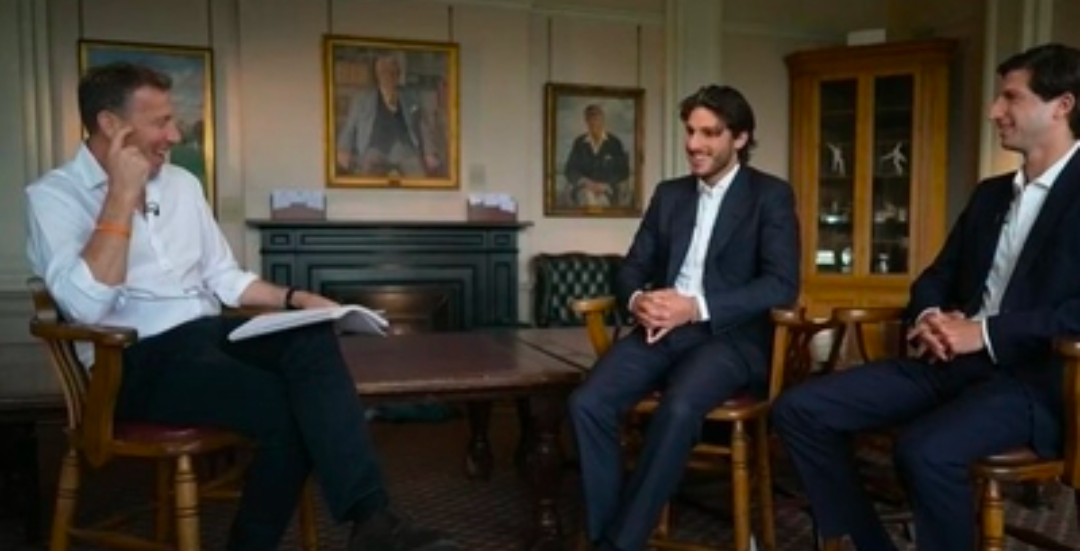
The PCB complaint over Michael Atherton’s interview with Imran Khan’s sons has created an unusual off-field controversy during the Pakistan-England Test at Lord’s. According to ESPNcricinfo, the Pakistan Cricket Board objected to Sky Sports broadcasting an 18-minute conversation between former England captain Michael Atherton and Imran Khan’s sons, Suleiman Khan and Kasim Khan.
The incident unfolded during the opening day of the second Test between Pakistan and England on Thursday. Atherton had recorded the interview at Lord’s on Wednesday, while Sky Sports had also used a preview of the conversation before the Test began. The full interview was ultimately broadcast during the lunch interval, despite reported objections from the PCB.
The dispute was not primarily about cricket. During the conversation, Imran Khan’s sons discussed their father’s health, their concerns about his safety and their efforts to secure appropriate medical treatment for him while he remains imprisoned in Pakistan. The interview therefore brought a highly sensitive political and humanitarian issue into the middle of a major international cricket fixture.
According to the report, the PCB had contacted Sky Sports before the lunch break and warned that Pakistan’s players could potentially refuse to return to the field if the interview was broadcast. The board reportedly considered the possibility of a protest involving the team, although Pakistan did ultimately take the field for the second session.
What happened between the PCB and Sky Sports?
The sequence of events is important because the dispute developed around the timing of the broadcast rather than an incident during play.
Atherton recorded his interview with Suleiman and Kasim at Lord’s on Wednesday. Sky Sports subsequently promoted the conversation ahead of the Test, meaning the broadcaster was already preparing viewers for an interview that was clearly separate from conventional cricket coverage.
Before lunch on the first day, however, the PCB reportedly contacted Sky Sports to object to the planned broadcast. The concern was significant enough that, according to ESPNcricinfo, the board considered whether Pakistan’s players should remain off the field at the beginning of the second session as a form of protest.
Sky Sports initially held back the segment before eventually broadcasting it during the lunch interval.
The result was an unusual situation in which a cricket broadcaster, a national cricket board and the family of one of Pakistan’s most famous sporting figures became connected through a television segment during an international Test match.
Why Michael Atherton interviewed Imran Khan’s sons
The interview needs to be understood in the broader context of concern surrounding Imran Khan’s health while he remains in prison.
Imran is one of the most influential figures in Pakistan cricket history. He captained Pakistan to its first and only men’s Cricket World Cup title in 1992 before moving into politics and eventually becoming Pakistan’s prime minister.
His imprisonment has therefore attracted attention well beyond Pakistan’s political sphere. His sons have become increasingly vocal about his condition and have repeatedly called for access to appropriate medical care.
During Atherton’s interview, Suleiman and Kasim discussed their concerns regarding their father’s health and safety. They also spoke about efforts to ensure that he receives suitable medical attention.
That subject explains why the conversation carried far greater significance than an ordinary pre-match or lunch-break interview. Atherton was not discussing batting techniques, England’s bowling plans or Pakistan’s selection decisions. The discussion concerned the wellbeing of a former Pakistan captain whose sporting legacy remains closely connected to the national identity of cricket in the country.
The interview was not shown on television in Pakistan
Another important detail is that the interview was not broadcast in Pakistan through the television coverage of the Test. The series television rights in Pakistan are held by state broadcaster PTV, meaning viewers in other territories did not necessarily receive the same programming.
This created an unusual split in the broadcast experience. International viewers watching Sky Sports were able to see Atherton’s conversation with Imran Khan’s sons, while the segment was not part of the television coverage available through PTV in Pakistan.
For an international cricket series, differences between broadcasters are normal. What made this situation unusual was that the difference arose around a politically sensitive interview involving a former national captain and prime minister.
PCB reportedly considered a player protest
The most extraordinary aspect of the episode is the reported consideration of a player protest.
According to ESPNcricinfo, the PCB considered whether Pakistan’s players might refuse to return to the field after lunch if the interview was broadcast. Such a move would have been highly unusual in international cricket because a Test match normally continues regardless of disputes surrounding broadcasting content.
Ultimately, Pakistan returned for the second session, meaning the reported possibility did not develop into an on-field protest.
The episode nevertheless demonstrates the level of sensitivity surrounding public discussion of Imran Khan’s health. A disagreement over television programming briefly had the potential to affect the conduct of an international Test match.
Why the Lord’s setting made the moment even more significant
The location also adds historical weight to the story.
Lord’s is one of the most famous cricket grounds in the world and has a deep connection with Imran Khan’s playing career. As an international cricketer, he played some of the most important matches of his career in England, and his status as Pakistan’s 1992 World Cup-winning captain remains central to his sporting legacy.
Having his sons discuss his health at Lord’s therefore created a striking intersection between his cricketing past and his current circumstances.
For many Pakistan supporters, Imran is not simply a former prime minister or political figure. His cricket career helped establish him as a national sporting icon long before he entered politics. An interview about his health taking place at one of cricket’s most historic venues inevitably carries an emotional dimension for followers of the game.
Imran Khan’s medical situation has already attracted international attention
The Atherton interview came after renewed concern about Imran Khan’s medical treatment in custody.
According to the report, Pakistan’s Supreme Court had directed that the former prime minister be admitted to Shifa Hospital in Islamabad. Instead, he was taken to the government-run Pakistan Institute of Medical Sciences for a medical check-up before being returned to prison.
Imran’s sisters and sons have alleged that authorities did not comply with the court’s direction and have continued to call for him to be examined by his own doctor.
The Pakistani government has rejected claims that Imran has been mistreated in prison or denied access to family members and legal representatives. According to comments reported by the Associated Press, the government said Imran had received more than 900 visits from relatives, lawyers and doctors since his imprisonment in August 2023.
These competing claims form the wider backdrop against which Atherton’s interview took place. The interview itself does not resolve the dispute, but it brought the family’s concerns to an international sports audience.
Former international captains have also raised concerns
The issue has also attracted attention from former cricket leaders.
Last week, 21 former international captains, including Atherton, signed a letter addressed to Pakistan Prime Minister Shehbaz Sharif. The letter called for Imran Khan to receive proper medical attention while in custody.
The group reportedly included former captains from India, Australia, England, New Zealand and the West Indies. That international composition is notable because cricket has historically created connections between players from countries that can otherwise have complicated political relationships.
The appeal was also not the first of its kind. According to reports, another letter signed by 14 former international captains was sent in February, with the signatories seeking attention to Imran’s situation.
This broader involvement helps explain why Atherton’s interview attracted attention. He was not approaching the issue as a journalist with no previous connection to the subject. As a former England captain, he belongs to the international cricket community that has already expressed concern about Imran’s treatment.
Atherton’s role makes the interview particularly notable
Michael Atherton occupies a unique position in this story because he has both played international cricket and worked extensively as a cricket journalist and broadcaster.
His playing career included leadership of England, while his post-playing career has involved detailed coverage and analysis of international cricket. That combination gives him a long-standing connection to the sport’s global community.
His involvement also illustrates how former athletes can remain influential after retirement. Atherton’s platform as a broadcaster allowed him to facilitate a conversation that might otherwise have remained largely within political or family circles.
At the same time, the episode demonstrates the challenges broadcasters face when sports coverage intersects with political subjects. Cricket audiences tune in primarily for the match, but major sporting events often become platforms for wider conversations when circumstances demand attention.
Cricket and politics have crossed paths before
The controversy also highlights a reality that international cricket has experienced repeatedly: the sport does not exist in isolation from politics.
Players and teams represent countries, national boards operate within political environments, and major cricket venues can become stages for issues far beyond the boundary rope.
Pakistan cricket has particularly strong links between sport and national public life because several of its most prominent cricketers have later entered politics or become major public figures. Imran Khan is the clearest example.
That history makes it difficult to completely separate his sporting legacy from his political identity. For broadcasters, the challenge is determining how such stories should be handled while maintaining appropriate editorial standards.
What the PCB complaint could mean for cricket broadcasting
The reported dispute raises an important question about the relationship between cricket boards and international broadcasters: how much influence should a national board have over editorial content produced by a broadcaster operating in another country?
Cricket boards control important aspects of tours, including team access, accreditation and commercial arrangements. Broadcasters, meanwhile, have their own editorial responsibilities and audiences.
When coverage involves a politically sensitive subject, those interests can collide.
The Lord’s incident shows how quickly such a disagreement can move beyond an ordinary editorial dispute. The fact that the PCB reportedly considered a possible team protest demonstrates the potential consequences when broadcasting decisions become connected to a national board’s position.
A comparison with normal Test-match controversies
Most disputes during Test cricket concern decisions made on the field, umpiring calls, player conduct, pitch conditions or scheduling. The controversy surrounding Atherton’s interview was fundamentally different.
| Typical Test controversy | Atherton interview dispute |
|---|---|
| Usually connected to events during play | Focused on television content during the lunch interval |
| Often involves players, umpires or match officials | Involved a broadcaster, cricket board and interview subjects |
| Usually has a direct sporting impact | Concerned a wider health and political issue |
| Generally resolved through match authorities | Required discussion between the board and broadcaster |
That difference is what makes the incident stand out. The match itself was not the original source of the controversy, but the controversy had the potential to affect the match.
What happens next?
The PCB had not publicly commented on the incident in the information available at the time of the report. That leaves several questions unanswered, including whether the board will formally explain its objection to the interview or whether the dispute will remain primarily between the PCB and Sky Sports.
The wider issue surrounding Imran Khan’s health is likely to continue attracting attention regardless of the cricket broadcast controversy. His family remains vocal about his medical treatment, while Pakistan’s government has disputed claims that he has been denied appropriate care.
For cricket, the immediate focus should return to the Test itself. Yet the incident is unlikely to disappear completely because it illustrates how closely sport, media and public affairs can become intertwined when a figure as prominent as Imran Khan is involved.
Conclusion: A cricket lunch break became a much bigger story
The PCB complaint over Michael Atherton’s interview with Imran Khan’s sons has created an extraordinary moment during the Pakistan-England Test at Lord’s. What began as an interview during a lunch interval reportedly became serious enough for the PCB to consider whether Pakistan’s players should protest by delaying their return to the field.
The interview focused on Suleiman and Kasim Khan’s concerns about their father’s health, safety and access to medical treatment. It came amid continuing disagreement between Imran Khan’s family and Pakistani authorities over his condition and medical care.
For cricket fans, the episode is a reminder that international sport often reflects the wider world around it. The boundary between cricket coverage and major public issues can become blurred, particularly when a former world champion and national sporting icon is at the centre of the discussion.
The reported dispute between the PCB and Sky Sports may ultimately remain a broadcasting disagreement, but its timing and potential impact on the Test have made it one of the most unusual off-field developments surrounding Pakistan cricket in recent times.
For breaking news and live news updates, like us on Facebook or follow us on Twitter and Instagram. Read more on Latest Cricket on thefoxdaily.com.






COMMENTS 0