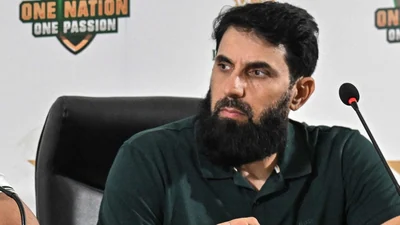
Misbah-ul-Haq resignation has added another layer to Pakistan Cricket‘s growing uncertainty after the Pakistan Cricket Board made extraordinary changes in the middle of the Test series against England. The former Pakistan captain has reportedly offered to step down from the men’s national selection committee and has also decided to leave his role as a batting consultant at the National Cricket Academy in Lahore.
The PCB has not yet formally accepted Misbah’s resignation, meaning he remains officially part of the selection committee for now. However, his decision comes at a particularly sensitive moment, with Pakistan already 2-0 down in the three-match Test series after a 194-run defeat at Lord’s.
The board’s response has been unusually aggressive. Seven players were released from the touring squad, Test head coach Sarfaraz Ahmed and bowling coach Umar Gul were removed from their positions, and several uncapped players were called up ahead of the final Test at Edgbaston beginning on September 9.
That makes the situation much bigger than one former captain considering his exit. Pakistan’s cricket administration is effectively attempting to reshape its Test structure while a series is still in progress.
Why did Misbah-ul-Haq offer to resign?
The precise reason for Misbah’s decision has not been publicly established by the PCB. What is clear is that his resignation offer arrived immediately after one of the most significant mid-series interventions in Pakistan’s recent Test cricket setup.
Misbah had been part of a four-member national selection committee since March, working alongside Aaqib Javed, Sarfaraz Ahmed and Asad Shafiq. The committee therefore had an important role in determining the composition of Pakistan’s national squads.
His decision to step away comes as the PCB has taken direct action over the Test team’s poor results. While it would be incorrect to claim that Misbah resigned because of any specific selection decision without confirmation, the timing makes his move an important part of the wider administrative story.
Pakistan’s England tour has triggered a major reset
The immediate sporting trigger was Pakistan’s loss at Lord’s. The 194-run defeat gave England an unassailable 2-0 lead in the three-Test series and left Pakistan facing a final match with little chance of changing the series result.
Instead of treating the Edgbaston Test as a conventional dead rubber, the PCB has turned it into an opportunity for a major reset.
Seven players were released from the touring squad:
- Mohammad Rizwan
- Imam-ul-Haq
- Salman Agha
- Ali Usman
- Aamer Jamal
- Awais Zafar
- Khurram Shahzad
The board also removed Sarfaraz Ahmed as Test head coach and Umar Gul as bowling coach. Such a broad intervention during an ongoing overseas series sends a strong message that the PCB believes the problems extend beyond individual match performances.
Five uncapped players arrive as Pakistan changes direction
The overhaul has also opened the door for a group of players without Test experience. Arafat Minhas, Mohammad Imran Jnr, Saad Baig, Mohammad Imran Randhawa and Razaullah have been summoned to England.
Saim Ayub and Abdullah Fazal have also been added to the Test squad.
The selection of several uncapped players creates an interesting contrast. Pakistan is trying to address poor results while simultaneously asking inexperienced players to step into one of the most demanding environments in international cricket.
That strategy can work if the players are introduced within a clear long-term plan. It becomes risky if selection is driven mainly by frustration with recent results.
The coaching structure has also been reshaped
The changes are not limited to the playing group. Mike Hesson and Ashley Noffke, who have been working with Pakistan’s white-ball setup as head coach and bowling coach respectively, have now joined the Test coaching group.
This move effectively brings personnel from Pakistan’s limited-overs structure into the Test environment at a crucial stage of the England tour.
There is a potential advantage to this approach: coaches already familiar with the wider Pakistan setup can provide continuity while new players enter the squad. But there is also a challenge. Test cricket requires a different preparation cycle from white-ball cricket, particularly when players are operating in English conditions.
The final Test will therefore offer an early indication of whether the reshaped coaching structure can provide clarity or whether the changes create even more uncertainty.
Why Misbah’s departure would matter
Misbah is not simply another former Pakistan player. He has occupied several influential positions within Pakistan cricket since retiring from international cricket in 2017.
In 2019, he became Pakistan’s head coach and chief selector, combining two of the most powerful roles in the national setup. He later relinquished the chief selector position in October 2020 and remained focused on coaching before stepping down as head coach in 2021.
His involvement with the PCB resumed in 2023, when he was brought in as an adviser during Zaka Ashraf’s tenure. He subsequently remained involved under the administration that took charge in 2024.
More recently, Misbah was appointed as one of the mentors for the men’s Champions Cup before that competition was discontinued. He also remained connected to domestic cricket and worked with Pakistan’s women’s teams within the domestic structure.
His experience therefore spans selection, coaching, mentoring and player development. Losing that experience at the same time as the Test setup is being reconstructed would represent another significant change for Pakistan.
Misbah’s dual role made his position particularly important
Misbah was not only serving on the national selection committee. He was simultaneously working as a batting consultant at the National Cricket Academy under a contract that required him to work with the PCB for 180 days each year.
His decision to step down from that assignment as well suggests that his latest move could be broader than simply leaving the selection committee.
If the PCB accepts both resignations, Pakistan would lose an experienced figure from two different parts of its cricketing structure at once.
That matters because one of the biggest challenges for any national cricket board is maintaining institutional knowledge. Coaches and selectors change, but the lessons from previous cycles can help prevent the same mistakes from being repeated.
Pakistan’s bigger problem is structural, not just tactical
The England series has exposed a problem that cannot necessarily be solved by changing seven players or replacing two coaches.
Test cricket requires long-term planning. A successful Test team needs a stable batting order, a dependable bowling attack, strong fitness standards, specialist preparation and a clear pathway from domestic cricket to international cricket.
Constant changes can make it difficult for players to understand what is expected of them.
This is where the PCB’s current strategy faces its biggest test. If the overhaul is part of a clearly designed rebuilding programme, introducing new players and coaches can be justified. If it is simply a reaction to a poor series, Pakistan could find itself repeating the cycle of frequent changes without solving the underlying problems.
What the Edgbaston Test now represents
Under normal circumstances, the third Test would be viewed primarily as Pakistan’s final opportunity to avoid a 3-0 series defeat.
Now it has a different significance.
The Edgbaston Test will provide the first competitive look at the new combination of players and coaching personnel. It will also show whether Pakistan’s decision-makers have a coherent plan for the next phase of Test cricket.
The result will matter, but performance indicators may be even more revealing. How do the new players respond to pressure? Does the batting unit show greater stability? Are bowling plans clearer? Does the team appear better prepared for long periods of Test cricket?
Those answers will tell Pakistan more than the final score alone.
Selection is now under the microscope
Misbah’s position on the selection committee makes the current situation particularly interesting.
Whenever a national team undergoes a major overhaul, the selection process comes under intense scrutiny. Pakistan now has to balance immediate performance with long-term development.
Experienced players can provide stability, while uncapped players can inject energy and fresh ideas. The challenge is finding the correct combination rather than automatically replacing one group with another.
The inclusion of five uncapped players suggests the PCB is willing to take significant risks. The success of that strategy will depend on whether those players are given sufficient support and realistic expectations.
A comparison with Pakistan’s previous rebuilding cycles
Pakistan cricket has repeatedly gone through periods in which disappointing results have been followed by changes in leadership, selection and coaching. The difficulty has often been maintaining continuity after the initial reset.
A rebuilding process works best when everyone understands the destination. Changing personnel is only one part of the equation; the board also needs a consistent playing philosophy and a clear development pathway.
The current overhaul therefore presents both an opportunity and a warning.
If the PCB uses the England tour as the starting point for a structured Test rebuild, the disruption could eventually prove worthwhile. If changes continue every time results turn negative, players and coaches may struggle to build the stability required for sustained success.
What happens if Misbah leaves?
If the PCB accepts Misbah’s resignation, the immediate consequence would be another vacancy within the selection structure. The board would then need to determine whether to replace him directly or further reorganise the selection committee.
His departure from the National Cricket Academy would create a separate loss of experience in player development and batting support.
However, the larger consequence could be symbolic. Misbah represents a link between Pakistan’s previous generation and its current administrative structure. His exit would underline just how extensively the PCB is changing its approach to the national team.
The biggest question for PCB is what comes next
It is easy to focus on the dramatic nature of the current changes. Seven players sent home, coaching positions altered and a former captain offering his resignation naturally dominate the headlines.
But the more important question is whether these decisions produce better cricket.
The PCB now needs to establish clear selection criteria, give the new coaching group enough time to work and develop a pathway for emerging players. It also needs to communicate its strategy clearly so that changes do not appear disconnected from one another.
The board has effectively pressed the reset button. The next challenge is proving that the reset has a destination.
Conclusion: Misbah’s resignation adds another layer to Pakistan’s Test crisis
Misbah-ul-Haq’s resignation offer has arrived at a time when Pakistan cricket is already undergoing one of its most significant Test-team shake-ups in recent years. The PCB has responded to a 2-0 series deficit against England with changes to the playing group, coaching staff and broader structure.
For now, Misbah remains officially part of the selection committee because the PCB has not accepted his resignation. But his decision to step away from his batting consultant role as well could signal a wider departure from the board’s current setup.
The Edgbaston Test will now be about far more than avoiding a series whitewash. It will be the first test of Pakistan’s new direction, with unfamiliar players, altered coaching personnel and major questions surrounding the selection structure.
The real measure of this overhaul will not be one match. It will be whether Pakistan can turn the current turmoil into a stable system capable of producing competitive Test cricket over the next several years.
For breaking news and live news updates, like us on Facebook or follow us on Twitter and Instagram. Read more on Latest Cricket on thefoxdaily.com.






COMMENTS 0