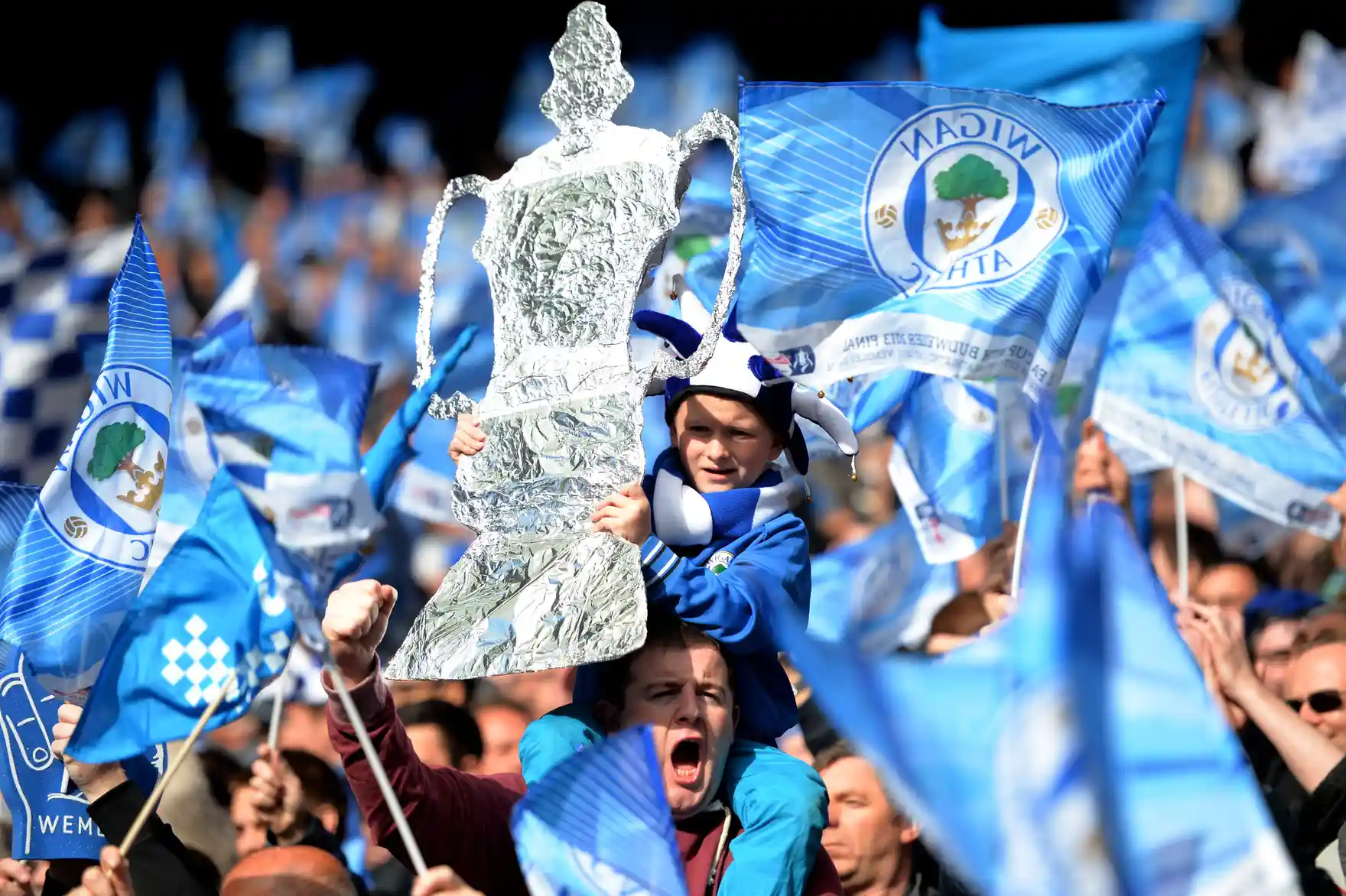
Wigan Athletic’s famous FA Cup triumph in 2013 remains one of the most cherished moments in the club’s history, but the present reality is a long way from those Wembley celebrations. A hard-fought 1-0 victory over Reading offered manager Gary Caldwell a welcome moment of relief, yet the Latics remain bottom of League One, with financial uncertainty, disappointing performances and questions over the club’s ownership continuing to cloud their future.
Scott Hogan’s 71st-minute goal secured only Wigan’s second league victory of the campaign, ending a frustrating run without a goal and providing a much-needed psychological boost. However, one result cannot resolve the deeper problems facing a club that has struggled to establish stability despite several seasons under its current ownership.
Caldwell, who captained Wigan during their historic FA Cup success against Manchester City in 2013, has returned to the club with hopes of rebuilding a competitive team. Yet his second spell as manager has quickly become a difficult assignment, with limited resources, an inexperienced squad and growing frustration among supporters making progress increasingly challenging.
The victory against Reading provided evidence that Wigan still possess the determination to fight, but their position at the bottom of the table means the immediate priority remains survival. With the threat of relegation to League Two becoming increasingly real, the club needs far more than a brief return to winning ways to escape its current predicament.
Wigan’s Famous FA Cup Triumph Feels Like a Distant Memory
For Wigan supporters, the 2013 FA Cup final remains a defining moment in the club’s history. Under Roberto Martínez, the Latics defeated Manchester City 1-0 at Wembley, with Ben Watson scoring a dramatic late winner to secure one of the most memorable upsets in English Football.
Manchester City, backed by Sheikh Mansour’s investment, were building towards sustained dominance of the domestic game. Wigan, meanwhile, were a club fighting to establish themselves among England’s elite. Their victory demonstrated the unpredictability of cup football and provided supporters with a memory that continues to outshine much of what has followed.
The triumph was particularly remarkable because Wigan were relegated from the Premier League at the end of the same season. Their FA Cup success offered a glorious conclusion to a campaign that ultimately ended in disappointment in the league.
More than a decade later, the contrast between that historic achievement and the club’s current situation is stark. Wigan are now battling at the bottom of League One, struggling to score goals and facing the possibility of dropping into the fourth tier of English football for the first time since the 1996-97 season.
The club’s supporters have every reason to remember the Wembley triumph with pride, but nostalgia cannot compensate for the problems confronting the modern team. The immediate challenge is no longer competing with Manchester City’s finest players in a cup final. It is finding a way to climb away from the bottom of the third division.
That contrast makes Caldwell’s return particularly significant. As captain during the FA Cup-winning campaign, he represents a direct connection to the club’s greatest achievement. His task now is to use that connection and his managerial experience to restore confidence at a club that urgently needs a new sense of direction.
Gary Caldwell Faces a Difficult Rebuilding Job
Caldwell returned to Wigan last season for a second spell as manager after previously guiding the club to promotion from League One during the 2015-16 campaign. His decision to leave Exeter City and return to Greater Manchester was viewed as a significant move, particularly given the financial restrictions imposed on the club by owner Mike Danson.
The former centre-back understands the club’s culture and has experience of delivering success in difficult circumstances. However, the conditions surrounding his latest appointment have made the challenge considerably more complicated than simply rebuilding the team on the pitch.
Wigan’s budget is extremely limited, and the manager has been unable to make the kind of investment that might be expected from a club seeking promotion. The squad has relied heavily on young loan players, while the money generated by the sale of goalkeeper Sam Tickle to Bristol City has not yet been reinvested in the playing staff.
The reported £1.5 million generated by Tickle’s departure could have provided valuable resources for strengthening several areas of the team. Instead, Caldwell has been left attempting to improve results with a squad that lacks depth and has struggled to produce consistent attacking performances.
Supporters have also criticised the team’s style of play. Wigan’s inability to create and convert chances has become a major concern, with the club scoring just six goals in its first nine league matches, the lowest total in League One over that period.
Those attacking difficulties have intensified pressure on Caldwell. While the manager’s supporters argue that his limited resources should be taken into account, fans understandably expect to see progress on the pitch, particularly when the team is struggling at the bottom of the standings.
The victory over Reading gave Caldwell a temporary reprieve, but the manager knows that his players must build on the result rather than treat it as a turning point in itself. Wigan need a sustained improvement in performance and results if they are to move away from the relegation zone.
Scott Hogan Ends Wigan’s Frustrating Goal Drought
Wigan’s 1-0 victory over Reading was decided by Scott Hogan’s 71st-minute strike, a goal that ended a miserable run in front of goal and gave the home supporters something to celebrate.
The Latics had gone 447 minutes without scoring in league football, a statistic that reflected the extent of their attacking problems. For a team already struggling to collect points, such a prolonged drought placed additional pressure on the defence and left little margin for mistakes.
The breakthrough came after substitute Christian Saydee delivered a cross that Reading goalkeeper Joel Pereira could only parry into a dangerous area. Hogan reacted to the loose ball and converted, giving Wigan the lead they had been desperate to find.
It was a crucial moment for the veteran forward and for a team that had struggled to turn promising attacking situations into goals. The strike rewarded Wigan’s persistence and provided a much-needed boost to their confidence.
However, the final stages were far from comfortable. Goalkeeper Joe Whitworth was called into action repeatedly as Reading attempted to find an equaliser, forcing Wigan to defend their narrow advantage under pressure.
The home side ultimately held on, earning three valuable points despite the tension that accompanied the closing minutes. Their performance demonstrated a willingness to battle for the result, even when the game threatened to slip away.
Caldwell was pleased with the determination shown by his players and praised the quality of some of their attacking play. He also acknowledged that significant improvements remained necessary.
“Our spirit, our character, our determination not to let the ball go in the net was fantastic,” Caldwell said after the victory.
The manager’s comments reflected the importance of the result beyond the league table. Wigan needed a win to restore some belief within the squad and give supporters a reason to leave the stadium feeling more positive.
Nevertheless, the team’s position remains precarious. A single victory cannot erase the problems that led to their poor start, and Caldwell must now find ways to make performances like the one against Reading more frequent.
Financial Uncertainty Continues to Define Wigan’s Future
Wigan’s struggles cannot be understood solely through their performances on the pitch. Financial uncertainty has been a defining feature of the club’s recent history, and the current ownership has struggled to provide the investment needed to move the team forward.
Mike Danson and his family rescued Wigan from liquidation in June 2023 after serious mismanagement under previous owners left the club facing a financial crisis. The consequences included a points deduction and relegation from the Championship.
The takeover provided a measure of stability after a period of considerable uncertainty. Wigan were able to continue operating, rebuild their squad and establish themselves in League One, where they recorded three consecutive mid-table finishes.
Those campaigns offered some hope that the club could recover gradually. However, the current season has exposed the limitations of that progress, with Wigan falling to the bottom of the division despite the relative stability of recent years.
Danson, a local businessman, has been keen to sell the club, but finding an ambitious buyer willing to take Wigan to the next level has proved difficult. The lack of a new owner has left the club in an uncomfortable position, unable to make the kind of investment that might accelerate its recovery.
Financial restrictions have affected recruitment, while dwindling attendances have further limited the club’s income. Poor performances have made it harder to persuade supporters to return regularly, creating a difficult cycle in which declining results and reduced revenue reinforce one another.
The club’s hierarchy has appealed to fans to return to the Brick Community Stadium, arguing that stronger attendance figures would generate additional income and potentially make Wigan more attractive to prospective buyers.
However, supporters have their own concerns. Many are reluctant to spend their hard-earned money watching a team that has scored so few goals and struggled to produce entertaining football.
The challenge for Wigan’s leadership is to convince supporters that their backing can contribute to a brighter future, while recognising that the team must provide better performances if it expects attendances to improve.
Supporters Demand Answers Over the Proposed Sale
Frustration among Wigan supporters extends beyond the results on the pitch. Questions about the ownership, recruitment strategy and lack of investment have become increasingly prominent as the team struggles to escape the bottom of League One.
The Wigan Athletic Supporters Action Group has called on Danson to explain why selling the club has proved so difficult and why the team has not received greater investment.
For many fans, a change of ownership represents the most realistic route towards a more ambitious future. A new investor with sufficient resources could strengthen the squad, improve the club’s financial position and provide a clearer long-term plan.
Others recognise that the recovery may require patience and that the club’s financial problems cannot necessarily be resolved overnight. After the damage caused by previous mismanagement, rebuilding a sustainable organisation may involve short-term sacrifices.
Despite those differences, there is broad agreement that Wigan need a clearer direction. Supporters want to understand the owners’ intentions and whether there is a realistic plan to improve the club’s competitiveness.
The uncertainty has been compounded by changes within the club’s leadership. Sarah Guilfoyle left her position as managing director on the eve of the new season after spending a decade at Wigan.
Her abrupt departure added to the sense of instability surrounding the organisation. While the reasons behind the wider difficulties extend beyond any single executive, the timing of the exit raised further questions about the club’s internal direction.
For Caldwell, the situation presents a difficult balancing act. He must keep the players focused on their performances while dealing with the consequences of decisions made above him.
The manager cannot resolve the ownership question or create a larger transfer budget himself. He can, however, attempt to improve results and restore enough confidence to give the club a stronger platform from which to address its wider challenges.
Leam Richardson’s Return Brings Back Memories of Better Days
The Reading match also carried an emotional subplot, with Leam Richardson in the visitors’ dugout. Richardson previously managed Wigan and guided the club to the League One title in April 2022, helping the Latics secure promotion from the third tier.
His return inevitably reminded supporters of a period when Wigan had a clearer sense of progress and a team capable of delivering meaningful success.
Richardson’s departure from the club had been abrupt. He was dismissed in November 2022, just 16 days after signing a new three-year contract, an episode that became another example of the instability that has affected Wigan in recent years.
His presence at the Brick Community Stadium provided a contrast between the club’s recent achievements and its current struggle. Promotion in 2022 had offered hope that Wigan could rebuild their position in the English football pyramid, but subsequent events prevented that progress from becoming a sustained upward trajectory.
For supporters, the memories of Richardson’s title-winning campaign and Caldwell’s role in the 2013 FA Cup triumph offer reminders of what Wigan can achieve when circumstances align.
However, neither past success nor familiar faces can substitute for a coherent plan to improve the current team. The club needs to build a squad capable of competing consistently, while also addressing the financial and organisational problems that continue to restrict its progress.
Relegation Fears Grow as Wigan Remain Bottom of League One
Despite the victory against Reading, Wigan remain at the foot of League One, and the possibility of relegation to League Two is becoming increasingly difficult to ignore.
A drop into the fourth tier would represent another significant setback for a club that has experienced the Premier League, won the FA Cup and enjoyed periods of success in the Championship and League One.
The threat is particularly concerning because Wigan’s problems extend beyond a temporary loss of form. Their limited scoring output, lack of investment and uncertainty over ownership suggest that the team may struggle to recover unless several issues are addressed simultaneously.
Hogan’s goal provided a welcome breakthrough, but Wigan must now demonstrate that they can score more regularly and turn competitive performances into points.
The defence also needs to remain organised. Whitworth’s contribution against Reading was important, but relying on the goalkeeper to make repeated saves is unlikely to provide a sustainable route away from the bottom of the table.
Wigan need to find a better balance between attacking ambition and defensive stability. Their players must create more opportunities while maintaining the concentration required to protect narrow leads.
Caldwell has acknowledged that there are still numerous aspects of the team’s game that need improvement. His immediate challenge is to turn the determination displayed against Reading into a consistent pattern of performances.
Every point will matter as the season progresses, particularly if the teams around Wigan begin to establish a gap. The Latics cannot afford to treat the Reading victory as a solution to their problems; it must serve as a foundation for further progress.
Gary Caldwell Needs More Than One Victory to Revive Wigan
The 1-0 win over Reading offered Caldwell a much-needed moment of relief and gave Wigan supporters a rare reason to celebrate. Hogan’s late strike ended the club’s goal drought, while the team’s determination in the closing stages demonstrated that the players remain committed to fighting for results.
Yet the broader picture remains deeply concerning. Wigan are still bottom of League One, their squad has been weakened by financial restrictions, and uncertainty surrounding the ownership continues to limit the club’s ambitions.
Caldwell’s connection to the 2013 FA Cup triumph gives him a special place in the club’s history, but his current responsibility is far removed from celebrating a famous Wembley victory. He must now help Wigan avoid a slide into the fourth tier while working within the constraints imposed by the club’s financial situation.
The manager’s supporters will argue that he deserves time and resources to improve the team. His critics, meanwhile, will continue to demand more convincing football and a stronger return from a squad that has struggled badly in front of goal.
Both perspectives reflect the difficult circumstances facing Wigan. The team needs better results, but meaningful progress will be harder to achieve without greater stability and a clearer plan for the future.
A successful sale could transform the club’s prospects, providing the investment and ambition needed to rebuild the squad and reconnect with supporters. Until that happens, Caldwell must attempt to create progress on the pitch despite the limitations beyond his control.
For now, Wigan’s victory over Reading is a welcome step rather than a turning point. The result has restored some confidence, but the Latics remain in danger, and their immediate future depends on whether they can build a sustained run of improved performances.
The memories of 2013 remain powerful, offering a reminder that Wigan have achieved extraordinary things before. But the club cannot rely on nostalgia to escape its present difficulties. Caldwell and his players must now find a way to turn one important victory into the beginning of a genuine recovery, while the ownership works to provide the stability that Wigan Athletic desperately needs.
For breaking news and live news updates, like us on Facebook or follow us on Twitter and Instagram. Read more on Latest Football on thefoxdaily.com.


COMMENTS 0