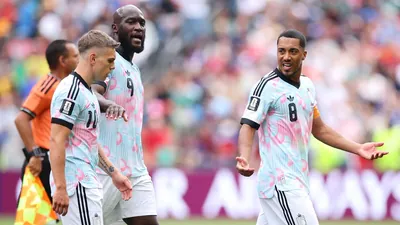
Youri Tielemans and Leandro Trossard World Cup argument became one of the most talked-about moments of the FIFA World Cup 2026 after the Belgian teammates were involved in a heated on-field confrontation during their Round of 32 clash against Senegal. What initially looked like a sign of frustration and internal tension ultimately transformed into a powerful symbol of Belgium’s resilience as the Red Devils produced a sensational comeback from two goals down to secure a dramatic 3-2 victory.
In modern football, visible disagreements between teammates often trigger concerns about dressing-room harmony. Yet Belgium’s extraordinary turnaround against Senegal has highlighted an important truth about elite competition: passion and conflict do not always signal division. Sometimes they reveal a team that refuses to accept defeat.
The incident involving Tielemans and Trossard has therefore become far more than a viral World Cup moment. It offers insight into the psychology of elite athletes competing under immense pressure on football’s biggest stage.
What Happened Between Tielemans and Trossard?
The confrontation occurred during a second-half hydration break while Belgium were trailing Senegal 2-0.
At that point, the match appeared to be slipping away from the European side.
Senegal had controlled large portions of the contest and looked on course to secure one of the biggest victories of the knockout stage. Belgium, meanwhile, seemed frustrated, disjointed, and increasingly desperate for answers.
As players gathered during the break, tensions boiled over.
Tielemans and Trossard exchanged angry words before the disagreement escalated into a heated confrontation that required intervention from teammates. Romelu Lukaku and Nicolas Raskin stepped in to separate the pair, preventing the situation from becoming even more dramatic.
Television cameras captured the exchange, and within minutes the images were spreading across social media platforms worldwide.
For many observers, it appeared to be a sign that Belgium’s World Cup campaign was unraveling.
What happened next completely changed the narrative.
From Internal Frustration to World Cup Inspiration
Football is often defined by momentum shifts, and Belgium experienced one of the most remarkable reversals of the tournament.
Trailing by two goals late in the match, they suddenly found renewed energy.
Romelu Lukaku ignited the comeback with a crucial goal in the closing stages, giving Belgium hope when elimination seemed inevitable.
Moments later, an even more symbolic moment arrived.
Trossard delivered a dangerous cross into the penalty area, and Tielemans rose to head home the equalizer.
The significance was impossible to ignore.
The two players who had been involved in a furious argument only minutes earlier combined to rescue Belgium’s World Cup hopes.
In a striking display of professionalism, Tielemans celebrated by lifting Trossard into the air, instantly creating one of the tournament’s most memorable images.
It was a reminder that elite athletes can separate emotional moments from their collective objective.
Youri Tielemans Delivers When Belgium Needed Him Most
While the confrontation attracted headlines, Tielemans’ footballing contribution ultimately proved even more important.
The midfielder not only scored the equalizer but also converted the decisive penalty deep into extra time to complete Belgium’s comeback.
His performance demonstrated why he remains one of Belgium’s most influential players.
Throughout his international career, Tielemans has been valued for his composure, technical quality, and ability to influence matches in crucial moments.
Against Senegal, he showcased all those qualities.
The ability to recover mentally after such an emotional confrontation and then produce match-defining contributions reflects the mentality required to succeed at the highest level.
Why Heated Arguments Happen in Elite Football
One unique angle often overlooked in discussions surrounding player confrontations is that disagreements are not necessarily signs of dysfunction.
In elite sport, emotional intensity is unavoidable.
Players compete under enormous pressure while carrying the expectations of teammates, coaches, supporters, and entire nations.
When results are slipping away, frustration can emerge.
Several factors contribute to these moments:
- High-pressure environments
- Competitive personalities
- Tactical disagreements
- Communication breakdowns
- Desire to improve performance immediately
The key difference between successful teams and struggling ones is often how they respond after such incidents.
Belgium’s reaction was exemplary.
Tielemans’ Response Reveals a Winning Mentality
After the match, Tielemans addressed the incident with notable maturity.
Rather than escalating the story or assigning blame, he emphasized the emotional nature of knockout football.
His comments reflected a broader understanding of elite competition.
Great teams are rarely built on complete agreement. Instead, they are often united by a shared commitment to winning.
When players care deeply about results, emotions can occasionally spill over.
The important factor is whether those emotions become destructive or productive.
Against Senegal, Belgium transformed frustration into motivation.
Leandro Trossard’s Crucial Role Often Goes Unnoticed
While Tielemans scored the decisive goals, Trossard’s contribution deserves equal recognition.
The Belgian winger has quietly emerged as one of the tournament’s most creative players.
His assist for the equalizer demonstrated his quality in crucial moments, while his overall creative output has consistently troubled opposing defenses.
In many ways, the incident and subsequent comeback highlighted Trossard’s importance to Belgium.
Rather than allowing emotions to affect his performance, he continued creating opportunities and influencing the match positively.
That ability to refocus under pressure is a hallmark of elite competitors.
Rudi Garcia’s Reaction Offers Valuable Insight
Perhaps the most revealing response came from Belgium head coach Rudi Garcia.
Instead of criticizing his players, Garcia interpreted the incident as evidence of competitive hunger.
His perspective reflects a common view among experienced coaches.
Passion, when properly managed, can become a powerful asset.
Garcia recognized that his players were not arguing because they lacked commitment. They were arguing because they desperately wanted to avoid elimination.
This distinction is important.
Many successful teams throughout sporting history have featured strong personalities capable of challenging one another during difficult moments.
The defining characteristic is their ability to move forward together afterward.
The Tactical Turning Point Behind Belgium’s Comeback
Beyond the emotional storyline, Belgium’s recovery was also driven by significant tactical improvements.
After struggling to create clear opportunities for much of the match, they became more aggressive in attack during the closing stages.
Several factors contributed to the turnaround:
| Factor | Impact |
|---|---|
| Romelu Lukaku’s introduction | Added physical presence and finishing threat |
| Improved wing play | Created crossing opportunities |
| Higher pressing intensity | Forced Senegal into mistakes |
| Greater urgency | Increased attacking momentum |
| Creative influence of Trossard | Generated key chances |
The combination of tactical adjustments and renewed determination transformed the contest.
Why This Match Could Define Belgium’s Tournament
Every successful World Cup campaign contains a defining moment.
For Belgium, the comeback against Senegal could become exactly that.
Championship-caliber teams often survive matches they appear destined to lose. Those experiences build confidence, strengthen belief, and create momentum.
The manner of Belgium’s victory may ultimately prove more valuable than a comfortable win would have been.
Players now know they can recover from adversity, overcome internal frustration, and deliver under immense pressure.
Those lessons become increasingly important as tournaments progress.
Round of 16 Challenge Against the United States
Belgium’s reward for their dramatic victory is a Round of 16 showdown against the United States.
The Americans arrive with confidence after defeating Bosnia and Herzegovina and have shown throughout the tournament that they possess the athleticism and organization to challenge elite opponents.
However, Belgium will take encouragement from their resilience.
The comeback demonstrated that even when performances fall below expectations, they possess enough quality and character to find solutions.
Matches at this stage of the World Cup are often decided by fine margins, and Belgium’s experience against Senegal could provide a valuable psychological advantage.
What This Incident Reveals About Modern Football
The Tielemans-Trossard confrontation highlights an important reality of modern football.
Supporters often expect elite athletes to display perfect composure at all times.
The reality is far more complex.
World Cup football is emotional, unpredictable, and intensely demanding. Players experience frustration, pressure, and disappointment just like anyone else.
What separates great teams is not the absence of conflict but the ability to channel those emotions effectively.
Belgium provided a textbook example of that principle.
Future Outlook: Can Belgium Build on This Momentum?
Momentum is one of the most powerful forces in tournament football.
Belgium now faces a critical opportunity.
If they can build on the confidence gained from their comeback victory, they could emerge as one of the tournament’s most dangerous dark horses.
The squad possesses experience, attacking quality, and players capable of producing decisive moments.
Most importantly, they have demonstrated resilience.
Teams that survive adversity often become stronger because of it.
The challenge now is ensuring that the emotional energy generated by the Senegal victory translates into sustained performances throughout the knockout rounds.
Conclusion
The Youri Tielemans and Leandro Trossard World Cup argument initially appeared to be a story about frustration and tension. Instead, it evolved into a story about resilience, professionalism, and competitive spirit.
Belgium’s dramatic comeback against Senegal showcased the emotional intensity that defines knockout football while proving that disagreements do not necessarily weaken a team. In this case, they may have strengthened it.
Tielemans’ equalizer and match-winning penalty, combined with Trossard’s crucial assist, transformed a moment of conflict into a symbol of unity and determination.
As Belgium prepares for its Round of 16 clash against the United States, the comeback victory may be remembered as the moment their FIFA World Cup 2026 campaign truly came alive.
For breaking news and live news updates, like us on Facebook or follow us on Twitter and Instagram. Read more on Latest Sports on thefoxdaily.com.






COMMENTS 0