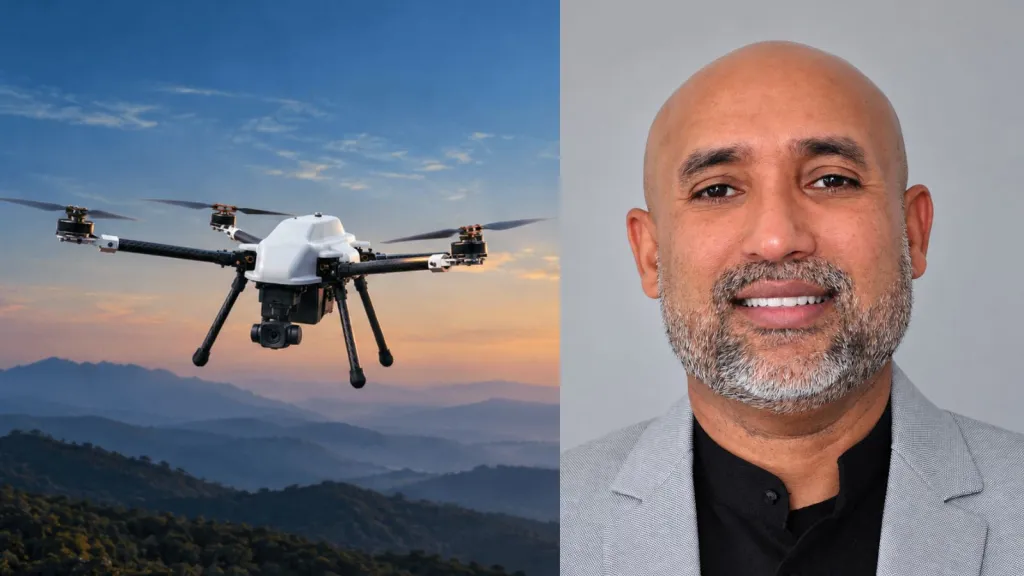
From starting out with a borrowed desk in Kerala to developing surveillance drones for the Indian Army and powering RFID-based merchandise checkout systems at New York’s Madison Square Garden, AXL Systems has built an unusual technology business with roots in India and customers overseas. The Kochi-based company has grown from a small consulting firm into a research and development organisation employing more than 150 people, with expertise spanning defence technology, electronics, radio frequency identification (RFID) and artificial intelligence (AI).
Founded around 2013, AXL Systems took a different path from many Indian technology startups that establish themselves in established technology hubs such as Bengaluru or Pune. Its founders began working wherever they could find space, gradually building a company focused on developing proprietary technology rather than relying exclusively on software services.
Today, the company’s operations cover two distinct areas: surveillance drones developed in collaboration with the Indian Army and RFID systems designed to make retail transactions faster and improve merchandise tracking. Although these businesses serve very different customers, both emerged from a similar approach to innovation: identifying practical problems and developing hardware and software to solve them.
For chief executive Joe Kuncharia, the journey reflects the challenges of building a technology company outside India’s largest startup ecosystems, where access to specialised talent and components can be difficult. It also demonstrates how a company based in Kerala can develop products for demanding domestic and international markets.
How AXL Systems Started in Kerala
AXL Systems began with modest resources. Recalling the company’s early days, Kuncharia described three people working together in a corner of somebody else’s office. The founders did not initially have an office of their own, and their immediate priority was finding a place where they could work together.
Rather than moving to a major technology centre, the team established its business in Kerala and built its operations from there. The company initially concentrated on consulting and served a small group of customers in Europe and the United States.
AXL became a public limited company in 2015, marking an important stage in its development. In its early years, much of its work involved integration projects for large independent software vendors. These assignments helped the company develop technical capabilities and establish customer relationships before it expanded into proprietary hardware and more specialised products.
Kuncharia believes that developing a product is only one part of building a sustainable technology business. Maintaining it over time can be considerably more challenging, particularly when customers depend on equipment that must perform reliably in demanding environments.
That emphasis on long-term reliability would later become important in both of AXL’s major businesses. Surveillance drones need integrated electronics and dependable flight systems, while RFID checkout equipment must read merchandise tags quickly enough to handle busy retail environments.
AXL’s evolution from consulting to research and development was therefore not simply a change in the products it sold. It represented a shift towards designing and controlling more of the underlying technology, allowing the company to address problems that could not always be solved by combining existing off-the-shelf components.
The Advantages and Challenges of Building a Technology Company in Kerala
Operating from Kerala has given AXL Systems certain advantages, but it has also introduced practical challenges. Kuncharia said that many employees live relatively close to the company’s workplace, with most commuting in less than 30 minutes. Shorter commutes can make collaboration easier and help create an environment where employees can work closely together.
However, the location presents difficulties when the company needs specialised engineers or components quickly. Compared with major technology centres and manufacturing hubs, Kerala can have a smaller pool of candidates for highly specialised technical roles.
Kuncharia said that finding an engineer in Bengaluru might take a couple of weeks, whereas a similar search in Kerala could take two to three months. Recruiting five people, he added, could take at least eight months.
These delays matter for a company developing complex hardware. Research and development teams need people with expertise in areas such as electronics, embedded systems, communications and mechanical engineering. A shortage of suitable candidates can slow product development even when a company has identified a clear market opportunity.
Supply-chain logistics create another obstacle. Kuncharia contrasted the speed of obtaining components in the United States, where some parts can arrive the next day, with the delays AXL encounters when sourcing equipment in India. Overseas shipments may reach major logistics centres such as Bengaluru, Mumbai or Chennai before moving closer to the company.
For a business that develops and tests physical products, these delays can affect schedules, prototyping and the ability to respond quickly to technical problems.
AXL’s response has been to maintain a lean organisation and prioritise specialised research and development capabilities. Kuncharia said the company does not see itself primarily as a services organisation but as an R&D organisation. Rather than recruiting people simply to fill positions, it prefers to wait for candidates whose skills match its requirements.
This approach may make expansion slower, but it reflects the demands of building technology in-house. When a product combines software, electronics, communications and mechanical systems, the quality of the engineering team can be as important as the size of the workforce.
Why AXL Systems Moved Beyond Software Into Hardware
AXL’s move into hardware emerged from its relationships with existing customers rather than from a single breakthrough or a sudden change in strategy. Customers who had worked with the company on software projects began asking whether it could help solve electronics-related problems.
Those requests encouraged the team to examine how software and hardware could be designed together. Kuncharia explained that changing the hardware could also improve the performance of the software running on it.
This became a guiding principle for the company. Instead of treating hardware as a separate component supplied by another manufacturer, AXL increasingly looked at how it could design the physical technology around the requirements of its software.
The approach is particularly relevant for systems that depend on speed, reliability and real-time responses. In RFID retail applications, for example, a software platform can only process merchandise transactions as quickly as the underlying readers can capture and transmit tag information.
Similarly, surveillance drones require more than an aircraft capable of taking off and flying. Their performance depends on the coordination of motors, flight controllers, power systems, communications equipment, navigation technology and onboard software.
By developing more of these elements itself, AXL has sought to build products in which hardware and software work as a unified system rather than as loosely connected components.
AXL’s RFID Technology at Madison Square Garden
One of AXL Systems’ most distinctive international deployments is its RFID-based merchandise checkout technology at Madison Square Garden in New York. The venue is home to the New York Knicks basketball team and hosts major sporting and entertainment events, where large numbers of customers may try to purchase merchandise within a short period.
AXL’s RFID business developed through a software partnership in the United States that lasted approximately four years. Through that relationship, the company worked on technology designed to make retail transactions faster and more efficient.
RFID, or radio frequency identification, uses radio waves to identify and read information stored on electronic tags attached to items. Unlike conventional barcode systems, which generally require a scanner to be directed at an individual barcode, RFID readers can detect multiple compatible tags without requiring each item to be individually scanned in the traditional manner.
This capability can be particularly useful at busy stadiums and arenas. Before a game or event, fans may have only a limited window to buy jerseys, caps and other merchandise. Long queues or slow checkout procedures can discourage purchases, especially when customers are trying to reach their seats before the event begins.
AXL says its standard RFID setup can read up to 300 tags per second. That capability allows its technology to process large quantities of tagged merchandise quickly, supporting retail environments where transaction speed is important.
One of the company’s key design decisions involves how its readers communicate with point-of-sale systems. According to Kuncharia, many competing approaches send tag information to the cloud and wait for a response. AXL’s readers, by contrast, connect directly to the point-of-sale system through USB.
By processing information locally rather than relying on a cloud round trip for the relevant interaction, the system can reduce delays and improve responsiveness. This matters when several customers are purchasing merchandise at once and retail staff need transactions to move quickly.
The deployment at Madison Square Garden demonstrates how a technology company based in Kerala can build specialised hardware for a high-volume international retail environment. It also illustrates the commercial value of integrating software and electronics instead of relying exclusively on standard components.
RFID Could Also Improve Merchandise Security
AXL’s RFID technology is not limited to checkout. The company is also working on applications designed to improve merchandise security as customers leave retail stores.
In conventional retail environments, security systems may trigger an alarm when an item passes through an exit without being properly processed. Identifying the specific item responsible can become difficult when a shopper is carrying several products.
RFID can help narrow down the source of an alarm by identifying tagged items within the detection area. If a customer is carrying 20 products, for example, the system can help determine which item triggered the alert rather than requiring staff to inspect every product manually.
AXL is piloting this technology in India, although wider adoption remains a challenge. Kuncharia said the company must overcome scepticism arising from previous attempts to introduce similar systems that did not meet expectations.
That history creates a commercial hurdle for businesses offering new retail technology. Even when a newer system addresses weaknesses in earlier implementations, retailers may remain cautious until they see convincing evidence that the technology can work reliably in everyday conditions.
For AXL, successful adoption will depend not only on technical performance but also on demonstrating practical benefits to retailers. Faster checkout, more efficient inventory handling and improved loss prevention could make RFID attractive, but businesses must also consider installation costs, compatibility with existing systems and operational reliability.
Building Surveillance Drones for the Indian Army
AXL Systems’ other major business is surveillance drones, including a long-range platform developed in collaboration with the Indian Army. Unlike its RFID systems, which serve retail and entertainment venues, its drone technology is intended for surveillance and other applications that require aerial observation.
Kuncharia said the idea emerged from the limitations of traditional monitoring methods. Tasks such as bridge inspections and area surveillance have often relied on fixed cameras, vehicles or other approaches that provide a limited viewpoint.
A drone can provide a different perspective by observing a location from above and changing its position as required. This three-dimensional approach can help operators examine infrastructure, monitor large areas and gather information from locations that are difficult to observe from the ground.
However, designing a useful surveillance drone involves considerably more than attaching a camera to an aircraft. Kuncharia identified durability and long-term reliability as major challenges, noting that some commercially available drones end up unused because they do not adequately meet the needs of their intended applications.
A dependable drone requires its motors, controllers, avionics, communications systems and power supply to operate together. A weakness in any one of these areas can affect the performance of the entire platform.
Kuncharia compared the task to constructing a large building, where the architecture, materials and interior systems must all be appropriate for the intended purpose. The analogy highlights an important distinction between assembling a flying device and engineering a system designed for sustained operational use.
For defence applications, reliability is especially important because equipment may need to operate in demanding environments and support missions where failures can undermine the usefulness of the entire system.
Why Indigenous Components Became Central to AXL’s Drone Development
A major influence on AXL’s drone programme was the decision to use Indian-made components wherever possible. The company found that sourcing parts that were not manufactured in China could be difficult, particularly when dealing with specialised electronics and systems.
Rather than treating the shortage of suitable components solely as a supply-chain problem, AXL used it as an incentive to develop more of its technology internally. George Kanatt, another AXL executive, described the challenge as a productive one because it pushed the company to build capabilities that it might otherwise have sourced from external suppliers.
According to the company, its in-house development work includes power distribution boards, GPS modules, flight controllers, remote controls and batteries. These components play different roles in the operation of a drone, from managing electrical power and navigation to controlling flight and supporting communication between the aircraft and its operator.
Developing such systems internally requires engineering expertise, testing and the ability to ensure that individual components work reliably together. It can also give a company greater control over product design and reduce its dependence on suppliers whose products may not meet specific operational requirements.
The effort aligns with India’s broader push to strengthen domestic manufacturing and reduce reliance on imported technology in strategically important sectors. However, the development of indigenous components is not simply a matter of replacing one supplier with another. Companies must ensure that locally developed parts meet the necessary standards for performance, durability and compatibility.
For AXL, the experience of building its own components has become part of the product-development process. The company has sought to design an integrated drone platform rather than depend entirely on commercially available equipment.
How AXL Systems Began Working With the Indian Army
AXL’s relationship with the Indian Army developed after the company approached the organisation and studied its requirements through publicly available portals. The process eventually led to what Kuncharia described as joint development, with the resulting drones carrying the names of both AXL and the Army.
Kuncharia declined to discuss the details of the company’s growing relationship with the armed forces. His limited comments nevertheless indicate that the drone programme developed through engagement with the end user rather than through a purely commercial product designed without reference to operational needs.
Working directly with a customer can help a technology developer understand the practical conditions in which a product must operate. For defence equipment, those requirements may differ significantly from the assumptions behind consumer drones or products designed for recreational use.
A system intended for surveillance may need to support specific flight characteristics, communications capabilities, endurance requirements and environmental conditions. Close collaboration can help engineers adapt the design to the needs of the organisation using it.
At the same time, developing defence technology presents challenges that extend beyond engineering. Companies must manage testing, manufacturing, procurement requirements and long-term support while protecting sensitive operational information.
AXL’s experience shows how a relatively small Indian technology company can pursue a specialised defence opportunity by combining proprietary engineering with an understanding of customer requirements. The long-term scale of the business will depend on factors such as product performance, procurement opportunities and its ability to support equipment throughout its operational life.
Artificial Intelligence Is Becoming Important to Both Businesses
Although AXL’s drone and RFID operations serve different industries, artificial intelligence is becoming an important part of both. Kuncharia said AI is integral to the company’s innovations, particularly in analysing the information collected by its systems.
For drones, AI can help identify and classify people, vehicles and other objects in aerial imagery. Such capabilities can support applications in industrial safety, wildlife management and the monitoring of activities such as illegal mining in forest areas.
When combined with aerial coverage, automated analysis can help operators identify areas or objects that require further attention. This can be useful in environments where manually reviewing every image or video would take considerable time.
However, the effectiveness of these systems depends on factors such as image quality, environmental conditions, the quality of training data and the ability to distinguish relevant objects from background activity. AI-based identification should therefore be understood as a tool for assisting surveillance and analysis, rather than as a guarantee that every object or activity will be identified correctly.
In retail, AXL’s analytics capabilities focus on understanding customer behaviour. Systems can be used to analyse patterns such as who shops, when customers visit and how long they spend in particular areas.
Such information can help retailers assess store activity and make better-informed decisions about merchandising, staffing and the customer experience. Yet the use of customer analytics also requires appropriate attention to privacy, data handling and the rules governing the collection and processing of personal information.
While both businesses can benefit from AI, their technical priorities differ. Drone systems must interpret information gathered from moving aerial platforms and may need to operate in environments where conventional navigation signals are unavailable. Retail analytics, by contrast, focuses on patterns of activity within commercial spaces and the efficient processing of product and customer-related information.
AXL Plans to Separate Its Drone and RFID Businesses
Despite their shared origins in hardware and software integration, AXL’s two businesses are moving towards increasingly different development paths. Kuncharia said the company expects to separate the areas more completely over the next five years.
The drone business is expected to focus more heavily on autonomy, AI-driven analysis and operation in GPS-denied environments. Autonomous capabilities could allow drones to perform more tasks with less continuous input from an operator, although the degree of autonomy depends on the system’s design, mission requirements and safety constraints.
Operating without dependable GPS signals is another significant engineering challenge. A drone that cannot rely on conventional satellite positioning needs alternative methods to estimate its position, understand its surroundings and navigate safely. Developing these capabilities requires advances in sensing, software, navigation and onboard computing.
Such technology can be relevant in environments where satellite signals are weak, unavailable or unreliable. For a company working on surveillance platforms, the ability to operate in these conditions could become an important area of differentiation.
AXL’s RFID business, meanwhile, is expected to develop as a separate ecosystem focused on retail technology and international deployments. The company has already established a presence at Madison Square Garden, giving it a reference point for demonstrating the capabilities of its RFID checkout systems.
The two businesses may continue to share some underlying engineering knowledge, particularly in electronics, software and data processing. Nevertheless, their customer requirements, product-development cycles and commercial opportunities are sufficiently different to justify more specialised strategies.
Separating the businesses could help AXL concentrate its resources on the distinct needs of each market. Defence technology requires sustained engineering, testing and customer engagement, while retail technology depends heavily on integration, transaction speed and the ability to demonstrate a clear business case to operators.
Why AXL’s Founder Advises Startups to Stay Focused
Despite building a company that operates across two very different sectors, Kuncharia is cautious about recommending the same approach to other founders. He advises entrepreneurs against attempting to pursue several unrelated businesses simultaneously.
AXL’s expansion into RFID and drones was shaped by opportunities that emerged through existing customer relationships. In at least one case, a customer approached the company with a specific problem and a commitment to purchase a solution if AXL could develop it.
That distinction matters for startups, which often face pressure to expand into new markets before they have established a reliable product or a sustainable revenue model. Developing hardware can be particularly demanding because it requires spending on engineering, components, testing and manufacturing before a product is ready for widespread use.
Kuncharia said AXL chose to build its own technology even though the benefits took four or five years to become visible. The decision required patience and a willingness to invest in capabilities that did not produce immediate results.
For founders, the lesson is not necessarily to avoid diversification altogether. Instead, AXL’s experience suggests that expanding into another market is more manageable when a company has a clear customer problem to solve, a realistic understanding of development costs and evidence that a buyer is willing to pay for the finished product.
Customer demand can provide a useful starting point, but it does not eliminate the risks associated with research and development. A startup still needs to establish that its solution can be built reliably, maintained over time and delivered at a cost that makes commercial sense.
What the AXL Systems Story Reveals About India’s Technology Ecosystem
AXL Systems’ journey highlights an alternative route to building a technology company in India. Rather than beginning in a major startup hub with access to a large technology workforce, the company developed from a small team in Kerala and gradually moved into specialised hardware and research-intensive products.
Its experience also demonstrates that software expertise can become a foundation for hardware innovation. By working closely with customers, AXL identified opportunities where software alone was not enough and where designing the underlying electronics could improve the overall system.
The company’s work spans two markets with different demands. Its RFID systems address the need for faster retail transactions and merchandise identification, while its surveillance drones require integrated engineering and reliability for demanding operational environments.
Both businesses illustrate the importance of designing technology around practical requirements. At Madison Square Garden, transaction speed matters because customers need to buy merchandise quickly. In surveillance applications, dependable flight systems and useful data analysis matter because the equipment must deliver meaningful information under real-world conditions.
AXL’s decision to develop Indian-made drone components also highlights the opportunities and difficulties associated with building domestic hardware capabilities. Local engineering can give companies more control over product design, but it requires sustained investment in specialised skills, testing and manufacturing.
Its operations in Kerala show that a company does not necessarily need to relocate to a major technology hub to pursue international opportunities. However, the challenges it faces in hiring and logistics underline the importance of stronger supply chains and deeper pools of specialised talent across India’s regional technology ecosystems.
From a borrowed desk to a workforce of more than 150 people, AXL Systems has built a business that connects Indian engineering with customers in both domestic and overseas markets. Its future will depend on how effectively it develops its drone and RFID operations, strengthens its technology and converts specialised products into sustainable commercial opportunities.
The company’s story is ultimately less about pursuing two unrelated industries and more about solving difficult problems through in-house research and development. For AXL, the next stage will involve turning that engineering foundation into two increasingly specialised businesses: one focused on intelligent aerial systems and the other on faster, more responsive retail technology.
For breaking news and live news updates, like us on Facebook or follow us on Twitter and Instagram. Read more on Latest Technology on thefoxdaily.com.

COMMENTS 0