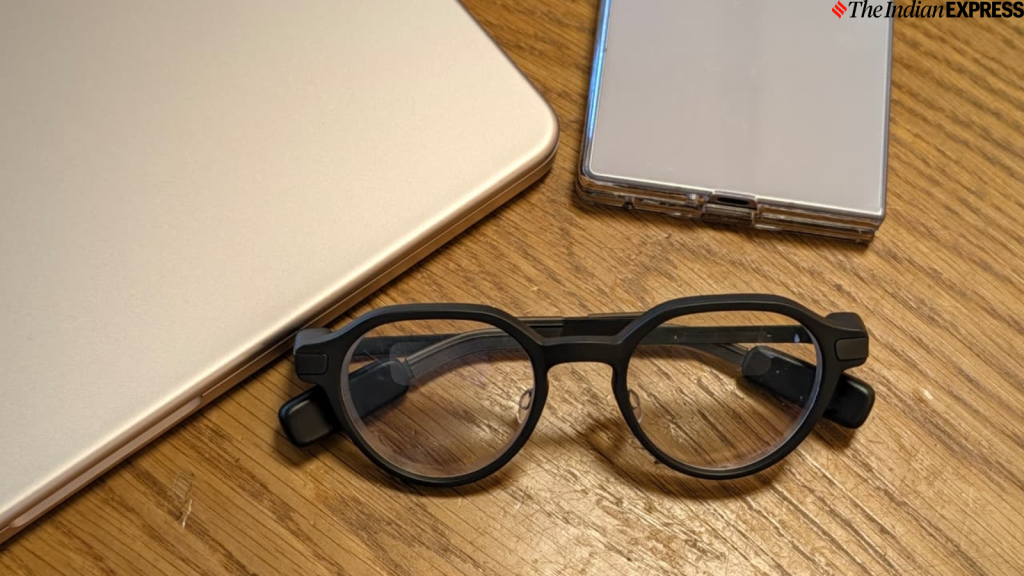
The Even Realities G2 Smart Glasses combine a minimalist, Steve Jobs-inspired design with a camera-free display, AI-powered conversation summaries, live translation and navigation. Priced at $599, they offer a privacy-conscious alternative to camera-equipped smart glasses, but inconsistent AI performance and limited functionality make them better suited to tech enthusiasts than everyday users.
Smart glasses promise to make technology more accessible by bringing digital information directly into your field of vision. Instead of reaching for a smartphone to check notifications, read directions or access meeting notes, users can glance at a small display integrated into their eyewear. However, the growing popularity of camera-equipped models has raised questions about privacy, social acceptance and whether these devices are becoming too intrusive.
The Even Realities G2 takes a different approach. Rather than focusing on photography, audio playback or recording, these smart glasses prioritise a discreet heads-up display, practical productivity tools and a conventional eyewear design. They have no built-in camera or speakers, making them particularly appealing to people who want smart features without wearing an obvious recording device.
After several months of use, the G2 emerges as an interesting example of how smart glasses could evolve beyond cameras and entertainment. Its monochrome display, real-time conversation summaries and teleprompter features offer genuine utility, although occasional control issues and limitations in AI-powered functions prevent it from becoming an essential everyday device.
Here is a closer look at the Even Realities G2’s design, display, software, privacy features, battery life and value for money.
Even Realities G2: Price and Key Specifications
The Even Realities G2 is a premium pair of smart glasses designed to provide information through an integrated optical display while maintaining the appearance of conventional eyewear.
- Product: Even Realities G2 smart glasses
- Price: $599, approximately Rs 57,004 as quoted in the original review
- Display: Monochrome green micro-LED with waveguide optics
- Resolution: 640 × 350 pixels
- Field of view: 27.5 degrees
- Peak brightness: Up to 1,200 nits
- Weight: Approximately 40 grams
- Materials: Titanium and magnesium
- Connectivity: Bluetooth pairing with Android and iOS smartphones
- Water and dust resistance: IP65-rated
- Camera: None
- Speakers: None
- Additional accessory: Even R1 control ring, sold separately for $249
These specifications highlight the G2’s central philosophy: it is designed to deliver useful information at a glance rather than reproduce the full smartphone experience in front of the user’s eyes.
Design and Comfort: Smart Glasses That Look Like Regular Eyewear
One of the Even Realities G2’s strongest features is its understated appearance. Unlike smart glasses with prominent cameras, bulky temples or conspicuous electronic components, the G2 looks much closer to a conventional pair of premium glasses.
Its round lenses and minimalist styling evoke the iconic eyewear associated with Apple co-founder Steve Jobs. That resemblance gives the glasses a distinctive identity without making them look overly futuristic. The design is understated enough for professional settings, casual outings and everyday use.
The original reviewer found that friends and colleagues could not immediately recognise the G2 as smart glasses. This is an important advantage for a product intended to be worn throughout the day. Technology that blends into existing habits is more likely to become part of a person’s routine than hardware that constantly attracts attention.
The frame combines titanium and magnesium and weighs approximately 40 grams. According to the review, the glasses remained comfortable during extended use, with no noticeable fatigue or irritation even after being worn for an entire day.
Comfort is particularly important for smart glasses because their value depends on how often people wear them. A device that feels cumbersome may end up being left at home, regardless of how impressive its software might be.
The G2 also conceals much of its technology inside the frame. The temple tips contain capsules housing electronic components and touch controls, keeping the external design relatively clean.
The glasses carry an IP65 rating, providing protection against dust and water exposure under specified testing conditions. They can handle rain and light rinsing, but the rating does not mean they are waterproof for swimming or submersion. High-pressure water exposure should also be avoided.
Overall, the G2’s design is one of its most convincing arguments. It demonstrates that smart glasses do not necessarily need to look like miniature computers attached to someone’s face.
Monochrome Micro-LED Display: Designed for Quick Glances
The display is what separates the Even Realities G2 from ordinary glasses. Instead of using a conventional full-colour screen, the device incorporates a monochrome green micro-LED display with waveguide optics.
The display has a resolution of 640 × 350 pixels, a 27.5-degree field of view and peak brightness of up to 1,200 nits. The resulting visuals resemble the green text associated with older monochrome computer screens, although the optical system is designed for a modern wearable device.
Waveguide technology directs the displayed image into the user’s field of vision, allowing information to appear without requiring a conventional screen mounted in front of the eyes. The G2 uses a binocular display arrangement, enabling both eyes to see the projected information.
Although the resolution may appear modest compared with modern smartphones, the glasses are not designed for watching videos or viewing detailed photographs. Their primary purpose is to present short pieces of information that can be understood with a quick glance.
Notifications, navigation arrows, meeting prompts and short text overlays are better suited to this format than visually complex content. The monochrome interface also helps maintain a consistent visual language instead of trying to reproduce smartphone applications on a much smaller display.
However, the experience depends on proper positioning. The reviewer noted that the glasses need to sit correctly on the nose to keep the display in focus. Customised lenses tailored to the reviewer’s vision helped avoid frequent repositioning during testing.
Prescription compatibility is particularly relevant because smart glasses must serve two purposes simultaneously: correcting vision and displaying digital information. Buyers should consider lens availability, fit and the additional cost of prescription options before making a purchase.
Interface and Touch Controls: Simple, but Not Always Perfect
After pairing the glasses with a smartphone and completing the setup through the Even app, users encounter a tile-based dashboard. It presents information such as the time, battery level, news, calendar updates and health data in a compact interface.
The heads-up display can be adjusted to an angle between zero and 60 degrees. Users navigate the interface through taps and swipes on touch-sensitive strips built into the temples.
The software has a minimalist appearance that the reviewer compared with the design philosophy associated with Nothing, the technology company known for its distinctive product aesthetics. The interface feels tailored to the monochrome display rather than attempting to imitate a conventional smartphone screen.
The G2 offers eight main functions:
- Notifications: Displays selected smartphone alerts.
- Conversate: Transcribes conversations and generates AI-powered summaries.
- Teleprompt: Displays scrolling text for presentations and speeches.
- Translate: Provides translations across supported languages.
- Navigate: Presents maps, directional arrows and turn information.
- Even AI: Provides a built-in voice assistant.
- Dashboard: Displays selected information and updates.
- Silent Mode: Provides a way to manage the glasses’ active experience more discreetly.
Users can customise which functions appear on the dashboard through the companion app. Swiping switches between different views, while tapping opens additional information. Double-tapping returns the interface to the main dashboard or puts the display to sleep.
Despite its clean presentation, the control system is not entirely polished. The reviewer found the touch controls generally responsive but occasionally sluggish, sometimes requiring repeated taps to register an input. It also took a couple of hours to become comfortable with the interaction system.
The separately sold Even R1 ring offers an alternative. Priced at $249, it mirrors the glasses’ tap-and-swipe controls through a wearable ring, placing the interaction point near the thumb rather than behind the ear.
The ring could make navigation more natural for users who frequently switch between features. However, it is an additional purchase, increasing the overall cost of an already expensive product.
Conversate: A Useful AI Assistant for Meetings and Conversations
Among the G2’s features, Conversate stands out as one of its most practical applications. It transcribes conversations in real time, uses Artificial Intelligence to produce summaries and can surface relevant contextual information.
Instead of constantly looking down at a phone to take notes, users can keep their attention on the conversation while receiving text-based assistance through the glasses. This approach could be particularly useful during meetings, interviews, discussions and other situations where maintaining eye contact matters.
In the original review, live captioning performed reliably during everyday conversations, although the system occasionally made errors. Technical terminology and product names proved more challenging, highlighting a limitation that can affect AI transcription systems when dealing with specialised subjects.
The reviewer also observed the system responding to dialogue in a commercial for Apple’s HomeView. During the advertisement, Siri was asked whether French toast originated in France. The G2’s AI-generated contextual information connected the dish’s name with an American man called Joseph French and the story that he supposedly created and advertised the dish in 1724.
This example illustrates both the potential and the limitations of contextual AI. A system that provides information during a conversation can be useful, but an answer appearing in a heads-up display should not automatically be treated as verified fact. Users may still need to check historical claims and other potentially inaccurate information.
Even Realities has also introduced Prep Notes, allowing users to upload documents before meetings. Relevant keywords and fact-checking information can then appear on the display in real time.
For professionals, this addition could be more valuable than a general-purpose AI assistant. Preparing a document in advance gives the system specific material to reference, potentially making it easier to follow discussions and recall important details.
Nevertheless, Conversate raises a significant privacy consideration. Transcribing a conversation involves processing information about other people, not just the wearer. Anyone using this feature in meetings, interviews or private discussions should consider consent, workplace policies and the sensitivity of the information being processed.
Teleprompt and Translate: Two Features With Clear Practical Value
The Teleprompt feature is another strong point. It displays scrolling text that follows the user’s voice, helping speakers deliver presentations without constantly looking down at notes or turning towards a separate display.
The reviewer found this feature worked particularly well during testing. It demonstrates why a monochrome heads-up display can be more useful than a colour screen for certain tasks: the wearer needs readable text in a convenient position, not a miniature entertainment display.
Potential users include presenters, educators, content creators and professionals who regularly deliver prepared remarks. However, its usefulness will depend on how well the scrolling text matches the speaker’s pace and the demands of the presentation.
The Translate feature supports more than 33 languages, including Hindi. During testing, translations were fast enough to follow natural conversations, making the feature potentially useful when communicating across language barriers.
There is one notable limitation: users must manually select the input and output languages through the app instead of relying on automatic language detection.
This extra step may be manageable during a planned conversation but can interrupt the experience when the speaker switches languages unexpectedly. Automatic detection would make the feature more convenient, particularly for travellers and people who regularly communicate with multilingual groups.
Navigation and Even AI: Useful Ideas With Room for Improvement
The G2’s navigation interface provides maps, directional arrows and countdowns to upcoming turns. In principle, this allows users to check directions without repeatedly taking out their smartphones.
However, the reviewer found the turn-by-turn directions less accurate than Google Maps. That limitation makes navigation one of the weaker features in the current experience.
Directions are a particularly demanding use case for smart glasses because mistakes can create confusion at intersections or during unfamiliar journeys. Until reliability improves, users should not assume the G2 can replace a dedicated navigation application on their phones.
The built-in Even AI voice assistant also produced mixed results. Although the feature worked, it sometimes misinterpreted requests and struggled to recognise or activate voice commands in noisy outdoor environments despite the glasses having four microphones.
These issues illustrate a broader challenge for wearable AI. A feature may appear impressive in a demonstration but become less dependable in everyday settings, where background noise, changing environments and unclear instructions can affect performance.
For now, the G2’s strongest applications are those that deliver relatively focused information through text, rather than functions that require consistently accurate voice recognition or navigation.
Even Hub Expands the Smart Glasses Ecosystem
The G2’s capabilities are not limited to the features built into the glasses. The Even Hub platform allows third-party developers to build and distribute applications using web technologies.
This approach could help the device become more versatile over time. Instead of relying exclusively on the manufacturer’s software updates, users can access additional functions created by developers for specific needs.
Examples mentioned in the review include Whoop Glance, which brings data from a WHOOP band to the glasses, and OcuClaw, which adds agentic AI capabilities. The platform also includes Spotify Lyrics Finder, although the reviewer found that the music-identification functionality failed to recognise the songs tested.
The experience suggests that third-party applications could become an important part of the G2’s long-term value, but the availability of a plugin does not guarantee that it will work reliably.
As with other emerging software ecosystems, the platform’s usefulness will depend on application quality, developer support and how consistently third-party tools perform. Buyers should evaluate the features that work today rather than purchasing the glasses solely on the promise of future applications.
Privacy: The Biggest Advantage of Camera-Free Smart Glasses
The absence of a camera is one of the Even Realities G2’s defining characteristics. While many smart glasses are built around photography, video capture or camera-powered AI, the G2 focuses on displaying information and processing conversations.
That distinction matters in public spaces. Camera-equipped eyewear can make people uncomfortable because they may not know whether they are being recorded. Conventional-looking glasses without a camera can reduce that particular concern.
The reviewer described feeling more comfortable wearing the G2 in public than camera-equipped Meta Ray-Ban glasses. The G2’s hardware and software are not designed around capturing images, which helps make the device feel less intrusive in everyday interactions.
For people who want discreet digital assistance without the social complications of a wearable camera, this is a meaningful advantage. It also challenges the idea that smart glasses need to record their surroundings to be useful.
However, camera-free does not mean completely private.
The G2 includes microphones that capture conversations for the Conversate feature. According to the review, Even’s AI can continue processing transcripts to generate summaries even when live captions and cues are switched off.
This distinction is important. A product can avoid image and video capture while still processing sensitive spoken information. Users should understand when audio is being captured, how transcripts are handled and what controls are available before using conversational AI around other people.
Likewise, the claim that the glasses do not harvest user data should not be interpreted as proof that every interaction is processed exclusively on the device or that no information is transmitted to external services. Those questions require clear information about the company’s data-handling practices.
The G2 is therefore better described as a privacy-conscious alternative to camera-equipped smart glasses rather than a device that eliminates every privacy concern.
Battery Life: Up to Two Days Under Typical Use
Battery performance is another area where the Even Realities G2 compares favourably with the reviewer’s experience of camera-equipped smart glasses.
The G2 delivered approximately two days of typical use in the review. However, battery life fell to around 12 to 15 hours when the reviewer used more demanding features such as navigation, Conversate and Even Hub applications.
The charging case provides approximately seven additional full charges, reducing the need to find a power outlet throughout the day.
Actual battery life will depend on usage patterns, particularly how frequently the display is active and how often processing-intensive features are used. Buyers who plan to rely heavily on live transcription, navigation or third-party applications should expect shorter intervals between charges than those who mainly check notifications and brief updates.
Even so, the reported endurance makes the G2 a more plausible all-day companion than a device that needs to be recharged after only a few hours of ordinary use.
Even Realities G2 vs Meta Ray-Ban Smart Glasses
The Even Realities G2 and Meta Ray-Ban smart glasses approach Wearable Technology differently. The G2 prioritises a discreet heads-up display and text-based assistance, while camera-equipped Ray-Ban models focus on a different combination of smart features.
The comparison is not entirely straightforward because the Meta Ray-Ban product family includes different models with different capabilities. The original review quotes approximately $799 for a Meta Ray-Ban model with a built-in colour display and notes that its prescription-lens options differ from those of the G2.
The key differences are more useful when considered by intended use rather than price alone.
| Feature | Even Realities G2 | Meta Ray-Ban alternatives |
|---|---|---|
| Primary approach | Discreet heads-up display and productivity | Features vary by model, including camera-based functions and display-equipped options |
| Camera | No built-in camera | Camera-equipped models are available |
| Display | Monochrome green micro-LED | Depends on the model |
| Speakers | None | Available on relevant models |
| AI conversation tools | Live transcription, summaries and contextual assistance | Features depend on the model and software |
| Quoted starting price in the review | $599 | Approximately half the G2 price for some camera-equipped models; the display-equipped model is quoted at $799 |
The G2 is particularly appealing to people who value text-based assistance, a conventional appearance and the absence of a camera. However, shoppers who want photography, video recording or integrated audio need to consider other options.
Price comparisons should also account for differences in hardware, software, prescription-lens support and available features. A cheaper product without a display is not necessarily a direct substitute for a pair of smart glasses built around a heads-up interface.
Is the Even Realities G2 Worth $599?
At $599, the Even Realities G2 is a substantial investment. The price rises further for buyers who require prescription lenses, which the original review says cost an additional $150. That brings the approximate total to $750 before considering any separately purchased accessories.
The optional $249 R1 ring increases the cost further but may improve the convenience of controlling the glasses. Buyers should therefore decide whether the standard touch controls are sufficient before investing in the accessory.
The G2’s value depends largely on how often its specialist features will be used. People who regularly deliver presentations, attend meetings, work across languages or need discreet access to short pieces of information may find the display genuinely useful.
By contrast, users who primarily want notifications or a general-purpose AI assistant may struggle to justify the price. A smartphone or smartwatch can already perform many basic tasks, even if neither offers the same hands-free, heads-up presentation.
Software development also affects the buying decision. The reviewer observed improvements during several months of use, suggesting that updates have expanded the product’s usefulness. Nevertheless, the inconsistent navigation, voice recognition and third-party applications show that the experience is not yet uniformly polished.
Potential buyers should assess the G2 based on its current capabilities rather than assuming every advertised or newly introduced feature will work flawlessly in every environment.
Who Should Buy the Even Realities G2?
The G2 is best suited to a specific group of users rather than the mass market.
- Technology enthusiasts: People interested in exploring an alternative to camera-focused smart glasses.
- Professionals and executives: Users who want discreet access to meeting notes, notifications and contextual information.
- Presenters and content creators: People who can benefit from a voice-following teleprompter.
- Multilingual users: Those who may find on-glasses translation useful during conversations.
- Prescription-glasses wearers: Buyers who want smart functionality integrated into eyewear they can wear throughout the day, subject to lens compatibility and fit.
It is less compelling for shoppers who want a camera, music playback through built-in speakers, highly accurate turn-by-turn navigation or a full smartphone replacement.
Final Verdict: A Promising Alternative for Privacy-Conscious Users
The Even Realities G2 demonstrates that smart glasses can offer meaningful digital assistance without cameras, speakers or an oversized frame. Its lightweight construction, understated styling and monochrome heads-up display create an experience that feels closer to ordinary eyewear than to a wearable computer.
Conversate, Teleprompt and Translate are among its most useful features, particularly for professionals who want information without constantly looking at their phones. The camera-free design also provides a compelling alternative for people concerned about the social implications of recording devices in public spaces.
However, the G2 has clear limitations. Touch controls can occasionally be sluggish, the voice assistant struggles in noisy environments, navigation needs improvement and some third-party applications do not work as expected. Its privacy-conscious design also does not eliminate the considerations associated with microphone-based transcription and AI processing.
Should you buy the Even Realities G2? If you are a technology enthusiast or professional who values discreet information access, a lightweight design and camera-free smart glasses, the G2 is worth considering. If you want an affordable wearable for basic notifications or expect smart glasses to replace your smartphone, it is difficult to recommend at $599.
The G2 is not a smartphone replacement, and it does not need to be one to make sense. Its significance lies in showing how smart glasses can become useful through focused features, thoughtful design and less intrusive hardware. For now, it remains a promising premium device for early adopters rather than an essential purchase for everyone.
For breaking news and live news updates, like us on Facebook or follow us on Twitter and Instagram. Read more on Latest Technology on thefoxdaily.com.






COMMENTS 0