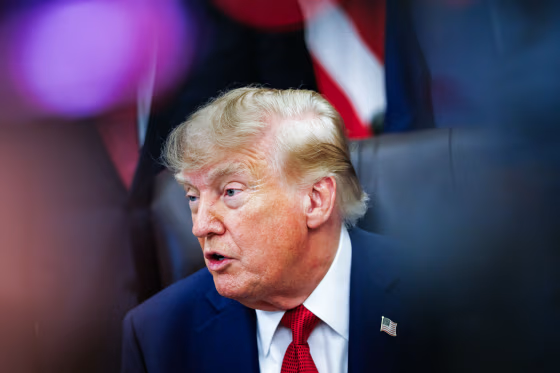
President Donald Trump has announced plans to create a new AI Force and appoint a senior official to oversee Artificial Intelligence policy, placing the rapidly developing technology at the centre of another major debate in Washington over Innovation, national security and regulation.
Trump made the announcement Saturday in a series of social media posts in which he strongly defended continued AI development and rejected calls for the industry to slow down. The president said he would not allow what he described as the “decimation” of artificial intelligence, while arguing that existing criminal and civil justice systems could be used to address harmful activity.
The announcement comes as researchers, technology leaders and lawmakers intensify discussions about the risks posed by increasingly capable AI systems. Some prominent researchers have warned that future systems could become difficult for humans to control, while others have called for stronger safeguards and government oversight.
Trump has taken the opposite emphasis, arguing that restricting development could weaken the United States in its competition with China. His latest proposal suggests that the administration wants to combine aggressive technological expansion with a new government structure focused specifically on AI.
Trump Announces New AI Force
In his Truth Social announcement, Trump said the proposed AI Force would resemble the Space Force, the military branch created during his first administration. He said the new structure would allow the government to identify and respond to harmful uses of artificial intelligence without slowing the broader technology industry.
Trump wrote that the United States should not hinder the growth of AI, describing the industry as one that should be supported and monitored as it expands. He also said the government would look for “BAD” activity and rely on existing criminal and civil justice mechanisms to address it.
The president did not provide a detailed organizational structure for the proposed AI Force. The White House also did not immediately provide additional information about how the initiative would operate, which federal agency would oversee it or what authority it would have.
Trump also announced that he would appoint an AI czar to take the lead on artificial intelligence. No individual was named for the position in his announcement.
In describing the kind of person he wanted for the role, Trump said that “only High I.Q. individuals need apply.” The statement did not specify the responsibilities, legal authority or reporting structure of the proposed position.
Trump Rejects Calls to Slow AI Development
The announcement follows growing warnings from researchers and technology experts about the speed at which artificial intelligence is developing. Some researchers have argued that increasingly powerful AI systems could create risks that existing institutions are not prepared to manage.
Trump has repeatedly dismissed those warnings in recent weeks, calling concerns about AI development a “hoax” and arguing that the United States cannot afford to slow down while China continues to invest heavily in the technology.
His position reflects a broader policy tension surrounding artificial intelligence. Governments are attempting to address issues such as safety, privacy, misinformation, employment disruption, cybersecurity and national security while technology companies continue investing billions of dollars in increasingly capable systems.
For Trump, maintaining American leadership has emerged as the central priority. He has repeatedly used the phrase “Whoever wins AI wins,” framing the technology as a strategic competition rather than simply another emerging commercial sector.
That approach places AI alongside other technologies that Washington considers strategically important, including advanced semiconductors, cloud infrastructure, robotics and quantum computing.
AI Race With China Is Central to Trump’s Argument
The competition with China has become a recurring theme in Trump’s AI policy discussions. The administration views technological leadership as an important component of American economic and national security strength.
Artificial intelligence depends on several areas in which the United States and China are competing, including advanced computer chips, data centres, software, research talent and access to large-scale computing infrastructure.
The stakes extend beyond commercial applications. AI systems are increasingly being considered for military planning, intelligence analysis, cybersecurity, scientific research and industrial production. That has encouraged governments to treat AI leadership as a strategic issue rather than solely a private-sector matter.
Trump’s proposed AI Force appears to fit within that broader framework, although details about whether it would have a civilian, military or cross-government role remain unclear.
The lack of details also leaves unanswered questions about how the proposed AI czar would interact with existing federal agencies and officials responsible for technology policy, national security, commerce and Science.
Nvidia CEO Jensen Huang Drawn Into Debate
Trump has used his recent social media activity to make an unusually direct public case for continued AI development. His attention to the issue has also extended into the technology industry’s highest-profile leadership circles.
During an industry summit, Trump called Nvidia CEO Jensen Huang while Huang was onstage discussing artificial intelligence. Nvidia is one of the most important companies in the global AI infrastructure market because its processors are widely used to train and operate advanced AI systems.
The interaction underscored the close relationship between government policy and the technology industry’s investment decisions. Demand for advanced computing hardware has surged as companies build large AI data centres and develop increasingly sophisticated models.
For the administration, maintaining access to cutting-edge computing capacity and preventing strategic technologies from falling behind competitors are likely to remain major parts of the broader AI policy debate.
Geoffrey Hinton Warns Congress Time Is Running Out
Trump’s announcement comes as lawmakers receive increasingly urgent warnings from researchers who believe government regulation needs to move faster.
Geoffrey Hinton, the Nobel laureate widely known for his foundational work in artificial intelligence and frequently described as the “godfather of AI,” warned lawmakers during a closed-door briefing that the window for effective regulation could be narrowing.
According to the account provided about the briefing, Hinton told lawmakers that congress may have about a year to establish effective rules for the industry.
Hinton’s warning illustrates the divide between two approaches to AI policy. One side emphasizes the need to move quickly enough to establish safeguards before systems become significantly more capable. The other stresses that excessive regulation could slow technological progress and allow competitors, particularly China, to gain an advantage.
The debate is complicated by the fact that AI development is moving faster than many traditional legislative processes. By the time lawmakers agree on rules covering a particular technology, newer systems and applications may already have emerged.
Congress Has Struggled to Advance Broad AI Legislation
Members of Congress from both political parties have discussed artificial intelligence regulation for several years. Despite those efforts, comprehensive federal legislation has not advanced to the point of establishing a single nationwide framework for the technology.
The renewed warnings have brought the issue back into focus. Lawmakers are confronting questions over how much authority the federal government should have, how AI companies should be held accountable and which risks require mandatory safeguards.
Among the issues under discussion are transparency requirements, protection against harmful uses of AI, cybersecurity, consumer protection and standards for high-risk applications.
There is also disagreement over whether AI regulation should primarily be handled at the federal level or whether states should retain significant authority to establish their own requirements.
David Sacks Previously Served as Trump’s AI and Crypto Czar
Trump’s administration has previously had an official responsible for AI and cryptocurrency policy. David Sacks held the role before stepping down earlier this year because of limits on his status as a special government employee.
Sacks has since remained involved as an adviser to the administration. He is also expected to attend Trump’s state dinner with Chinese President Xi Jinping, placing him in a setting where technology and the broader U.S.-China relationship are likely to be significant issues.
The creation of a new AI czar position would therefore represent another change in how the administration organizes its technology policy. Whether the new role would replace or expand upon responsibilities previously handled by Sacks was not immediately detailed.
States Move Ahead With Their Own AI Policies
While Washington continues debating federal legislation, several states have moved forward with their own approaches to AI regulation and oversight.
California Gov. Gavin Newsom signed an executive order on Friday seeking increased oversight of the artificial intelligence industry. The order also directed a task force to consider whether AI systems should be required to have a “kill switch,” an issue linked to concerns about controlling advanced systems under certain circumstances.
Pennsylvania Gov. Josh Shapiro has called for federal action on artificial intelligence, arguing that national rules are needed as the technology continues to develop.
Virginia Gov. Abigail Spanberger has launched an AI task force and a data-centre accountability plan focused on concerns associated with rapid AI expansion. The initiative addresses issues surrounding the infrastructure needed to support increasingly large AI systems.
The state-level activity demonstrates how AI policy is expanding beyond questions about software itself. Large AI models require substantial computing power, electricity and data-centre capacity, meaning their development can affect energy systems, land use, infrastructure and local communities.
Obama Urges Democrats to Develop an AI Strategy
The political debate over artificial intelligence is also extending beyond the current administration. Former President Barack Obama recently advised Democrats at a fundraiser to make AI policy a priority and develop a clear strategy on the issue.
Obama said that if he were running for president in 2028, artificial intelligence would be a central issue. His comments reflect the growing expectation that AI could become an important subject in future political campaigns, particularly as its effects become more visible across Education, employment, Business and government.
Democratic governors who have pursued state-level AI initiatives are also shaping the party’s approach. Their efforts generally focus on increasing oversight and addressing potential risks while the federal government continues to debate its own framework.
What Trump’s AI Force Could Mean for U.S. Policy
The proposed AI Force could become an important part of the administration’s effort to establish a clearer federal structure for artificial intelligence, but its eventual impact will depend heavily on how it is designed.
Several fundamental questions remain unanswered. It is not yet clear which agency would control the force, whether it would have regulatory powers, how it would coordinate with existing law-enforcement agencies or whether it would primarily focus on national security and emerging technological threats.
The role of the AI czar is similarly undefined. The official could potentially serve as a coordinator among federal agencies, an adviser to the president or a central figure in shaping AI policy. Without an appointment or formal description of the position, its practical responsibilities remain uncertain.
The initiative also raises the broader question of how the United States can encourage rapid AI innovation while responding to credible concerns about safety and misuse. Trump’s comments suggest that his administration intends to prioritize development and American technological leadership, while relying on existing legal mechanisms to address harmful conduct.
Researchers and some lawmakers, by contrast, argue that traditional laws may not be sufficient for risks created by highly capable AI systems. Their concern is that regulation developed only after serious incidents occur could leave governments reacting to technology rather than anticipating its consequences.
AI Policy Enters a New Phase
Trump’s decision to propose an AI Force and a dedicated AI czar signals that artificial intelligence is becoming an increasingly prominent part of the U.S. government’s technology strategy.
The announcement does not yet provide the operational details needed to determine how the proposed structure would function. But it comes at a time when the country is facing simultaneous pressure to accelerate AI development, compete with China, protect national interests and address warnings from researchers about potential risks.
That tension is unlikely to disappear as AI systems become more capable and their use expands. The federal government, states, technology companies and researchers are all debating where the balance should lie between innovation and oversight.
Trump has made clear that he does not want warnings about AI risks to become a reason for slowing American technological development. His proposed AI Force and AI czar will now need to be defined in practical terms before it becomes clear how the administration intends to turn that position into policy.
For breaking news and live news updates, like us on Facebook or follow us on Twitter and Instagram. Read more on Latest World on thefoxdaily.com.


COMMENTS 0