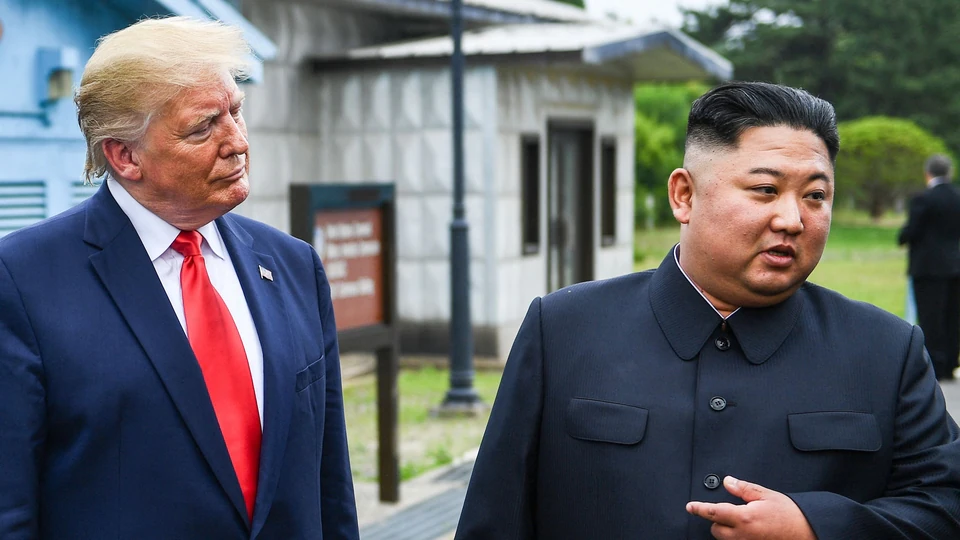
US President Donald Trump‘s latest efforts to revive diplomatic engagement with North Korean leader Kim Jong Un have failed to produce a breakthrough, with Pyongyang showing little interest in renewed talks, according to a report by The Wall Street Journal. Despite attempts to re-establish contact through diplomatic channels and a personal letter, Washington has reportedly been unable to secure direct engagement with the North Korean leader.
The diplomatic push comes as North Korea continues to expand its nuclear and missile capabilities and strengthens military cooperation with Russia. These developments have made the prospect of persuading Kim to abandon his strategic weapons programme increasingly difficult, raising questions about whether future negotiations will focus on limiting nuclear capabilities rather than achieving complete denuclearisation.
Trump, who met Kim three times during his first presidential term, had hoped to revive the personal diplomacy that once produced historic encounters between the two leaders. However, the latest outreach has reportedly encountered resistance over the conditions Pyongyang wants Washington to accept.
Trump’s Attempts to Reopen Communication With Kim Jong Un
According to the Wall Street Journal, Trump’s latest outreach began well before his November 2026 Asia trip. The US president reportedly attempted to contact Kim through established communication channels, but those efforts did not receive a response.
Washington subsequently explored a more personal approach. White House officials reportedly prepared a letter from Trump to Kim and attempted to deliver it through North Korea’s diplomatic mission to the United Nations in New York.
However, the attempt also failed to establish direct communication. A North Korean diplomat reportedly refused to accept the letter, with accounts indicating that it was subsequently discarded without being opened.
The reported episode illustrates the difficulty Washington has faced in restarting dialogue with Pyongyang. Even direct communication from Trump, who previously developed an unusually personal relationship with Kim, has not been enough to bring North Korea back to the negotiating table.
What the US Proposed to Restart Nuclear Negotiations
During discussions about arranging a possible meeting, US officials reportedly considered several proposals that would have represented a significant adjustment to Washington’s traditional approach to North Korea.
One proposal involved formally declaring an end to the Korean War. Although fighting stopped in 1953 with an armistice agreement, the two Koreas have technically remained at war because no permanent peace treaty was signed.
Another idea involved issuing a statement that would neither formally recognise North Korea as a nuclear-armed state nor demand the immediate dismantlement of its existing nuclear programme. Washington also reportedly considered opening liaison offices as an initial step towards establishing formal diplomatic relations.
In return, the United States hoped to secure restrictions on future North Korean nuclear tests and ballistic missile launches. Such an arrangement would have focused on limiting the expansion and development of the country’s weapons capabilities rather than immediately eliminating its existing arsenal.
This approach would mark a notable departure from the long-standing US objective of complete denuclearisation of the Korean Peninsula. Previous administrations have maintained that North Korea must abandon its nuclear weapons programme, while Pyongyang has repeatedly rejected demands that it surrender its strategic arsenal.
Any move towards an arrangement based primarily on arms-control measures would also raise difficult questions for Washington’s regional allies, particularly South Korea and Japan, which remain directly exposed to North Korea’s military capabilities.
White House Denies Efforts to Arrange a Kim-Trump Meeting
Despite the reported diplomatic preparations, a Trump administration official disputed the account of efforts to organise a summit. Speaking to the Wall Street Journal, the official said there had been no attempts to broker a meeting between Trump and Kim.
The White House has also maintained that the United States remains committed to the denuclearisation of North Korea. This position is important because the reported proposals suggested that Washington was at least considering a more flexible negotiating framework.
The conflicting accounts leave uncertainty about the precise extent of the administration’s diplomatic efforts. While the newspaper reported that officials explored different options for a possible summit, the administration’s denial suggests that there is no confirmed agreement or formal negotiating process between the two sides.
Three Historic Meetings Failed to Produce a Nuclear Agreement
Trump and Kim have met three times, making their relationship one of the most unusual diplomatic engagements between leaders of the United States and North Korea.
Their first meeting took place in Singapore on June 12, 2018. It was the first-ever summit between a sitting US president and a North Korean leader. The two sides signed a joint statement committing to work towards new bilateral relations and the denuclearisation of the Korean Peninsula.
The second summit was held in Hanoi, Vietnam, in February 2019. However, the talks ended without an agreement after the two governments failed to reach a compromise over sanctions relief and the scope of North Korea’s nuclear concessions.
The third encounter took place on June 30, 2019, at the Korean Demilitarised Zone. Trump crossed into North Korean territory to meet Kim, creating a historic moment in relations between the two countries.
Despite the unprecedented nature of these meetings, they did not produce a lasting agreement on North Korea’s nuclear programme. Negotiations eventually stalled, and Pyongyang continued developing its weapons capabilities.
The breakdown of the Hanoi summit was particularly significant because it exposed the gap between the two sides’ expectations. Washington wanted meaningful nuclear concessions, while Pyongyang sought substantial sanctions relief. Neither government was willing to accept the other’s terms.
North Korea’s Nuclear Arsenal Has Grown Since 2019
One of the biggest obstacles to renewed negotiations is the expansion of North Korea’s nuclear capabilities since Trump and Kim last met in person.
Estimates cited in the Wall Street Journal report suggest that North Korea’s nuclear stockpile has increased from approximately 20 to 30 warheads in 2019 to around 60. Such estimates are based on assessments of the country’s nuclear materials and weapons programme, as North Korea does not provide independently verifiable information about its complete arsenal.
The country’s missile technology has also advanced. North Korea has developed solid-fuel intercontinental ballistic missiles, which can be launched more quickly than many liquid-fuel systems because they do not require the same lengthy fuelling preparations before launch.
These developments have increased concerns among US officials and regional security experts about the country’s ability to threaten targets far beyond the Korean Peninsula. North Korea’s expanding missile programme is intended to strengthen its ability to deter potential military action and increase its strategic leverage.
The US intelligence community has also assessed that Kim has no intention of negotiating away his strategic weapons programmes. This assessment suggests that Washington is unlikely to achieve its long-standing denuclearisation objective through negotiations alone without a major shift in North Korea’s calculations.
North Korea Strengthens Military Ties With Russia
North Korea’s growing relationship with Russia has further complicated the diplomatic situation. Since Russia launched its full-scale invasion of Ukraine in February 2022, Moscow and Pyongyang have significantly expanded their military and political cooperation.
Western governments have accused North Korea of supplying Russia with artillery ammunition, missiles and military personnel for its war effort in Ukraine. Both governments have faced international scrutiny over the reported military cooperation, although they have denied various allegations concerning the transfers.
The partnership has created additional strategic opportunities for Pyongyang. Closer ties with Moscow could provide North Korea with economic support, diplomatic backing and access to military cooperation at a time when it faces international sanctions.
It also reduces the diplomatic isolation that Washington has traditionally sought to use as leverage. If North Korea believes it has stronger external partners and greater military capabilities, it may see fewer reasons to make concessions in negotiations with the United States.
For Washington, this creates a more complicated diplomatic environment than the one that existed during Trump’s first term. Any new agreement would have to account for North Korea’s expanded weapons programme and its strengthened relationship with Russia.
Why Experts Believe Future Talks May Focus on Arms Control
The changing balance of capabilities has prompted some analysts to question whether complete denuclearisation remains a realistic immediate objective. Instead, they argue that future negotiations may need to concentrate on limiting the risks posed by North Korea’s existing arsenal.
Victor Cha, a former White House adviser and North Korea negotiator, highlighted the difficulty of attracting attention to the changing realities of the nuclear issue. Speaking to the Wall Street Journal, he said, “For someone like me, it’s kind of like screaming in a forest. Nobody is really paying attention.”
Cha’s comments reflect a broader debate among North Korea specialists about the effectiveness of decades of diplomatic efforts. Despite sanctions, negotiations and international pressure, Pyongyang has continued to develop its nuclear and missile programmes.
An arms-control approach would not necessarily mean accepting North Korea’s nuclear status. Instead, it could involve negotiating restrictions on nuclear tests, missile launches, weapons development or other military activities while maintaining the longer-term objective of denuclearisation.
However, even a limited agreement would face considerable obstacles. North Korea would need to accept meaningful restrictions and some form of verification, while the United States and its allies would have to decide what concessions they could offer in return.
What Happens Next in US-North Korea Relations?
The latest failed outreach highlights the limits of Trump’s personal diplomacy with Kim. Their earlier meetings created expectations that direct engagement could help break the deadlock, but the expansion of North Korea’s nuclear programme and its closer relationship with Russia have changed the strategic environment.
For Trump, reviving negotiations could offer an opportunity to secure a diplomatic achievement that eluded his first administration. For Kim, however, nuclear weapons remain central to North Korea’s national security strategy and international bargaining position.
The immediate prospect of a new summit remains uncertain. The reported diplomatic proposals have not produced an agreement, North Korea has not committed to renewed negotiations, and the White House has disputed claims that it attempted to arrange a meeting.
Unless both sides find a negotiating framework they can accept, the nuclear standoff is likely to continue. The central challenge for Washington will be determining whether it can reduce the threat posed by North Korea’s growing arsenal without abandoning its stated objective of denuclearisation.
For breaking news and live news updates, like us on Facebook or follow us on Twitter and Instagram. Read more on Latest World on thefoxdaily.com.






COMMENTS 0