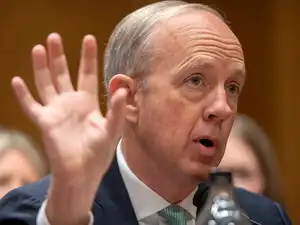
President Donald Trump’s nominee to lead the Government Accountability Office (GAO), Eric Ueland, has defended his independence during a contentious Senate confirmation hearing, telling lawmakers he would not act as a political representative of the White House if appointed to the powerful oversight position.
Ueland made the assurance on Thursday, November 19, as Democratic senators questioned whether his close ties to the Trump administration could compromise the independence of an agency responsible for investigating federal spending, auditing government programmes and providing Congress with nonpartisan oversight.
“I’m not here as a plant, a stooge, a lackey for anybody,” Ueland told members of the Senate Homeland Security and Governmental Affairs Committee, seeking to address concerns that he could become a rubber stamp for the administration.
The nomination carries significant implications because the comptroller general leads the GAO for a 15-year term. The appointment would give Ueland authority over one of Congress’s principal oversight institutions well beyond the remainder of Trump’s current presidential term.
However, opposition to the nomination extends beyond Democratic lawmakers. More than 20 former inspectors general have urged senators to reject Ueland’s confirmation, while some Republicans have also questioned aspects of the process used to select him.
Why Democrats Are Questioning Eric Ueland’s Independence
The central concern surrounding Ueland’s nomination is his current position as deputy director of the White House Office of Management and Budget (OMB), the agency responsible for coordinating the administration’s budget policies and overseeing the implementation of federal spending priorities.
The OMB has been at the centre of several disputes with the GAO over the Trump administration’s handling of federal funds. During the past two years, the watchdog has repeatedly found administration spending freezes and impoundments unlawful, placing the two institutions on opposing sides of important questions about executive authority and congressional control of public money.
Democratic senators argue that appointing a senior official from an agency involved in these disputes to lead the body responsible for examining government spending could create questions about impartiality.
Senator Gary Peters, the committee’s ranking Democratic member, directly challenged Ueland’s ability to serve as an independent oversight figure. Peters argued that the OMB had refused to cooperate with GAO audits during Ueland’s tenure and questioned whether the nominee could objectively oversee matters involving the administration he currently serves.
Describing the GAO as an important institutional check on government power, Peters said the agency was supposed to function as an impartial umpire. He questioned whether Ueland could fulfil that responsibility given his close association with the White House.
Peters also warned that confirming the nominee could cause lasting damage to the credibility of the watchdog. His objection is not simply about Ueland’s political background but also about whether the selection process and his previous government responsibilities provide sufficient assurance of independence.
Unusual Nomination Process Adds to Senate Opposition
Alongside concerns about Ueland’s White House connections, Democrats have challenged the process through which Trump selected him for the position.
Under the established statutory framework, a 10-member congressional commission is expected to recommend at least three candidates for comptroller general to the president. The commission is intended to provide a bipartisan screening mechanism, allowing lawmakers to assess potential candidates before the White House makes its selection.
Critics say that process was effectively bypassed in Ueland’s case. Instead of a lengthy review involving candidate interviews and bipartisan consideration, the nomination moved forward through an accelerated procedure that opponents argue weakened the safeguards intended to protect the GAO’s independence.
Peters has said the White House had already settled on Ueland before lawmakers were meaningfully involved in the process. He also objected to the limited opportunity provided to Democratic members to suggest candidates.
The dispute has raised a broader institutional question: whether the appointment of a comptroller general should follow a process designed to build bipartisan confidence, rather than one that allows the president’s preferred candidate to move forward with limited consultation.
Republican Senator Rand Paul of Kentucky, who chairs the Homeland Security and Governmental Affairs Committee, is involved in the nomination process. However, the committee’s handling of the selection has itself become a subject of criticism from opponents of Ueland’s confirmation.
Former congressional counsel Henry R. Wray has also criticised the process, arguing that the lack of a proper bipartisan selection procedure could undermine the GAO’s ability to operate as a nonpartisan watchdog.
More Than 20 Former Inspectors General Oppose Confirmation
Resistance to Ueland’s nomination is not limited to current Democratic senators. More than 20 former inspectors general signed a letter opposing his confirmation earlier in the week, raising concerns about the selection procedure, independence and the credibility of government oversight.
Inspectors general traditionally serve as independent oversight officials within federal agencies. Their responsibilities include investigating misconduct, examining programmes, identifying waste and reporting findings to help ensure that public resources are used lawfully and effectively.
The former officials argued that the credibility of government oversight depends on compliance with statutory safeguards and leadership committed to nonpartisan evaluation of evidence.
In their view, the circumstances surrounding Ueland’s nomination do not meet those standards. They warned that weakening the process for selecting the comptroller general could create a damaging precedent for an institution whose authority depends heavily on public and congressional confidence.
Their intervention is particularly significant because the GAO and inspectors general operate in different parts of the federal oversight system but share a common purpose: examining government activity independently of the officials and agencies being scrutinised.
The opposition therefore reflects concern about more than one nominee. It also raises questions about how future leaders of independent oversight institutions should be selected and what safeguards are necessary to protect their work from political influence.
Republicans Are Not Fully United Behind the Nomination
Although Ueland has received support from some Republican lawmakers, the nomination has not attracted unanimous backing within the party.
Senator James Lankford of Oklahoma described Ueland as a strong candidate to lead the GAO and indicated that he believed the White House had followed the letter of the law in putting forward the nomination. However, Lankford also expressed reservations about whether the process respected the spirit of the statutory framework.
Senator Thom Tillis of North Carolina has raised a separate procedural objection, saying he would oppose including Ueland in a package of nominees being considered together by the Senate.
That position matters because Republican leaders have used grouped confirmation procedures to move multiple nominations through the Senate with a simple majority and a shortened debate period.
Ueland’s nomination could therefore face a more complicated path if senators are unwilling to treat it like other appointments. The objections from Tillis and Lankford also show that questions about the selection process are not confined to Democrats.
The timing adds another political dimension. Republicans are seeking to advance Trump’s nominees before Democrats take control of the Senate in January, creating pressure to resolve pending appointments while the current party balance remains in place.
What Does the Government Accountability Office Do?
The Government Accountability Office is Congress’s principal investigative and auditing agency. It examines how federal departments and agencies manage public money, assesses whether government programmes are operating effectively and investigates potential problems involving the use of taxpayer funds.
Unlike an executive department, the GAO serves Congress. Its work provides lawmakers with independent information that can help them oversee federal agencies, evaluate government policies and decide whether changes to laws or spending programmes are necessary.
The agency also identifies waste, fraud, inefficiency and weaknesses in government administration. Its reports can highlight failures in programme delivery, question the legality of certain government actions and recommend changes to improve accountability.
With a budget exceeding $900 million and a workforce of nearly 3,000 employees, the GAO has substantial investigative capacity. Its findings can influence congressional debates, government reforms and decisions about how federal resources are allocated.
The comptroller general is central to maintaining that role. The officeholder leads the agency, oversees its institutional direction and is expected to ensure that its findings are based on evidence rather than political considerations.
The 15-year appointment is deliberately longer than a standard presidential term. Its extended duration is intended to provide continuity and reduce the likelihood that the leadership of the watchdog will change with every new administration.
Why the OMB Connection Matters
The disagreement over Ueland’s nomination comes against a wider backdrop of conflict between the Trump administration and Congress over federal spending authority.
The OMB plays a central role in carrying out the president’s budget priorities and managing the administration’s approach to federal funds. The GAO, meanwhile, examines whether government agencies are acting within the law and following congressional spending requirements.
When the two institutions disagree, the GAO’s ability to investigate the administration without interference becomes particularly important.
Democrats argue that Ueland’s senior role at the OMB creates an inherent concern because he could eventually lead the agency responsible for examining decisions made by an institution in which he currently holds a leadership position.
Ueland has responded by pointing to more than two decades of experience working across the executive and legislative branches. He has argued that his background would allow him to understand the responsibilities of both Congress and the administration while continuing to fulfil the comptroller general’s duties independently.
His confirmation would therefore place considerable attention on how he approaches investigations involving the OMB and other parts of the Trump administration. His assurances during the hearing will be assessed alongside his record in government and the institutional safeguards governing the GAO.
What Happens Next in Ueland’s Confirmation Process?
Ueland’s appearance before the Senate committee has not settled the dispute over his nomination. The next major question is whether committee leaders can secure enough support to advance his appointment and whether Republican senators will allow it to move through the same expedited procedures used for other nominees.
Senators must weigh Ueland’s experience and promises of nonpartisan leadership against concerns about his current government position, the selection process and the potential consequences for the GAO’s reputation.
The opposition from former inspectors general adds another layer to that decision, while the differing positions of Republican senators suggest that the nomination could require more than routine party-line support.
For the GAO, the stakes extend beyond the identity of its next leader. The agency’s ability to examine federal spending and hold government departments accountable depends on lawmakers, public institutions and taxpayers having confidence that its work is independent.
Ueland has told senators that he would call matters as he sees them and would not undermine the GAO’s responsibilities to Congress. Whether those assurances are sufficient to address the concerns surrounding his nomination will be central to the Senate’s decision on a position that could shape federal oversight for the next 15 years.
For breaking news and live news updates, like us on Facebook or follow us on Twitter and Instagram. Read more on Latest World on thefoxdaily.com.






COMMENTS 0