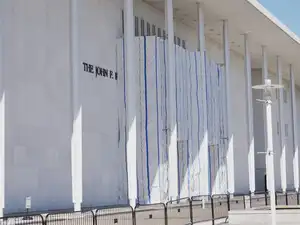
The administration of US President Donald Trump is asking a federal judge to remove a legal barrier preventing the planned two-year closure of the John F. Kennedy Center for the Performing Arts in Washington, DC, as a dispute over renovations and the institution’s governance continues.
The legal challenge centres on the Kennedy Center board’s decision to close the performing arts institution for an extensive renovation programme. US District Judge Christopher Cooper had previously blocked the move, questioning the board’s decision-making and the legal basis for proceeding with the closure.
Representative Joyce Beatty, an ex officio member of the Kennedy Center’s board, has challenged the renovation plans. Her objections include concerns about the way the decision was made, the management of the institution and the possibility of further legal or governance disputes if the project proceeds.
What Is the Government’s Argument for Closing the Kennedy Center?
Government lawyers argue that the Kennedy Center’s main building has deteriorated to a condition that requires extensive renovation. In court filings, they described the facility as dangerously dilapidated and said a partial ceiling collapse in early September demonstrated the urgency of addressing its infrastructure problems.
The administration maintains that closing the building completely for two years would be the most efficient and cost-effective way to carry out the necessary work. It argues that the board reconsidered the closure decision after the judge identified shortcomings in its earlier approval process and that the revised decisions should receive substantial judicial deference.
Justice Department attorney William Jankowski told the court that the board’s decisions were reasonable and should stand. He also argued that the court should give considerable weight to the board’s assessment of the renovation requirements.
The government has not disputed that the Kennedy Center needs significant construction and maintenance work. Its central argument is that a complete two-year closure is the appropriate way to complete those repairs.
Why Did Judge Christopher Cooper Block the Closure in May?
In May, Judge Christopher Cooper issued a preliminary injunction preventing the Kennedy Center board from proceeding with the planned two-year closure. He described the board’s earlier vote as “ill-informed and seemingly preordained”, questioning whether trustees had properly considered their legal obligations before approving such a major decision.
The ruling did not establish that the building did not need repairs. Instead, it focused on the process through which the board approved the closure and whether that decision had been made in accordance with its responsibilities.
The distinction is central to the current legal dispute. Both sides recognise the need for substantial renovation, but they disagree over whether the board followed an adequate decision-making process and whether shutting the entire building for two years is justified.
The administration is now asking Cooper to dissolve the preliminary injunction, arguing that subsequent board decisions have addressed the concerns raised in his earlier order.
How Is Joyce Beatty Challenging the Renovation Plan?
Representative Joyce Beatty, a Democrat from Ohio and an ex officio member of the Kennedy Center’s board, is opposing the administration’s request to lift the injunction. She initially filed a lawsuit challenging President Trump’s takeover of the institution and later expanded her legal challenge to include the proposed closure.
Beatty’s lawyers argue that the renovation plan could conceal problems involving the centre’s management and financial condition. They have described the proposed shutdown as a measure that could cover up mismanagement rather than simply address the building’s infrastructure needs.
Her legal team has also questioned whether the board genuinely reconsidered the available options or merely attempted to justify a closure decision that had already been made. The dispute therefore extends beyond the physical renovation work to questions about governance, accountability and the responsibilities of the board.
Beatty’s attorney, Nathaniel Zelinsky, warned that lifting the injunction could encourage further breaches of legal and governance obligations. He described the situation as an ongoing breach of fiduciary duty and urged the judge to consider appointing an independent monitor to oversee the centre if the injunction is removed.
The $257 Million Renovation Dispute: Full Closure or Phased Repairs?
One of the main disagreements concerns how the renovation work should be carried out. Congress appropriated approximately $257 million for maintenance of the Kennedy Center’s main building in 2025, following a funding request from the institution.
Beatty’s lawyers argue that the work could be completed in phases over approximately four years, allowing the centre to remain partially open to audiences. Under this approach, different sections could undergo repairs at different times, reducing the need to suspend the institution’s entire entertainment programme for an extended period.
The administration, however, maintains that a complete two-year closure would be more efficient and cost-effective. Government lawyers have argued that the board’s preferred approach provides a practical way to address the building’s infrastructure problems.
The disagreement is not simply about how long construction should take. It also concerns the consequences for performers, audiences, employees, fundraising and the institution’s cultural activities during the renovation period.
Beatty’s legal challenge raises questions about whether the board adequately considered the impact of a full shutdown and whether a phased alternative could meet the building’s needs without stopping all activity in the main facility.
Why Is the Kennedy Center Closure Politically Controversial?
The renovation dispute is part of a wider legal and governance conflict surrounding Trump’s involvement with the Kennedy Center. The president took control of the institution’s board and became its chairman, while trustees appointed during his administration gained influence over its decisions.
Beatty’s original lawsuit challenged the addition of Trump’s name to the institution. In May, Cooper also ruled that the decision to rename the centre in Trump’s honour violated federal law governing the institution. The court ordered the removal of Trump’s name from the building and official materials.
The naming dispute and the proposed closure are separate legal issues, but both have contributed to the broader conflict over the institution’s governance and the limits of the board’s authority.
For critics of the closure, the two-year shutdown raises concerns about whether decisions concerning a major publicly supported cultural institution are being made transparently and in the interests of the organisation. The administration’s position is that the building requires urgent work and that the board has selected the most practical renovation strategy.
What Did the Judge Say During the Latest Hearing?
During Thursday’s hearing, Cooper questioned both sides about the consequences of maintaining or lifting the injunction. He asked Beatty’s lawyer how keeping the restriction in place indefinitely would benefit the Kennedy Center and the public.
The exchange indicated that the judge was examining the practical implications of the legal dispute, rather than simply accepting either side’s position. He also questioned the legal authority for appointing an independent monitor, which Beatty’s lawyers proposed as a possible safeguard if the injunction were dissolved.
Zelinsky argued that such an appointment was consistent with established principles of trust law. However, Cooper questioned what specific authority would allow him to impose that arrangement on the centre.
The judge did not issue an immediate ruling after hearing arguments. He also did not announce a specific date for his decision, leaving the future of the proposed two-year closure unresolved.
What Happens Next in the Kennedy Center Legal Battle?
The immediate decision rests with Judge Cooper, who must determine whether the administration has provided sufficient grounds to dissolve the preliminary injunction issued in May.
If the judge lifts the order, the Kennedy Center board would have greater freedom to proceed with its two-year closure plan, subject to any other applicable legal requirements. If the injunction remains in place, the administration would continue to face restrictions on implementing the shutdown.
The possibility of an independent monitor is another issue raised during the hearing, although the judge’s questions suggest that the legal basis for such an appointment would need further consideration.
The case also leaves broader questions about the institution’s future unresolved. These include how renovation costs will be managed, whether the work can be completed through phased construction and how the centre can maintain its cultural activities while addressing its infrastructure needs.
Kennedy Center’s Future Depends on the Court’s Decision
The Trump administration’s request to lift the injunction has brought the Kennedy Center’s two-year closure plan back before the federal court. The government says a complete shutdown is necessary to address serious infrastructure problems, while Joyce Beatty’s legal team argues that the board’s decision-making and management require continued scrutiny.
The dispute highlights the difficulty of balancing urgent maintenance requirements with public access, institutional accountability and the cultural role of a major performing arts venue.
For now, the judge has not decided whether the administration can proceed with the proposed closure. His ruling will determine whether the board can move forward with its two-year renovation strategy or whether the legal restrictions on the plan will remain in place.
For breaking news and live news updates, like us on Facebook or follow us on Twitter and Instagram. Read more on Latest World on thefoxdaily.com.






COMMENTS 0