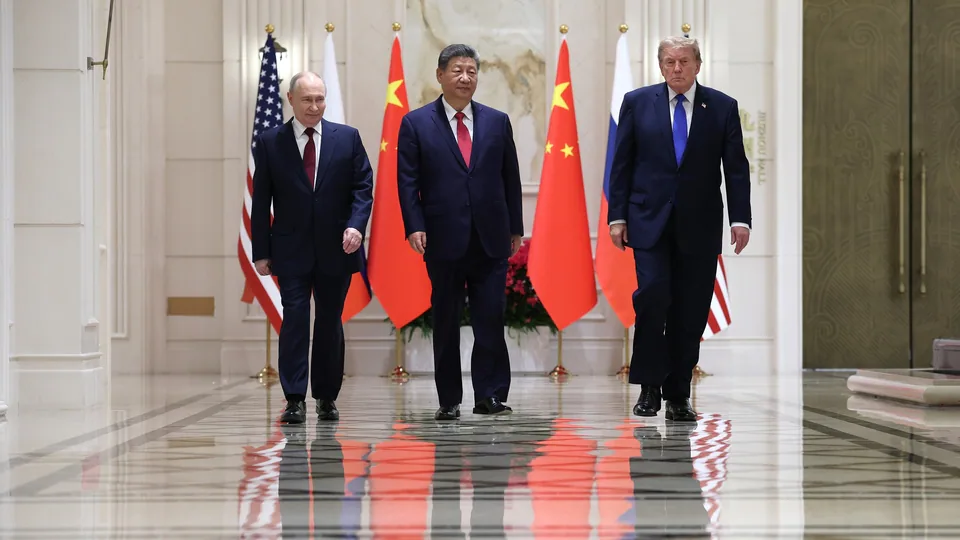
China, Russia and the United States have adopted a joint Declaration on Peace following a historic trilateral meeting between US President Donald Trump, Chinese President Xi Jinping and Russian President Vladimir Putin in Shenzhen on November 19. The declaration places nuclear risk reduction, international security, stable energy supplies and cooperation on global challenges at the centre of the three powers’ stated priorities. It also signals their intention to increase the production and supply of refined petroleum products, while calling for reform of the United Nations and raising concerns about the powers exercised by international judicial institutions.
The agreement followed the first-ever trilateral meeting between the leaders of the three countries, held on the sidelines of the Asia-Pacific Economic Cooperation (APEC) summit. Although the document uses broad language about peace and cooperation, its significance lies in bringing Washington, Moscow and Beijing together around issues where their interests often differ sharply.
What Is the China-Russia-US Declaration on Peace?
The Declaration on Peace is a joint document adopted after Trump, Xi and Putin met in Shenzhen. It records their commitment to maintaining strategic stability and international security following discussions about the global political situation and the responsibilities of the three major powers.
According to the published declaration, the leaders reaffirmed their commitment to international security and acknowledged the importance of cooperation between their countries. They also referred to their positions as permanent members of the United Nations Security Council, arguing that the global institution should be reformed to respond more effectively to international challenges.
The document brings together several areas of cooperation, including nuclear weapons, energy supplies, international institutions and the principles governing relations between states.
However, the declaration should not automatically be interpreted as a comprehensive peace treaty or a binding agreement to resolve existing conflicts. Its published language establishes broad areas of cooperation, but does not provide detailed implementation schedules, specific production targets or a verification framework for the commitments it describes.
Nuclear Disarmament and Risk Reduction Take Centre Stage
Nuclear security is one of the most significant issues addressed in the declaration. The three countries reaffirmed the principle that a nuclear war cannot be won and must never be fought. They also stated that they would engage in dialogue to reduce nuclear risks and prevent the proliferation of nuclear weapons.
The commitment is important because the United States, Russia and China possess some of the world’s largest nuclear arsenals. Any deterioration in relations between these powers carries consequences beyond their individual territories, particularly because their military capabilities influence international security calculations.
Trump had highlighted nuclear weapons reduction as a major subject for the trilateral meeting. In his public remarks before the closed-door discussions, he argued that the three countries were uniquely positioned to discuss reducing nuclear weapons and lowering the risk that they might be used.
Xi also called for stronger cooperation among the three powers and advocated the complete elimination of nuclear weapons. Putin, meanwhile, emphasised the responsibility of Russia, China and the United States to contribute to international stability.
The declaration’s language reflects a shared recognition of the catastrophic consequences of nuclear conflict. But there is an important distinction between agreeing that nuclear risks should be reduced and reaching a practical agreement on how to reduce arsenals.
Why Nuclear Cooperation Is Difficult
The three countries do not have identical nuclear capabilities or strategic priorities. Russia and the United States possess substantially larger nuclear arsenals than China, while Beijing has traditionally resisted joining arms-control negotiations on the same terms as Washington and Moscow.
This difference creates a major challenge for any future agreement. The United States has sought a broader framework that includes China, while Beijing has argued that its nuclear arsenal is considerably smaller than those of the other two powers.
The expiration of the New START nuclear arms control treaty between Washington and Moscow in February 2026 has added urgency to discussions about future arms-control arrangements. The treaty had placed limits on the deployed strategic nuclear forces of the two countries.
Without an effective replacement framework, questions about nuclear transparency, strategic calculations and the management of military competition remain important concerns.
The Shenzhen declaration creates a stated basis for continued dialogue, but it does not announce new numerical limits on nuclear weapons, a timetable for disarmament or a formal inspection mechanism. Those details would be necessary to turn general commitments into measurable arms-control progress.
Three Countries Plan to Increase Refined Petroleum Production and Supply
Energy security is another notable part of the declaration. The three leaders stated that their countries plan to increase the production and supply of refined petroleum products for the well-being of countries worldwide.
The document also reaffirms the importance of stable energy supplies, placing petroleum availability alongside broader international security concerns.
Refined petroleum products include fuels and other materials produced by processing crude oil. These products are essential to transportation, industrial activity, logistics and several parts of the global economy.
Disruptions to their supply can affect fuel availability, transport costs and industrial operations, particularly in countries that depend heavily on imported energy. A more stable supply environment can therefore have implications beyond the three countries involved in the declaration.
What the Petroleum Commitment Could Mean for Global Energy Markets
The proposed increase in refined petroleum production and supply could become relevant to countries facing energy shortages or uncertainty over international shipments. The three powers have significant roles in global energy production, consumption and trade, giving their stated intention potential importance for international markets.
However, the declaration does not specify how much additional petroleum will be produced, which countries will receive the supplies or when the increase will begin. It also does not identify particular refineries, shipping routes or commercial arrangements through which the commitment would be implemented.
That means the announcement should be understood as a broad policy intention rather than confirmation of an immediate increase in fuel availability.
Actual effects on international energy markets will depend on future production decisions, refining capacity, trade arrangements, shipping conditions and demand. Without specific targets or delivery mechanisms, the declaration alone does not establish how much additional supply will reach global consumers.
Strategic Security and the Future of US-China-Russia Relations
The declaration’s wider significance lies in its emphasis on strategic stability between three countries whose relations have been shaped by competition, disagreements and areas of cooperation.
The United States, China and Russia have different political systems, economic priorities and security interests. Their relationship is influenced by issues ranging from military competition and technology restrictions to trade, energy and regional conflicts.
By agreeing to continue dialogue on international security, the leaders have signalled that communication between the three governments remains important even when their positions differ.
The declaration does not suggest that these disagreements have disappeared. Instead, it establishes a broad statement of intent to maintain strategic stability and address international challenges through engagement.
For Global Security, regular communication between major nuclear powers can help reduce the risk of miscalculation. Diplomatic channels are particularly important during periods of military tension, when misunderstandings or rapidly escalating events could have consequences extending far beyond the countries directly involved.
United Nations Reform Included in the Declaration
The leaders also addressed the role of the United Nations, with particular attention to the responsibilities of the three countries as permanent members of the UN Security Council.
The declaration says Russia, China and the United States are committed to reforming the United Nations so that it can respond more effectively to global challenges and fulfil its central responsibility of maintaining international peace and security.
The inclusion of UN reform is significant because the Security Council is one of the main international bodies responsible for addressing threats to peace. Its five permanent members have veto powers, giving them considerable influence over major decisions involving international security.
Disagreements among these countries can complicate efforts to reach common positions on conflicts and other international crises. Their stated support for reform raises the question of whether the three governments can find common ground on improving the institution’s ability to respond to emerging challenges.
However, the declaration does not outline a specific reform proposal, identify changes to the Security Council’s membership or establish a timetable for institutional changes.
Declaration Questions the Use of Powers by the International Criminal Court
Another notable section concerns the International Criminal Court (ICC) and similar international bodies. The declaration states that the principle of state consent and respect for the immunities of state officials are fundamental.
It further says that the three leaders agreed that the ICC and other comparable institutions should not abuse their powers.
The issue is significant because the authority and jurisdiction of international courts have long been subjects of disagreement between governments. The ICC investigates and prosecutes individuals accused of serious international crimes under the conditions established by its founding legal framework.
Questions involving state sovereignty, the jurisdiction of international institutions and the legal status of serving officials can create diplomatic tensions, particularly when court proceedings involve senior political or military figures.
The declaration’s language reflects the three countries’ stated position on state consent and official immunity. However, it does not announce a specific legal change to the ICC’s mandate or alter the court’s existing statutory framework.
Why the Shenzhen Meeting Was Historically Significant
The meeting brought Trump, Xi and Putin together for their first-ever trilateral summit as the leaders of the United States, China and Russia. The talks took place in Shenzhen on the sidelines of the APEC summit, giving the gathering a wider international diplomatic setting.
The three countries are among the most influential powers in global security, and their leaders’ direct participation gave the meeting particular importance. Their discussions covered nuclear weapons, international stability and the broader responsibilities of major powers.
China hosted the meeting, while the United States and Russia used the gathering to engage directly with Beijing on issues that affect their respective strategic interests.
The summit also provided an opportunity for the three governments to publicly emphasise dialogue despite their disagreements. Its outcome, however, needs to be assessed through the actual commitments in the declaration rather than the symbolism of the leaders appearing together.
What the Declaration Does Not Resolve
Despite its broad language, the Declaration on Peace does not provide a detailed settlement of the major international disputes involving the three countries.
It does not establish a new nuclear arms-control treaty, set binding limits on the number of nuclear weapons or provide a timetable for eliminating nuclear arsenals. Its commitment to reducing nuclear risks will require further negotiations if it is to produce measurable results.
Similarly, the petroleum commitment does not include production volumes, delivery dates or a detailed plan for increasing international supplies. Its economic impact will depend on whether the three governments translate the statement into concrete production and trade decisions.
The document also does not provide a detailed mechanism for UN reform or specify how disagreements over the authority of international judicial institutions should be addressed.
These limitations do not make the declaration insignificant. Rather, they highlight the difference between a political statement of shared intentions and an operational agreement supported by specific obligations, deadlines and monitoring arrangements.
What the US, China and Russia Peace Declaration Means for the World
The Shenzhen Declaration on Peace brings together several issues that directly affect international stability: nuclear weapons, energy security, the role of global institutions and the relationship between major powers.
Its nuclear language is particularly important because continued dialogue among the world’s leading nuclear powers can contribute to reducing the risk of miscalculation. Its petroleum commitment also places energy supply on the agenda at a time when stable fuel availability remains essential for international trade and economic activity.
The declaration’s references to UN reform and the ICC show that the three governments also want to address questions about international governance, state sovereignty and the authority of global institutions.
For now, the document represents a broad diplomatic commitment rather than a detailed programme with measurable outcomes. Whether it leads to meaningful changes will depend on follow-up negotiations, policy decisions and the willingness of Washington, Moscow and Beijing to maintain cooperation when their strategic interests diverge.
The central message from Shenzhen is that the three major powers have formally acknowledged the importance of dialogue on global security and stability. Turning that declaration into practical progress on nuclear risk reduction, reliable energy supplies and international cooperation will be the more difficult test.
For breaking news and live news updates, like us on Facebook or follow us on Twitter and Instagram. Read more on Latest World on thefoxdaily.com.





COMMENTS 0