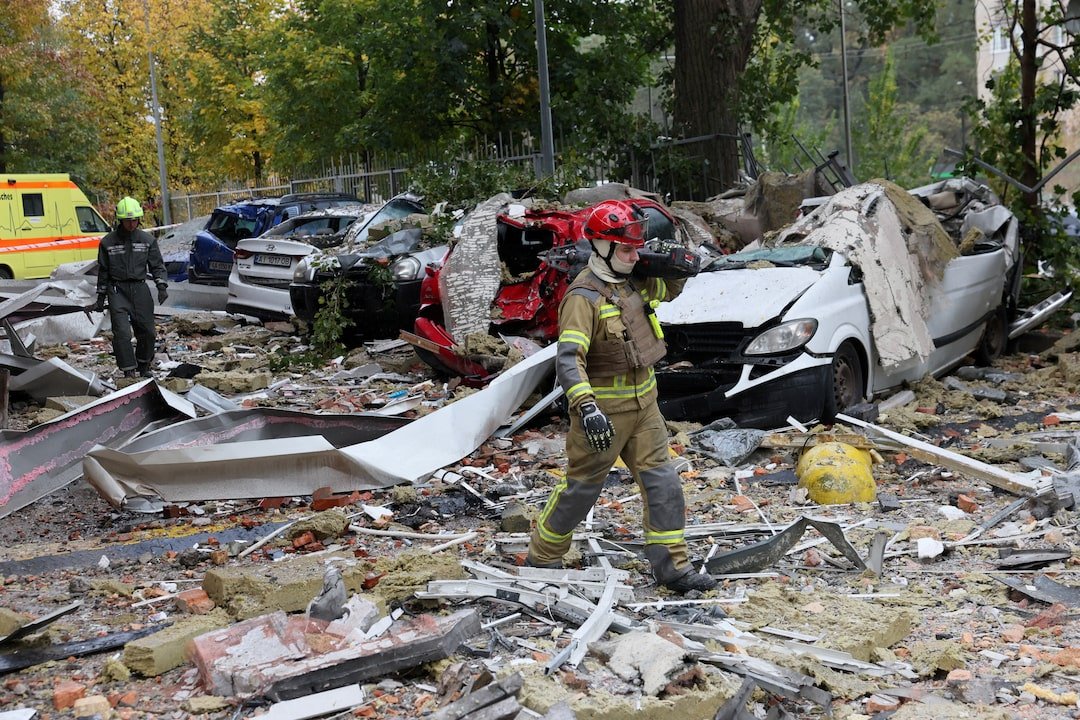
At least four people, including two Ukrainians aged over 80, were killed in overnight Russian attacks across Ukraine, officials said on October 21, as Moscow intensified strikes on energy infrastructure and US President Donald Trump urged Kyiv to reach a peace agreement with Russia.
The attacks targeted power facilities in four regions, damaged residential buildings and struck civilian infrastructure, according to Ukrainian officials. The casualties included two people killed in Kyiv after a drone hit an apartment building and an elderly man and woman who died outside the northeastern city of Kharkiv.
The latest strikes came amid growing pressure on Ukraine to negotiate an end to the war, which has continued for more than four years. Trump’s call for Kyiv to agree to terms coincided with renewed diplomatic activity involving US special envoy Steve Witkoff and Russian President Vladimir Putin.
Russian Attacks Kill Four People Across Ukraine
Ukrainian police reported that four people were killed in overnight Russian attacks, including two residents of the capital, Kyiv. A drone struck an apartment building in the city, killing two people, highlighting the continuing danger faced by civilians as aerial attacks persist.
Two other victims were killed near Kharkiv in northeastern Ukraine. Police identified them as an 83-year-old man and an 81-year-old woman. Their deaths underscored the risks faced by older residents living in areas affected by the conflict.
Ukrainian officials also reported damage and injuries in several other parts of the country. A university building and a shopping centre in central Ukraine were struck, while injuries were reported in the Poltava, Lviv, Cherkasy and Chernihiv regions.
The breadth of the reported damage illustrated the geographical reach of the overnight attacks, which affected residential areas, educational facilities, commercial property and critical infrastructure.
Energy Facilities Targeted in Four Ukrainian Regions
Ukrainian Prime Minister Sergii Koretskyi said Russian forces attacked power facilities in the Kyiv, Volyn, Odesa and Mykolaiv regions. Civilian enterprises in at least two additional regions were also targeted, he said.
The attacks on energy infrastructure come as Ukraine approaches the winter months, when households, hospitals, businesses and public services depend heavily on reliable electricity and heating.
Damage to power generation, transmission or distribution infrastructure can disrupt electricity supplies well beyond the immediate location of a strike. Repairs may also become more difficult when facilities are repeatedly targeted, increasing the pressure on emergency services and energy workers.
Ukraine has faced repeated Russian attacks on its energy system during the war. The latest strikes form part of a broader campaign that Ukrainian officials say threatens the country’s ability to maintain essential services as temperatures fall.
The potential consequences extend beyond electricity shortages. Disruptions can affect water supplies, communications, transport, healthcare and industrial activity, making the protection and restoration of critical infrastructure a major concern for the Ukrainian government.
What Russia Said About the Overnight Strikes
Russia’s Defence Ministry said its forces had struck a warehouse complex in Poltava that it described as being used to store drones. It also reported hitting an electric power substation that supplies Ukraine’s defence and industrial sectors, as well as logistics centres in Kyiv.
The ministry further claimed that Russian forces had hit a ship carrying military cargo to Ukraine as it headed towards the port of Odesa.
These statements presented the attacks as operations against facilities linked to Ukraine’s military and industrial capabilities. Ukrainian officials, meanwhile, reported civilian deaths, injuries and damage to residential and public buildings.
The claims from the two sides describe different aspects of the attacks, and the reported military targets and damage to civilian infrastructure should be distinguished when assessing their consequences. The available account does not independently establish the full extent of the damage at every location.
Trump Urges Ukraine to Agree to Peace Terms
The attacks took place hours after US President Donald Trump urged Ukraine to make a deal to settle the conflict. Trump said Moscow wanted to reach an agreement, renewing pressure for a negotiated end to the war.
His remarks came as diplomatic efforts continued to explore a possible path towards ending the fighting. However, a call for negotiations does not by itself establish that the two sides have reached agreement on the terms, territorial questions or security arrangements that would shape any settlement.
For Kyiv, the challenge is to weigh the prospect of ending the fighting against the conditions of a potential agreement. Any settlement would have major implications for Ukraine’s sovereignty, security and territorial integrity, as well as for the future relationship between Russia and Western countries.
For Moscow, negotiations would involve determining the conditions under which it would be prepared to stop military operations. The positions of the two governments and the details of any proposed agreement remain central to whether diplomatic efforts can produce a lasting outcome.
The continued attacks on Ukrainian cities and energy facilities also highlight the gap between diplomatic calls for peace and conditions on the ground. While political leaders discuss possible terms, civilians continue to face the consequences of the ongoing conflict.
US-Ukraine Relations Face Strain
Relations between Washington and Kyiv have come under significant strain, according to the report. Ukrainian President Volodymyr Zelenskiy has reported a pause in advance warnings about missile strikes and limitations involving Elon Musk’s Starshield system.
Such developments are significant because Ukraine relies on intelligence, communications and military assistance from Western partners to defend itself against Russian attacks. Changes in the availability or timing of support can affect how Ukrainian authorities prepare for incoming threats and coordinate their response.
Advance warnings can help officials assess risks, alert emergency services and take steps to protect civilians and critical infrastructure. Reliable communications systems are also important for maintaining coordination between military units and other parts of the response network.
The reported strain adds another dimension to the diplomatic challenge facing Kyiv. Ukraine must continue defending its territory while navigating discussions with the United States, a key partner in its efforts to resist Russia’s invasion.
The precise operational effects of the reported warning hiatus and Starshield limitations were not detailed in the supplied report. Their broader significance lies in the importance of intelligence-sharing and communications support during a conflict in which missile and drone attacks remain a persistent threat.
Steve Witkoff Set to Meet Putin in St Petersburg
US special envoy Steve Witkoff was due to meet Russian President Vladimir Putin in St Petersburg on Wednesday for talks concerning Ukraine. The meeting was scheduled as Trump publicly called on Kyiv to agree to peace terms.
Witkoff’s planned visit represented a further diplomatic effort to engage Moscow over the conflict. However, the announcement of talks did not establish whether an agreement would emerge or what specific proposals would be discussed.
Any negotiations will need to address difficult questions, including the conditions for ending hostilities and the arrangements required to prevent renewed fighting. The positions taken by Russia and Ukraine, along with the role of the United States and other international partners, will influence the prospects for progress.
The timing of the planned meeting was particularly notable because Russian attacks continued even as Washington pressed for a settlement. The overnight strikes demonstrated that military operations remained active alongside diplomatic efforts.
Russian Authorities Report Drone Interceptions Near St Petersburg
Separately, the governor of Russia’s Leningrad region, which surrounds St Petersburg, said on Wednesday that Russian forces had shot down three drones over the region.
The announcement came ahead of Witkoff’s planned meeting with Putin in the city. The report did not establish who launched the drones or provide further details about their intended targets.
Drone warfare has become a prominent feature of the conflict, with both countries reporting aerial attacks and interceptions. Such incidents can complicate military planning and create additional security concerns around important locations.
Why the Winter Energy Situation Matters for Ukraine
The latest attacks have renewed concerns about Ukraine’s energy security as winter approaches. Electricity and heating are essential for protecting civilians from cold weather, keeping hospitals operational and maintaining basic public services.
Repeated damage to energy facilities can force authorities to prioritise repairs, organise emergency supplies and consider contingency arrangements if power shortages occur. Industrial operations may also be affected, potentially adding pressure to an economy already strained by the war.
Residential areas face particular risks when infrastructure disruptions coincide with continued attacks. Older people and others who have difficulty relocating may be especially vulnerable when heating, electricity or access to essential services is interrupted.
The deaths of the 83-year-old man and 81-year-old woman near Kharkiv, alongside the two fatalities in Kyiv, underline the human cost of the latest round of violence. Beyond those killed or injured, strikes can leave residents dealing with damaged homes, disrupted routines and uncertainty over further attacks.
Ukraine’s immediate priorities include responding to casualties, assessing damage and restoring essential services. At the same time, its government must manage the military and diplomatic consequences of a conflict that continues despite international efforts to secure a settlement.
What Happens Next in the Russia-Ukraine War?
The next developments will depend in part on the outcome of diplomatic contacts between Washington and Moscow and on whether the parties can identify terms that are acceptable to the governments involved.
Witkoff’s planned meeting with Putin was an important scheduled event in the latest diplomatic push, but no outcome should be assumed before details are confirmed. Trump’s call for Ukraine to agree to a deal also leaves open questions about the proposed terms and the role Kyiv would play in determining any settlement.
Meanwhile, the reported attacks on power facilities suggest that Ukraine’s energy infrastructure will remain a major concern as the country prepares for winter. The scale of damage, the speed of repairs and the possibility of further strikes will influence the pressure on households, businesses and public services in the coming months.
For civilians, the immediate concerns remain safety, access to essential services and the threat of further attacks. For political leaders, the challenge is to determine whether diplomatic engagement can produce a sustainable end to the fighting while addressing the security concerns at the centre of the conflict.
The overnight Russian strikes, which killed four people including two elderly Ukrainians, therefore came at a critical moment: as Washington renewed its push for negotiations, Kyiv reported strains in its relationship with the United States, and preparations for winter increased the urgency of protecting Ukraine’s power infrastructure.
For breaking news and live news updates, like us on Facebook or follow us on Twitter and Instagram. Read more on Latest World on thefoxdaily.com.





COMMENTS 0