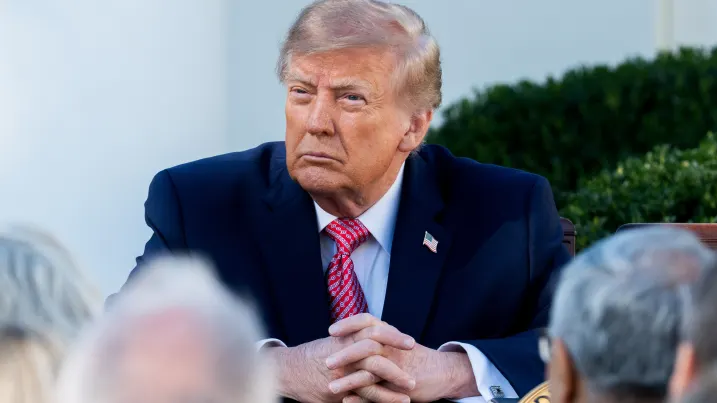
US President Donald Trump has been ordered to cooperate with court-mandated evidence gathering and sit for a deposition in his $10 billion lawsuit against the BBC, with a federal judge warning that failure to comply could lead to the case being dismissed.
The order follows a dispute over the discovery process in Trump’s legal action against the British broadcaster. The lawsuit concerns a BBC Panorama documentary that edited together remarks Trump made during a rally on January 6, 2021, before the riot at the US Capitol.
Federal magistrate judge Enjoliqué Lett issued the order during a lengthy hearing in Miami, addressing concerns about the documents Trump’s legal team had provided and a previously cancelled deposition. She directed the plaintiff’s team to produce relevant documents within 30 days and ordered Trump to sit for a deposition by December 11.
The judge also rejected Trump’s request to prevent the deposition from being videotaped, although access to the recording will be restricted to attorneys involved in the case. Separately, she allowed the BBC to proceed with a subpoena seeking information from Mar-a-Lago, Trump’s Florida club.
The dispute places the case at a critical procedural stage. Although the underlying lawsuit concerns the BBC’s editing of Trump’s January 6 remarks, the immediate issue is whether the president’s legal team will comply with the court’s requirements for exchanging evidence and providing testimony.
Why Trump Is Suing the BBC for $10 Billion
The lawsuit stems from a BBC Panorama documentary that spliced together comments Trump made during a rally on January 6, 2021, before the riot at the US Capitol.
Trump’s legal team has argued that the broadcast caused him personal harm under Florida’s Unfair and Deceptive Trade Practices Act. The legal dispute therefore involves questions about the documentary’s editing, the alleged harm and the basis on which the lawsuit can proceed.
The source material states that the broadcast was not readily available to view in Florida. Nevertheless, Trump’s team has argued that he was personally damaged by it under the relevant Florida law.
The $10 billion figure represents the scale of the lawsuit described in the case. It should not be interpreted as a damages award or a finding that the BBC is liable. The dispute remains subject to the legal process, and the judge’s latest order addresses discovery obligations rather than resolving the underlying allegations.
Discovery is the stage of litigation in which parties exchange documents, obtain relevant information and take testimony to prepare their cases. It can help each side establish the factual record needed to support its arguments or challenge the other party’s claims.
In this case, the judge’s concerns about document production and the scheduling of Trump’s deposition have become central to the proceedings. Before the underlying claims can be fully addressed, the parties must comply with the court’s requirements for gathering evidence.
Judge Warns Trump Team Over Missing Documents
One of the main issues at the Miami hearing was the adequacy of the documents Trump’s legal team had provided to the BBC. Judge Lett agreed with the broadcaster’s lawyers that the plaintiff’s side had not been sufficiently forthcoming in producing internal materials relevant to the case.
According to the account of the hearing, the documents produced by Trump’s team consisted primarily of material taken from the internet or information that had originally been supplied by the BBC itself.
Charles Tobin, representing the BBC, argued that the discovery process remained heavily imbalanced because his side had received little substantive material from the plaintiff.
“We still have a completely lopsided [situation] here on discovery. They have produced absolutely nothing of any substance,” Tobin argued in court.
The judge also questioned whether Trump’s team had conducted a sufficiently thorough search for documents responsive to the BBC’s requests.
“The court is not satisfied that anyone is doing a thorough job,” Lett told Trump’s Florida-based attorney, Alejandro Brito.
The comments indicate that the judge’s concerns extended beyond the number of documents produced. She questioned whether the plaintiff’s legal team had made an adequate effort to identify and provide relevant materials.
For the BBC, access to the requested documents is important because discovery can help establish the factual basis of the claims being litigated. For Trump’s team, the order creates a clear obligation to improve its document production within the court’s prescribed timetable.
Trump Given 30 Days to Produce Relevant Documents
Judge Lett gave Trump’s legal team 30 days to produce the relevant documents. She acknowledged that discovery can be burdensome for both sides but warned that failure to comply could have serious consequences.
“This is the last opportunity to do so.”
The judge’s warning made clear that the court expected meaningful compliance rather than further delays or an inadequate response to outstanding requests.
She said failure to meet the requirements could result in sanctions, including possible dismissal of the lawsuit for failure to prosecute the case and participate meaningfully in discovery.
Dismissal would be a significant procedural consequence for a lawsuit seeking $10 billion from the BBC. However, the judge has not dismissed the case under the order described in the source material. The warning establishes what could happen if the plaintiff fails to meet the court’s requirements.
The distinction between a warning and an actual sanction is important. The latest order gives Trump’s team an opportunity to comply, while placing the consequences of further non-compliance on the record.
The order also underscores that parties bringing lawsuits must participate in the litigation process, including complying with requests for relevant evidence and attending court-ordered testimony.
Why Trump Must Sit for a Deposition by December 11
Judge Lett also addressed the BBC’s request to compel Trump to attend a deposition. The broadcaster had sought testimony after an earlier scheduled date of October 16 was cancelled.
Trump’s counsel said the deposition had been postponed because of what he described as other matters of national importance. The BBC’s lawyers disputed the explanation, noting that Trump had been campaigning in Georgia on the date in question.
Tobin characterised the explanation as “fake news”, according to the account of the hearing. Brito responded that the president was involved in numerous matters each day that the BBC’s legal team did not know about.
The disagreement highlights the competing positions over scheduling. Trump’s team pointed to the demands on the president’s time, while the BBC argued that the deposition needed to take place within the court’s discovery timetable.
Judge Lett said she was required to follow the schedule governing the case. She ordered Trump to sit for a deposition by December 11, while recognising that the timetable could be extended by district court judge Jeffrey T Kuntz.
Tobin indicated that the BBC would be willing to move the deposition if Kuntz adjusted the discovery schedule. The broadcaster’s position, as described in the hearing, was therefore tied to the court’s timetable rather than an absolute refusal to consider a different date.
In a court filing on Wednesday, Trump’s team said he would be willing to sit for a deposition during the second or third week of January. That proposed window came after the December 11 deadline set by Lett.
Unless the schedule is changed, the difference between the court-ordered date and Trump’s proposed availability creates a timing issue that the parties must resolve through the legal process.
Judge Rejects Trump’s Request to Block Video Recording
During the hearing, Lett rejected a request from Trump’s legal team to prevent his deposition from being videotaped.
The deposition is expected to last seven hours. Although the judge allowed the recording, access will be limited to attorneys involved in the case.
A deposition is a form of sworn testimony taken outside a courtroom as part of discovery. Lawyers can question a witness, obtain answers on the record and use the resulting evidence in accordance with the applicable rules.
Video recording can preserve not only the words spoken but also the manner in which testimony is delivered. In this case, however, the judge’s decision does not make the recording publicly accessible. The restriction means that the recording will remain available only to the attorneys involved in the litigation.
The ruling addresses how the deposition will be conducted, rather than deciding the merits of Trump’s allegations against the BBC.
BBC Wins Approval for Subpoena to Mar-a-Lago
The hearing also addressed the BBC’s request to subpoena Mar-a-Lago, Trump’s Florida club, for information relevant to the case. Judge Lett allowed the subpoena to proceed despite objections from Trump’s lawyer.
Brito argued that Mar-a-Lago was a separate business and should not be treated as part of the president’s occupation.
“The president’s occupation is the president of the United States,” Brito said. “It has nothing to do with Mar-a-Lago as far as his occupation.”
The BBC’s lawyers disputed that separation. Tobin argued that the club was closely connected to Trump’s public reputation and business interests, pointing to its use as a venue for meetings with political leaders.
“His business successes are a measure of his reputation,” Tobin argued.
The judge agreed that Mar-a-Lago fell within the scope of discoverability for the purposes of the case.
“I think it is intertwined with his profession and therefore any harm that may be alleged under his professional trade and occupation would be reflected with how he conducts business with Mar-a-Lago, at least for discovery purposes,” Lett said.
The decision allows the BBC to pursue the requested information through the subpoena. It does not establish that Mar-a-Lago is legally responsible for the alleged harm or that the club’s records prove Trump’s claims.
Instead, the ruling reflects the judge’s conclusion that information connected to the club may be relevant to the allegations and therefore subject to discovery.
Can Trump’s $10 Billion Lawsuit Be Dismissed?
Yes, dismissal is one of the possible sanctions identified by Judge Lett if Trump fails to comply with the discovery requirements. The judge warned that continued failure to produce relevant documents or engage meaningfully in the process could result in the case being dismissed.
However, dismissal has not been reported as an outcome of the hearing described in the source material. Trump has been given an opportunity to comply with the document-production order and must also meet the deposition requirement unless the court changes the timetable.
The judge’s warning concerns the conduct of the litigation. It is separate from the question of whether the BBC’s documentary was legally defamatory or otherwise actionable under the claims asserted by Trump.
The court has not resolved those underlying allegations through the discovery order. The immediate focus remains on ensuring that both sides can obtain relevant evidence and proceed according to the applicable schedule.
What Happens Next in the Trump-BBC Case?
The next stage will depend on whether Trump’s team complies with the document-production order, attends the deposition within the prescribed period and follows any further directions from the court.
Several developments will be important to watch:
- Document production: Trump’s team has been given 30 days to provide relevant documents following the judge’s criticism of its earlier disclosures.
- The deposition deadline: Trump has been ordered to sit for a seven-hour deposition by December 11, unless the court changes the schedule.
- Possible timetable adjustments: District court judge Jeffrey T Kuntz may extend the discovery schedule, potentially affecting the deposition date.
- The Mar-a-Lago subpoena: The BBC has been allowed to pursue relevant information from Trump’s Florida club as part of discovery.
- Potential sanctions: Continued non-compliance could result in sanctions, including dismissal of the lawsuit.
These procedural developments will determine how the case progresses before the court considers the underlying dispute over the BBC’s documentary.
Why the Latest Order Matters
The ruling places the focus on the obligations that come with bringing a lawsuit. Plaintiffs must provide relevant evidence, respond to discovery requests and comply with court orders even when the litigation involves a prominent public figure.
For the BBC, the order creates an opportunity to pursue documents and testimony it considers necessary to defend itself against Trump’s claims. For Trump, it establishes specific deadlines and makes clear that the court expects substantive compliance.
The dispute also demonstrates why discovery can become a major battleground in high-profile litigation. Before a court can resolve the merits of a case, the parties must establish an evidentiary record through documents, testimony and other relevant material.
For now, the $10 billion lawsuit remains unresolved. Judge Lett’s order does not determine whether the BBC’s editing of Trump’s January 6 remarks violated the law. Instead, it puts Trump’s team on notice that failure to participate meaningfully in discovery could jeopardise the case before those central allegations are decided.
For breaking news and live news updates, like us on Facebook or follow us on Twitter and Instagram. Read more on Latest World on thefoxdaily.com.






COMMENTS 0