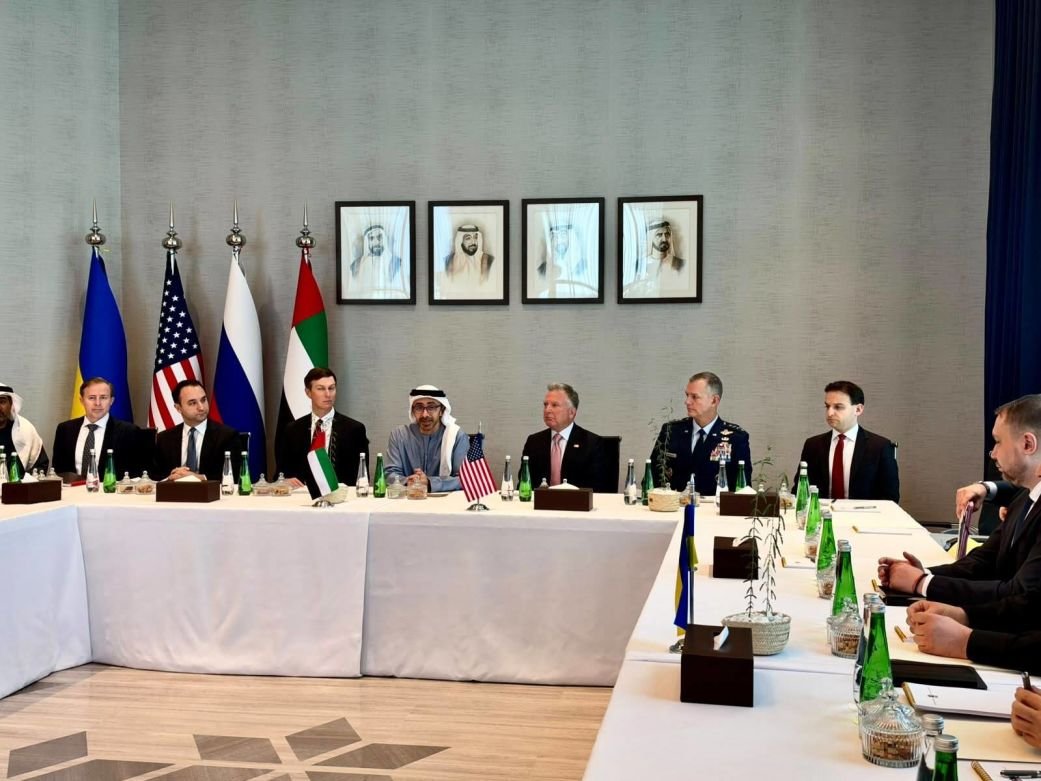
Peace negotiations involving Ukraine, Russia and the United States have resumed in Abu Dhabi, marking a renewed diplomatic effort to end Russia’s nearly five-year war against Ukraine. The latest round is significant because it comes after months without trilateral talks, amid a fresh push by the Trump administration and growing pressure from European countries to have a direct role in decisions affecting the continent’s security.
The discussions lasted more than four hours on Tuesday and were described by US officials as very productive. Ukrainian President Volodymyr Zelensky called the meeting constructive and substantive, while confirming that negotiations were expected to continue on Wednesday morning in the United Arab Emirates capital.
However, the renewed diplomatic activity does not necessarily mean that a peace agreement is close. Russia continues to demand major concessions from Ukraine, including control over the eastern Donbas region, restrictions on Ukraine’s military and an end to Kyiv’s ambitions to join NATO. These demands have repeatedly been rejected by Ukraine.
What makes the latest negotiations different is the growing involvement of European governments in parallel discussions, the focus on long-term security guarantees for Ukraine and the changing relationship between Washington and Kyiv. At the same time, the situation on the battlefield and uncertainty surrounding future US support continue to complicate the prospects for a settlement.
Why Have Ukraine, Russia and the US Resumed Peace Talks?
The latest negotiations represent a renewed effort by the Trump administration to bring the war to an end through direct discussions involving the three countries. They are the first trilateral negotiations of their kind since February, following earlier rounds that failed to produce a significant breakthrough.
The talks are taking place in Abu Dhabi, where US, Ukrainian and Russian representatives have gathered to discuss the future of the conflict. The first session on Tuesday continued for more than four hours before officials indicated that discussions would resume the following morning.
US representatives described the opening session as very productive. Zelensky also thanked Washington for organising the negotiations and characterised the discussions as constructive and quite substantive.
Those descriptions indicate that the participants engaged in detailed discussions, but they do not establish that the sides have agreed on the central questions dividing them. Territorial control, Ukraine’s future military capabilities and the security arrangements required after a ceasefire remain major obstacles.
The renewed negotiations also come as Russia continues its military campaign and Ukraine faces pressure on its energy infrastructure and air defences. The diplomatic effort is therefore unfolding alongside an ongoing conflict rather than after a pause in fighting.
Who Is Leading the Abu Dhabi Peace Negotiations?
The negotiations involve senior representatives from all three countries, although the delegations have different structures and political roles.
US Delegation: Jared Kushner and Steve Witkoff
The United States is represented by Jared Kushner, US President Donald Trump’s son-in-law, and Steve Witkoff, the administration’s Middle East envoy.
Kushner does not hold an official position within the Trump administration, but he has taken part in the president’s diplomatic efforts. Witkoff has also been involved in negotiations connected to the administration’s international policy priorities.
Their presence reflects Trump’s decision to rely on close associates and special envoys to pursue negotiations rather than limiting the process to officials holding conventional diplomatic posts.
Ukraine Delegation: Rustem Umerov
Ukraine’s delegation is led by Rustem Umerov, the country’s foreign intelligence chief and leading negotiator.
Umerov has been central to Kyiv’s diplomatic engagement with Washington and other international partners. His role in Abu Dhabi is particularly important because Ukraine wants European governments to participate directly in discussions about the country’s future security.
Before the trilateral meeting, Umerov said Ukraine was doing everything possible to ensure that Europe became a participant in the diplomatic process.
Russia Delegation: Senior Diplomatic and Military Representatives
Russia has sent a delegation that includes senior diplomatic, political and military figures. Russian state news agency TASS identified Deputy Foreign Ministers Sergei Ryabkov and Mikhail Galuzin among the representatives.
The reported delegation also includes Kremlin aide Vladimir Medinsky, military intelligence chief Igor Kostyukov and General Staff member Yuri Zhigarlovsky.
The composition brings together officials with diplomatic, political and military backgrounds. Their participation reflects the range of issues involved in negotiations over territorial control, military arrangements and the future security framework surrounding Ukraine.
What Makes These Ukraine Peace Talks Different This Time?
The most notable difference is the stronger effort by European countries to secure a direct role in discussions about Ukraine’s future. Previous diplomatic efforts have raised concerns in Europe that decisions about the continent’s security could be negotiated primarily between Washington and Moscow, leaving European governments with limited influence.
Several European officials are now in Abu Dhabi for separate meetings. Representatives from the United Kingdom, France, Germany and Italy, collectively known as the E4, are present alongside officials from NATO and the European Commission.
These representatives met with Ukrainian and American delegations before the trilateral negotiations began on Tuesday. Their presence creates a parallel diplomatic channel, even though Russia has insisted that the main negotiations should remain strictly trilateral.
The second major difference is the increased attention being given to security guarantees for Ukraine. Discussions are not limited to how the fighting could stop. Ukrainian and Western officials are also examining what arrangements would be needed to prevent another conflict after a settlement.
A third difference is the changing political environment in Washington. The Trump administration has taken a different approach to Ukraine from the previous US administration, creating uncertainty about the scale and continuity of American support.
Together, these developments make the Abu Dhabi discussions more complicated than a simple ceasefire negotiation. Any settlement would need to address Ukraine’s territorial demands, European security concerns and the question of how future guarantees could be enforced.
Why Is Europe Demanding a Direct Role in the Negotiations?
European governments argue that the outcome of the Ukraine war will directly affect the security of the wider continent. They therefore want a meaningful role in shaping any agreement rather than being asked to support a settlement negotiated without their participation.
The French presidency emphasised this position before Tuesday’s talks, saying that peace in Ukraine and security in Europe are closely connected.
“Our objective is to assert a fundamental principle: the pursuit of peace in Ukraine and security in Europe are inextricably linked,” the Elysée Palace said.
European governments are particularly concerned about the long-term consequences of an agreement that might leave Ukraine vulnerable to renewed military pressure. They also have a direct interest in the future security arrangements, given their geographic proximity to the conflict and their role in supporting Ukraine.
Ukraine shares that position. Umerov has publicly stressed the importance of European participation, while Zelensky has discussed the need for reliable security guarantees as part of any eventual settlement.
US envoy Steve Witkoff said he and Kushner met Ukrainian and European partners on Tuesday to continue coordination on ending the war. He said the discussions included support for strong security guarantees as part of a lasting peace agreement.
Witkoff also said participants reaffirmed their commitment to a strong post-war European security framework and recognised NATO’s central role in collective defence.
US Secretary of State Marco Rubio, speaking from Paris during a G7 meeting, said the administration wanted to expand the current negotiations so that European representatives could eventually sit directly at the table.
Rubio also sought to minimise differences between Washington and European capitals over the broader objective of ending the war, saying their goals were the same.
Why Is Russia Objecting to European Participation?
Although European officials are holding separate meetings in Abu Dhabi, Moscow wants the main negotiations to remain a three-country process involving Russia, Ukraine and the United States.
Russian Foreign Minister Sergey Lavrov criticised the presence of European representatives, describing their involvement as an unpromising approach. His comments underline a fundamental disagreement over who should help shape the eventual settlement and the security arrangements that follow it.
For Russia, keeping the central negotiations trilateral limits the number of governments directly involved in deciding the terms. European countries, however, argue that any agreement affecting Ukraine’s security and the wider European order cannot be negotiated without their participation.
The disagreement is not simply about who attends the meetings. It concerns the future security structure of Europe, NATO’s role and whether Russia should have a voice in arrangements involving countries that Moscow considers part of its broader security environment.
The European presence in Abu Dhabi therefore represents an effort to remain involved in the diplomatic process even while the formal negotiations continue between the three principal parties.
Security Guarantees Have Become a Central Issue
One of the most important subjects discussed in Abu Dhabi is how Ukraine could be protected if a peace agreement is reached. Kyiv wants assurances that Russia will not launch another invasion after hostilities end.
For Ukraine, a ceasefire without credible long-term protection could leave the country exposed to renewed military pressure. This is why its negotiators are treating security guarantees as a central part of any settlement rather than an issue to be addressed after the war.
Zelensky said the negotiators discussed the substance of security guarantees for Ukraine and the foundations needed to make those guarantees work over the long term.
Witkoff also said the US, Ukrainian and European representatives discussed arrangements intended to support a durable peace. The participants reaffirmed their commitment to a post-war European security framework and recognised NATO’s continuing importance to collective defence.
However, the question of what those guarantees would actually involve remains unresolved. A meaningful arrangement would need to clarify what support Ukraine could receive if it were attacked again, which countries would provide that support and how their commitments would operate in practice.
Russia’s position adds another complication. Moscow has its own demands concerning NATO and the wider European security framework, while Ukraine and its European partners oppose arrangements that would undermine Kyiv’s sovereignty or restrict its independent decisions.
The negotiations must therefore address not only the end of the current fighting but also the competing security expectations that have helped sustain the conflict.
How Likely Is a Breakthrough in the Abu Dhabi Talks?
Expectations for a major breakthrough remain limited. Previous rounds of trilateral negotiations have failed to resolve the fundamental disagreements between Moscow and Kyiv, particularly over territory and Ukraine’s future military and political position.
Earlier discussions in Geneva in February did not deliver the outcome Ukraine wanted. A subsequent round that had been expected in March was postponed after the war involving Iran disrupted the diplomatic schedule.
The Abu Dhabi meetings are therefore a renewed attempt to restart a process that had stalled for months. The fact that officials have returned to the negotiating table is significant, but it does not mean the sides have moved closer to agreement on the most difficult questions.
Russia continues to demand control over Ukraine’s eastern Donbas region, a reduction in the size of Ukraine’s armed forces and an end to Kyiv’s ambition to join NATO. Ukraine has repeatedly rejected these demands, particularly proposals that would require it to surrender territory.
John Herbst, senior director of the Atlantic Council’s Eurasia Center and a former US ambassador to Ukraine, urged caution about the prospects for the negotiations.
“They are only taking place because Putin wants to give Trump a reason to continue to distance himself from Ukraine,” Herbst wrote.
His assessment reflects wider doubts among some Western observers about whether Moscow is prepared to make meaningful compromises. European Union foreign policy chief Kaja Kallas has also questioned Russia’s willingness to negotiate in good faith.
There are reasons for caution on the Ukrainian side as well. Any agreement that requires Kyiv to give up territory or accept restrictions on its future security choices would face significant political and strategic obstacles.
The opening session’s positive descriptions from US and Ukrainian officials should therefore be viewed as an indication that discussions took place constructively, not as evidence that a settlement is imminent.
What Is Happening on the Ground in Ukraine?
The negotiations are taking place while fighting continues across Ukraine. Russia’s military campaign has involved repeated attacks on cities and critical infrastructure, while Ukrainian forces continue to defend their positions and target Russian military and industrial assets.
One of the most pressing concerns is the growing pressure on Ukraine’s energy system as winter approaches. Russian drone and missile attacks have targeted power infrastructure, creating risks for households, hospitals and essential services during periods of falling temperatures.
Zelensky said Russian attacks left more than 600,000 people in the Dnipropetrovsk region without electricity overnight into Sunday. The disruption illustrates how attacks on energy facilities can affect civilian life far beyond the immediate location of a strike.
The conflict has also taken a heavy toll on civilians. The source material reports a deadly bombing at a school building used as a shelter and aid centre in Zaporizhzhia, as well as rising civilian deaths. Such incidents underline the humanitarian consequences of the continuing war, although casualty figures and details of individual attacks require careful verification as information emerges.
Ukraine’s air defences face additional challenges from the changing technology used in Russian attacks. Russia has increasingly deployed faster, jet-powered Shahed drones, which can be more difficult to intercept than slower versions.
At the same time, Ukraine has faced shortages of US-made Patriot missile interceptors. These systems are among the weapons capable of engaging ballistic missiles, making their availability particularly important as Russia continues missile attacks.
The battlefield situation matters directly to the negotiations. Each side’s assessment of its military position influences the concessions it may be prepared to consider. Continued attacks also make it harder to build confidence that a diplomatic agreement would be respected.
Why Is the US Approach to Ukraine Different Under Trump?
The Trump administration’s relationship with Kyiv has been more complicated than the approach taken by the previous US administration, which positioned Washington as Ukraine’s leading international military and financial supporter.
Trump has made ending the war a major diplomatic objective, but his administration has also placed pressure on Ukraine to consider an agreement. The United States halted financial aid to Ukraine at the beginning of 2025, while questions have also emerged over the continuity of intelligence and technology support.
Ukraine has expressed concern about gaps in intelligence assistance. Last month, Zelensky accused Western allies of failing to provide warnings ahead of several ballistic missile attacks. The Trump administration denied the allegation.
There have also been disagreements involving satellite communications. Ukraine’s military relies on satellite connectivity for important operational functions, and changes affecting access to military-grade Starshield services have raised concerns about the reliability of that support.
Trump denied approving a decision to impose speed limits on the satellite terminals, while Elon Musk said in a social media post that the administration was behind the restriction.
These disputes have contributed to uncertainty about how much support Kyiv can expect from Washington during the negotiations and after any potential settlement.
Could the US Midterm Elections Change Washington’s Ukraine Policy?
The recent US midterm elections have added another political dimension to the peace process. Democratic victories have raised questions about whether a change in the balance of power in Congress could influence future American support for Ukraine.
Zelensky has publicly expressed hope that Democrats’ stronger position will help sustain assistance to Kyiv. He has pointed to the party’s stated support for Ukraine and its continued provision of aid.
However, an election result does not automatically produce a change in foreign policy. Congress can influence funding, oversight and legislation, but the administration continues to play a central role in diplomatic decisions and the direction of US foreign policy.
It therefore remains uncertain whether the midterm results will lead to a significant shift in Washington’s approach to the war.
The political debate is also taking place against the background of economic pressures, including higher energy prices associated with the Iran conflict. These pressures have affected the domestic political environment and added to the administration’s interest in pursuing an agreement.
For Ukraine, the central concern is whether American military, financial and intelligence support will remain dependable while negotiations continue. For Russia, changes in Washington’s approach could affect its calculations about how long the conflict can continue and what terms might eventually be acceptable.
Trump’s Comments on Ukraine’s Future Territory Add to Uncertainty
Trump has suggested that Ukraine may ultimately have to accept territorial changes as part of a settlement. In an interview broadcast on Sunday, he declined to say whether he trusted Zelensky or Russian President Vladimir Putin more and described a possible future in which Ukraine would have a different shape.
“They’re gonna end up with a little bit different shape, Ukraine,” Trump said.
The comment reflects the possibility that Washington could press Kyiv to consider territorial compromises. However, Zelensky has repeatedly rejected surrendering Ukrainian territory to Russia.
Territorial control remains one of the most difficult issues in the negotiations because it involves Ukraine’s sovereignty and the status of areas occupied by Russian forces.
Any proposal involving changes to Ukraine’s borders would face major political and constitutional questions in Kyiv. It would also need to address the security of people living in affected areas and the status of territory under Russian control.
The gap between Trump’s comments and Ukraine’s stated position illustrates why a diplomatic breakthrough remains difficult even with renewed US involvement.
What Are the Main Obstacles to a Ukraine Peace Agreement?
Several major disagreements continue to stand in the way of a settlement:
- Territorial control: Russia wants control over the entire Donbas region, while Ukraine rejects surrendering its territory.
- NATO membership: Moscow wants Ukraine to abandon its ambition to join the alliance, a demand Kyiv has resisted.
- Ukraine’s military: Russia is demanding restrictions on the size of Ukraine’s armed forces, raising concerns about the country’s ability to defend itself.
- Security guarantees: Ukraine wants credible long-term protection against another Russian attack, while the details and enforcement of such guarantees remain unsettled.
- European participation: European governments want a direct role in decisions affecting their security, while Russia has objected to their involvement in the main trilateral format.
- Trust and enforcement: Any agreement would need mechanisms to monitor compliance and respond to violations, particularly given the continuing fighting and lack of trust between the sides.
These issues are interconnected. For example, Ukraine’s willingness to discuss territorial arrangements would be influenced by the strength of the security guarantees it receives. Similarly, any agreement on NATO or Ukraine’s military would have implications for the wider European security system.
What Happens After the Abu Dhabi Negotiations?
The talks are expected to continue on Wednesday, with the delegations facing the challenge of turning broad diplomatic discussions into specific proposals.
The immediate focus is likely to remain on security arrangements, de-escalation and the unresolved political questions surrounding the conflict. European governments are also seeking a path towards more direct participation in the wider negotiations.
US Secretary of State Marco Rubio has said Washington wants European partners represented directly at the negotiating table. Whether Russia agrees to such an expanded format remains uncertain.
Another important question is whether the discussions can produce progress on practical measures, such as reducing attacks on energy infrastructure, improving humanitarian arrangements or establishing more reliable communication between the parties.
Even limited agreements could help create conditions for further negotiations, although they would not resolve the central dispute over territory and Ukraine’s long-term security.
Why the Restarted Peace Talks Matter
The return of Russian, Ukrainian and American representatives to direct negotiations after nine months is an important diplomatic development. It creates another opportunity to discuss an end to the war at a time when continued fighting is placing growing pressure on Ukraine’s population and infrastructure.
But the latest round is different from earlier efforts because European governments are pressing more visibly for a role, security guarantees have become a central part of the discussions and Washington’s policy towards Kyiv remains uncertain.
The first day’s positive descriptions offer some indication that the parties are willing to continue talking. Yet Russia’s territorial and military demands remain far apart from Ukraine’s position, and European concerns about the future security framework have not been resolved.
The outcome will depend on whether the negotiations can move beyond general statements towards practical compromises that Ukraine, Russia and their international partners are prepared to accept. Until those differences are addressed, the restart of talks should be seen as a renewed diplomatic opportunity rather than a sign that peace is close.
For breaking news and live news updates, like us on Facebook or follow us on Twitter and Instagram. Read more on Latest World on thefoxdaily.com.






COMMENTS 0