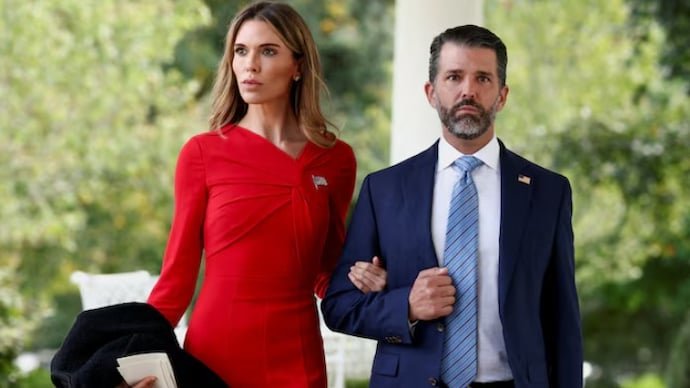
- Donald Trump Jr.’s Bahamas Wedding Comes at a Difficult Time
- Trump’s Remarks Reflect the Political No-Win Situation Presidents Often Face
- The Iran Crisis Is Reshaping Trump’s Presidency Again
- Why Presidential Travel During Conflict Becomes a Security Nightmare
- The Trump Family’s Political Identity Makes Every Event Public
- Could Donald Trump Jr. Eventually Run for President?
- The Personal Side of Presidential Leadership Often Gets Ignored
- Trump’s Communication Style Keeps Driving Headlines
- The Media Dynamic Around Trump Remains Unusually Intense
- The Iran Conflict Could Overshadow Everything Else Politically
- The Trump Political Dynasty Question Is Growing
- Conclusion
When Donald Trump told reporters, “I have a thing called Iran,” while discussing whether he would attend his son’s wedding in the Bahamas, the remark instantly became headline material.
On the surface, it sounded like classic Trump blunt, unscripted, and layered with humor. But beneath the joke lies something far more revealing about modern presidential Politics.
The President of the United States is currently navigating one of the most volatile geopolitical crises in recent years, while simultaneously confronting the unavoidable reality of family life continuing in parallel.
That tension between personal obligations and presidential responsibility has long defined leadership during periods of conflict.
For Trump, however, the situation carries an additional layer: the intense media scrutiny surrounding every decision, every public appearance, and even every family event.
His comments about attending Donald Trump Jr.’s wedding may have sounded casual, but they exposed how political leadership in the modern media era rarely allows public figures to separate personal moments from geopolitical crises.
Donald Trump Jr.’s Bahamas Wedding Comes at a Difficult Time
Donald Trump Jr., widely known as Don Jr., is set to marry socialite Bettina Anderson in what the Trump family describes as a small, private ceremony in the Bahamas.
According to reports, the couple intentionally kept details tightly guarded due to privacy and security concerns.
That concern becomes understandable given the extraordinary logistical and security implications of a sitting US president attending any private gathering abroad.
If Trump attends, the event immediately transforms from a private wedding into a major international security operation involving:
- Secret Service deployment
- Airspace coordination
- Marine security zones
- Intelligence monitoring
- Diplomatic coordination with Bahamian authorities
- Massive media presence
In ordinary times, that alone would complicate wedding planning.
During an escalating conflict involving Iran and the wider Middle East, the challenge becomes exponentially more sensitive.
Trump’s Remarks Reflect the Political No-Win Situation Presidents Often Face
Trump openly acknowledged the political dilemma surrounding his decision.
“If I do attend, I get killed. If I don’t attend, I get killed by the fake news, of course,” he joked.
While phrased humorously, the statement reflects a genuine reality for modern presidents: almost every public action during a geopolitical crisis becomes politically interpreted.
If Trump attends the wedding:
- Critics may accuse him of appearing distracted during international instability
- Opponents could question crisis prioritisation
- Media attention may focus on optics rather than diplomacy
If he skips the wedding:
- Questions emerge about family sacrifice
- Personal criticism intensifies
- The story itself still dominates headlines
This dynamic illustrates how modern political leadership increasingly operates inside an environment where symbolism matters nearly as much as policy itself.
The Iran Crisis Is Reshaping Trump’s Presidency Again
Trump’s offhand reference to Iran is significant because the Middle East crisis has once again become central to his presidency.
The ongoing confrontation involving Iran has already triggered:
- Global energy market instability
- Security concerns in the Strait of Hormuz
- Military readiness escalations
- Diplomatic pressure from allies
- Fears of wider regional conflict
As commander-in-chief, Trump remains at the centre of military, intelligence, and diplomatic coordination.
Unlike domestic political controversies, international crises impose constant operational demands on the presidency.
Every presidential movement becomes a security calculation.
That is especially true when conflict conditions create heightened concerns over retaliation, instability, or symbolic targeting opportunities.
Why Presidential Travel During Conflict Becomes a Security Nightmare
A US president attending a private overseas event during geopolitical conflict creates extraordinary security complexity.
The presence of the president immediately elevates threat assessments.
Security agencies must account for:
- Potential terror threats
- Airspace vulnerabilities
- Maritime risks
- Cybersecurity concerns
- Crowd management
- Emergency evacuation planning
Even the wedding location itself becomes strategically sensitive.
The Bahamas, while geographically close to the United States, would require enormous coordination between American and local security agencies.
That logistical reality helps explain why Trump Jr. and Bettina Anderson reportedly wanted the ceremony to remain small and private.
The Trump Family’s Political Identity Makes Every Event Public
One reason even a family wedding attracts national attention is because the Trump family itself functions as a political institution.
Donald Trump Jr. is not merely the president’s son.
He has evolved into one of the most visible public defenders of Trump-era conservatism and the MAGA political movement.
As executive vice president of The Trump Organization and a major political surrogate, Don Jr. occupies a unique position blending business, media influence, and politics.
His speeches, podcast appearances, campaign activity, and online presence have made him one of the most recognizable conservative political figures in America.
That prominence means even private family moments carry political dimensions.
Could Donald Trump Jr. Eventually Run for President?
The wedding story has also revived discussion surrounding Donald Trump Jr.’s political future.
Last year, he publicly acknowledged he might consider a presidential run “someday.”
While no formal political plans currently exist, speculation continues because:
- He possesses strong recognition within conservative politics
- He remains deeply connected to the MAGA movement
- He has extensive fundraising and media influence
- Trump loyalists increasingly view him as part of a long-term political dynasty
The Republican Party has increasingly become shaped by personality-driven political branding, and the Trump family remains central to that ecosystem.
Whether Don Jr. eventually enters electoral politics directly remains uncertain, but his influence inside conservative circles is already substantial.
The Personal Side of Presidential Leadership Often Gets Ignored
One overlooked aspect of stories like this is how major geopolitical crises affect presidents personally.
Political leaders are expected to project control, decisiveness, and stability at all times.
But they simultaneously remain parents, spouses, and family members navigating ordinary human obligations.
Throughout history, presidents have faced deeply personal moments during periods of war or crisis:
- Family weddings
- Illnesses
- Births
- Funerals
- Private celebrations
The difference today is that the 24-hour media cycle transforms those moments into political theatre almost instantly.
Every appearance becomes analyzed through strategic and partisan lenses.
Trump’s Communication Style Keeps Driving Headlines
The phrase “I have a thing called Iran” instantly spread online partly because it reflected Trump’s uniquely conversational communication style.
Unlike traditional political language that often sounds heavily scripted, Trump frequently speaks in blunt shorthand designed for immediate public resonance.
Supporters view this as authenticity.
Critics view it as overly casual for serious geopolitical matters.
Regardless of interpretation, the strategy consistently dominates media attention.
Trump understands modern political communication better than many traditional politicians because he instinctively generates headlines through memorable phrasing.
Even brief comments can rapidly become global political talking points.
The Media Dynamic Around Trump Remains Unusually Intense
Trump’s remarks about the “fake news” also reflect his long-running adversarial relationship with major media institutions.
For years, Trump has framed media coverage as politically biased against him.
His supporters frequently argue that coverage of Trump often focuses excessively on optics and controversy rather than policy substance.
Critics, meanwhile, argue that his own rhetoric and unpredictability fuel the nonstop attention.
The wedding story perfectly illustrates this cycle.
A relatively personal family question quickly evolved into a broader political and geopolitical news discussion because of Trump’s remarks and the surrounding international context.
The Iran Conflict Could Overshadow Everything Else Politically
Ultimately, the larger issue remains the escalating confrontation involving Iran.
Foreign policy crises have historically reshaped presidencies more dramatically than domestic political debates.
The ongoing instability in the Middle East could influence:
- Global oil prices
- Inflation
- Military strategy
- Election politics
- US alliances
- National Security priorities
That is why even Trump’s brief wedding comments gained unusual attention.
They highlighted the reality that international crises now overshadow almost every aspect of presidential life.
The Trump Political Dynasty Question Is Growing
Another underappreciated angle is the long-term future of the Trump political brand.
With Donald Trump constitutionally limited by term rules after his second presidency, questions are growing over who may inherit leadership of the movement he built.
Several possibilities continue generating speculation:
- Donald Trump Jr.
- Eric Trump
- Ivanka Trump
- Other emerging MAGA-aligned figures
Among them, Don Jr. has remained perhaps the most politically vocal and ideologically aligned with Trump’s base.
That makes even personal milestones politically noteworthy.
Conclusion
Donald Trump’s remarks about trying to attend Donald Trump Jr.’s Bahamas wedding while managing the Iran crisis may initially appear like a light political moment.
But the story ultimately reveals something much deeper about modern leadership, media pressure, and the increasingly blurred boundary between private life and presidential responsibility.
For Trump, every personal decision now exists inside a geopolitical spotlight.
The combination of war tensions, security concerns, political optics, and media scrutiny ensures that even a family wedding becomes part of a larger national conversation.
The episode also underscores how global crises reshape not only governments and economies, but the personal realities of leadership itself.
And in Trump’s case, where politics, media, branding, and family identity remain deeply intertwined, even a wedding invitation becomes a headline tied to international conflict.
Because in modern presidential politics, there are no truly private weekends anymore especially when “Iran” is part of the schedule.
For breaking news and live news updates, like us on Facebook or follow us on Twitter and Instagram. Read more on Latest World on thefoxdaily.com.

COMMENTS 0