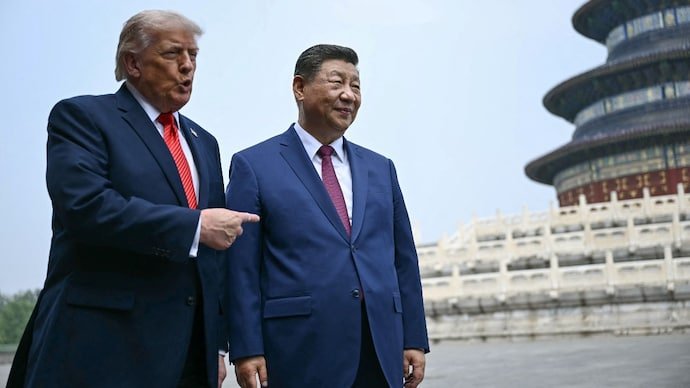
- Trump Says Xi Agreed the Strait of Hormuz Must Reopen
- Trump Insists He Did Not Ask China for “Favours”
- Why the Strait of Hormuz Crisis Matters Globally
- China Publicly Criticised the Conflict But Carefully
- Trump Hints at Possible Sanctions Relief for Chinese Oil Companies
- Trump Says Patience Over Iran’s Nuclear Programme Is Fading
- Iran Signals It Is Open to Talks But Also Ready for Conflict
- The US-China-Iran Triangle Is Becoming More Important
- Global Markets Are Watching Every Signal
- Conclusion: Diplomacy Continues, But the Pressure Is Rising Fast
US President Donald Trump on Friday sharply escalated pressure on Iran, warning that his patience was “running out” while insisting he did not ask Chinese President Xi Jinping for any political favours during high-level talks in Beijing.
The remarks came after two days of closely watched meetings between Trump and Xi that focused heavily on Iran, global energy security, trade tensions and the growing instability surrounding the Strait of Hormuz.
Speaking aboard Air Force One after departing China, Trump claimed Xi agreed that Iran must reopen the strategically critical waterway, though Beijing itself avoided making any direct public commitment to pressure Tehran.
The situation highlights the increasingly complicated triangle involving Washington, Beijing and Tehran one where Diplomacy, oil markets, Military pressure and global economic stability are now deeply interconnected.
Trump Says Xi Agreed the Strait of Hormuz Must Reopen
According to Trump, discussions with Xi included strong agreement on maintaining open shipping lanes through the Strait of Hormuz, one of the world’s most important energy corridors.
The narrow maritime route handles nearly one-fifth of global oil and liquefied natural gas shipments under normal conditions.
“We don’t want them to have a nuclear weapon, we want the straits open,” Trump said during his appearance alongside Xi in Beijing.
Later, the White House added that Xi opposed any Iranian attempt to impose tolls or restrictions on commercial shipping passing through the strait.
However, despite Trump’s interpretation of the talks, Beijing itself did not publicly confirm any direct commitment to intervene with Tehran.
That distinction matters because China remains one of Iran’s most important economic partners and one of the largest buyers of Iranian oil.
Trump Insists He Did Not Ask China for “Favours”
One of the more revealing moments came when Trump was asked whether Xi had firmly agreed to pressure Iran into reopening Hormuz fully.
Trump responded by emphasizing that he had not approached China from a position of dependence.
“I’m not asking for any favours because, when you ask for favours, you have to do favours in return,” he told reporters.
The comment reflected Trump’s broader political style of projecting leverage and avoiding any appearance that the United States requires Chinese assistance.
But strategically, the reality is more complex.
China’s relationship with Iran gives Beijing substantial influence that Washington cannot easily ignore.
At the same time, Beijing has carefully balanced:
- Its economic ties with Iran
- Its trade relationship with the United States
- Its energy security interests
- Its broader Middle East diplomacy
That balancing act explains why China’s public statements remained measured despite Trump’s claims.
Why the Strait of Hormuz Crisis Matters Globally
The Strait of Hormuz is not just a regional issue.
It is one of the most strategically sensitive energy chokepoints in the global economy.
| Why the Strait of Hormuz Is Critical | Global Impact |
|---|---|
| Major oil transit route | Supports global energy supply chains |
| LNG transportation corridor | Vital for Asia and Europe |
| High geopolitical sensitivity | Military tensions can disrupt markets instantly |
| Key route for Gulf exporters | Impacts inflation and fuel prices worldwide |
Since Iran restricted shipping following recent US-Israeli military operations, global markets have reacted nervously.
Oil prices have climbed amid fears that prolonged instability could:
- Increase global inflation
- Disrupt fuel supplies
- Slow economic growth
- Create shipping bottlenecks
- Trigger wider regional conflict
Even limited disruptions in Hormuz typically send shockwaves through financial and energy markets because so much of the global oil trade depends on uninterrupted passage.
China Publicly Criticised the Conflict But Carefully
Although Xi avoided direct public comments on Iran after the meetings, China’s foreign ministry released a strongly worded statement criticizing the ongoing conflict.
“This conflict, which should never have happened, has no reason to continue,” the ministry said.
The wording reflected Beijing’s longstanding preference for stability, especially regarding energy-producing regions crucial to China’s economy.
However, China also remains cautious about appearing too closely aligned with Washington’s pressure campaign against Tehran.
That balancing strategy allows Beijing to maintain influence across multiple sides of the dispute.
Trump Hints at Possible Sanctions Relief for Chinese Oil Companies
Another major development from the Beijing talks involved sanctions.
Trump revealed he is considering whether to ease US sanctions targeting Chinese refiners purchasing Iranian crude oil.
“We talked about that and I’m going to make a decision over the next few days,” Trump said.
The statement immediately drew attention because sanctions on Chinese firms have been a major source of tension between Washington and Beijing.
If the US relaxes restrictions, it could:
- Reduce friction with China
- Increase Iranian oil exports
- Help stabilize global energy markets
- Lower pressure on crude prices
But politically, such a move could also trigger criticism inside the United States from lawmakers who support maintaining maximum economic pressure on Tehran.
Trump Says Patience Over Iran’s Nuclear Programme Is Fading
Despite discussing diplomacy, Trump’s rhetoric toward Iran grew noticeably harsher.
“I am not going to be much more patient. They should make a deal,” he said during an interview on Fox News.
The comments suggest increasing frustration inside Washington over stalled nuclear negotiations.
The core dispute remains unresolved.
Iran insists its nuclear programme is peaceful and says it has no intention of building nuclear weapons.
However, Tehran has refused to:
- Stop nuclear research entirely
- Surrender enriched uranium stockpiles
- Accept certain long-term restrictions
For the United States and several allies, those unresolved issues remain unacceptable.
Iran Signals It Is Open to Talks But Also Ready for Conflict
Iranian Foreign Minister Abbas Araqchi responded cautiously during a visit to New Delhi.
He suggested Tehran still sees diplomacy as possible if negotiations progress constructively.
“We hope that, with the advancement of negotiations, we will reach a good conclusion,” Araqchi said.
At the same time, he also warned that Iran remains prepared for renewed confrontation.
“Iran is prepared for a resumption of fighting as well as for diplomatic solutions,” he stated.
That dual-track message reflects Tehran’s broader strategy:
- Project openness to diplomacy
- Maintain leverage through regional pressure
- Avoid appearing weak domestically
- Preserve strategic deterrence
Iran additionally indicated that some shipping traffic could continue moving through Hormuz if vessels coordinate with Tehran and are not linked to countries participating in military actions against Iran.
The US-China-Iran Triangle Is Becoming More Important
One of the most important developments emerging from the Beijing summit is the growing role of China in Middle East diplomacy.
China has steadily expanded its influence in the region through:
- Energy partnerships
- Infrastructure investments
- Diplomatic mediation
- Trade relationships
Unlike the United States, Beijing often presents itself as a less confrontational power focused primarily on economic stability.
That positioning gives China unique access to countries like Iran.
At the same time, the United States still maintains unmatched military influence in the Gulf region.
The result is an increasingly delicate geopolitical balance where Washington and Beijing may simultaneously compete and cooperate depending on the issue.
Global Markets Are Watching Every Signal
Investors and energy traders are now monitoring every statement coming from Washington, Tehran and Beijing.
The combination of:
- Hormuz disruptions
- Nuclear tensions
- Sanctions uncertainty
- US-China diplomacy
- Regional military activity
has created one of the most volatile geopolitical environments in years.
Any major escalation could rapidly affect:
- Fuel prices
- Inflation
- Shipping costs
- Stock markets
- Global economic growth
That explains why even carefully worded diplomatic statements are moving markets almost instantly.
Conclusion: Diplomacy Continues, But the Pressure Is Rising Fast
Donald Trump’s remarks after meeting Xi Jinping revealed both the possibilities and limitations of current diplomacy surrounding Iran.
While the United States and China appear to share concerns about keeping the Strait of Hormuz open and preventing nuclear escalation, major disagreements remain unresolved.
China continues balancing its economic ties with Iran against its broader global interests.
Iran insists it remains open to negotiations while refusing to surrender key strategic leverage.
And Trump’s increasingly impatient rhetoric suggests Washington may soon demand faster movement toward a deal.
For now, diplomacy is still alive.
But with oil markets under pressure, military tensions unresolved and nuclear negotiations stalled, the margin for miscalculation appears to be shrinking rapidly.
For breaking news and live news updates, like us on Facebook or follow us on Twitter and Instagram. Read more on Latest World on thefoxdaily.com.




COMMENTS 0