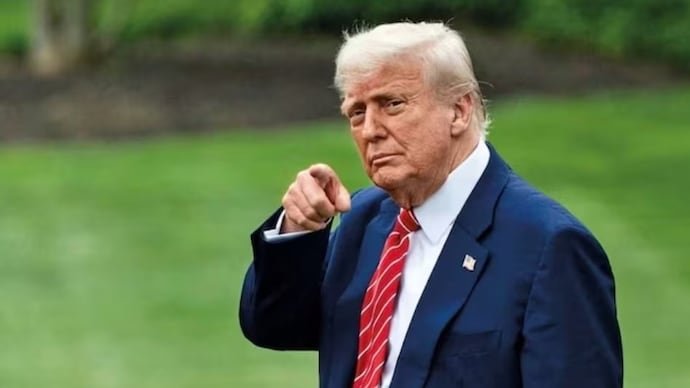
The latest chapter in the escalating confrontation between the United States and Iran has produced not only renewed Military exchanges but also an unusually candid explanation from US President Donald Trump about how he views ceasefires in conflict zones.
Speaking to reporters in the Oval Office amid fresh attacks across the Gulf region, Trump suggested that a ceasefire does not necessarily mean the complete cessation of hostilities. Instead, he described it as a situation where opposing sides are “shooting in a more moderate manner.”
The comment came at a time when missile strikes, drone attacks, retaliatory military operations, and growing concerns about regional stability continue to dominate headlines. While Trump sought to downplay the significance of the latest exchanges, the developments highlight a deeper reality: modern conflicts increasingly operate in a grey zone where ceasefires exist on paper while limited military actions continue on the ground.
The central question is no longer whether a ceasefire exists between Washington and Tehran. It is whether both sides share the same definition of what a ceasefire actually means.
What Triggered the Latest Escalation?
The renewed tensions emerged after a series of military exchanges involving US and Iranian forces.
Reporter: How do you define ceasefire?
Trump: In that part of the world, ceasefire is when you’re shooting in a more moderate manner pic.twitter.com/wXdr2EraDC
— Open Source Intel (@Osint613) June 3, 2026
According to reports, Iran launched missile and drone attacks targeting locations in Kuwait and Bahrain following American strikes on Iranian military assets and energy-related infrastructure.
The attacks have intensified concerns that a conflict initially viewed as manageable could gradually expand into a broader regional confrontation involving multiple countries across the Gulf.
Although both sides continue to publicly support negotiations, recent events demonstrate how fragile the current situation remains.
Trump’s Definition of a Ceasefire: Why It Matters
Traditionally, a ceasefire is understood as a temporary suspension of military operations between opposing forces. In international Diplomacy, ceasefires are designed to create space for negotiations, humanitarian assistance, prisoner exchanges, or broader peace agreements.
Trump’s remarks suggest a more pragmatic interpretation.
His statement implies that in some conflicts, especially those involving long-standing regional rivalries, ceasefires may not completely eliminate violence. Instead, they reduce the intensity, frequency, or scale of attacks.
This perspective reflects a reality seen in many modern conflicts where:
- Direct warfare decreases but does not disappear.
- Proxy groups continue operations.
- Limited retaliatory strikes occur.
- Negotiations proceed alongside military pressure.
- Both sides seek leverage before final agreements.
Whether one agrees with Trump’s characterization or not, it highlights the increasingly complex nature of contemporary conflict management.
The Strait of Hormuz Remains the Key Battleground
Trump on Iran attacking Kuwait:
There is a reason for everything, and we hit them pretty hard… They were slightly provoked; they were reciprocating. pic.twitter.com/VvIgyJHb3m
— Clash Report (@clashreport) June 3, 2026
At the heart of the crisis lies the Strait of Hormuz, one of the world’s most strategically important waterways.
This narrow maritime corridor connects the Persian Gulf to international shipping routes and serves as a critical artery for global energy markets.
Before the current conflict escalated, approximately one-fifth of the world’s oil and liquefied natural gas shipments passed through the strait.
The prolonged disruption has created significant concerns among governments, shipping companies, and energy traders worldwide.
Every military exchange now carries implications far beyond the immediate battlefield, influencing global trade, inflation, energy prices, and economic stability.
Why Oil Markets Are Watching Every Missile Launch
The recent escalation immediately affected global energy markets.
Oil prices rose as investors reacted to fears that continued hostilities could further disrupt shipping routes and energy supplies.
Markets are particularly sensitive because the Gulf region remains central to global energy production.
| Conflict Factor | Potential Economic Impact |
|---|---|
| Strait of Hormuz Disruptions | Higher global oil prices |
| Missile Attacks on Infrastructure | Supply chain uncertainty |
| Regional Escalation | Increased market volatility |
| Shipping Restrictions | Higher transportation costs |
| Prolonged Conflict | Global inflationary pressure |
Even limited disruptions can have disproportionate consequences because energy markets often react not only to actual shortages but also to perceived risks.
Why Neither Side Wants a Full-Scale War
Despite the rhetoric and military exchanges, both Washington and Tehran appear to have strong incentives to avoid a direct, prolonged war.
For the United States, a major conflict in the Gulf would require significant military resources at a time when multiple global challenges demand attention.
For Iran, an expanded war could place immense pressure on its economy, infrastructure, and regional influence.
As a result, both sides appear to be pursuing a strategy often described by analysts as “controlled escalation” applying pressure while attempting to avoid crossing thresholds that could trigger an uncontrollable conflict.
This dynamic helps explain why military actions and diplomatic talks frequently occur simultaneously.
The Rise of the “Managed Conflict” Model
One of the most important trends emerging from the US-Iran confrontation is the growing prevalence of managed conflicts.
Unlike traditional wars, where victory or defeat is the primary objective, managed conflicts focus on influencing behavior without triggering total confrontation.
Characteristics of such conflicts include:
- Limited military operations.
- Economic pressure and sanctions.
- Cyber activities.
- Proxy engagements.
- Ongoing diplomatic communication.
In these situations, ceasefires often look very different from historical examples because low-level hostilities may continue even while negotiations progress.
Trump’s remarks arguably reflect this reality more than traditional diplomatic language does.
Diplomatic Channels Remain Open
One reason markets and policymakers have not reacted more dramatically is the continued existence of communication channels between Washington and Tehran.
Both sides have indicated that discussions are ongoing despite the absence of a formal breakthrough.
This is a critical factor because diplomatic engagement often serves as a safety valve during periods of heightened tension.
History shows that conflicts become significantly more dangerous when communication breaks down completely.
As long as talks continue, even indirectly, opportunities remain for de-escalation and negotiated solutions.
The Human Cost Often Gets Overlooked
Amid geopolitical discussions, it is easy to overlook the human consequences of ongoing violence.
Civilian casualties, disruptions to travel, economic uncertainty, and regional instability affect millions of people across the Middle East.
The reported death of an Indian national and injuries to dozens of others highlight how international conflicts frequently impact individuals far removed from the political decisions driving events.
As tensions persist, protecting civilian lives will remain one of the most urgent challenges facing all parties involved.
What This Means for Global Geopolitics
The US-Iran confrontation extends beyond the Middle East.
Major powers across Europe, Asia, and the Indo-Pacific are closely monitoring developments because of their implications for:
- Energy Security.
- Maritime trade routes.
- Regional alliances.
- Military deterrence.
- Global economic stability.
The conflict is also becoming a test case for how modern powers manage crises in an increasingly interconnected world where military actions, economic consequences, and diplomatic negotiations unfold simultaneously.
Prediction: A Formal Peace Deal Remains Difficult
While both sides have indicated progress toward a preliminary understanding, significant obstacles remain.
Disagreements over security guarantees, maritime access, military deployments, and future regional influence continue to complicate negotiations.
A comprehensive peace agreement is likely to take considerably longer than many observers initially expected.
In the meantime, the most probable scenario is neither full-scale war nor complete peace but a continuation of the current pattern: periodic flare-ups combined with ongoing diplomatic engagement.
Future Outlook
The coming weeks will be crucial in determining whether the current ceasefire framework can survive repeated tests. Efforts to reopen the Strait of Hormuz and restore confidence in regional stability will remain at the center of negotiations.
Much will depend on whether both Washington and Tehran can maintain communication while resisting domestic and strategic pressures that favor escalation.
If negotiations continue, a limited agreement focused on maritime security and de-escalation may emerge before a broader settlement becomes possible.
Conclusion
Donald Trump’s description of a ceasefire as “shooting in a more moderate manner” may have sounded unconventional, but it reflects a deeper truth about many modern conflicts. In today’s geopolitical environment, ceasefires are often imperfect, fragile, and frequently violated without fully collapsing.
The ongoing US-Iran confrontation illustrates this reality. Military exchanges continue, tensions remain high, and yet diplomatic channels stay open. Both sides appear determined to protect their interests while avoiding a larger war that could destabilize the entire region.
The real challenge is not simply achieving a ceasefire but transforming a temporary reduction in violence into a sustainable framework for peace. Until that happens, the world may continue witnessing a conflict that exists in an uneasy space between war and diplomacy where ceasefires are measured not by silence, but by the degree of restraint shown by the parties involved.
For breaking news and live news updates, like us on Facebook or follow us on Twitter and Instagram. Read more on Latest World on thefoxdaily.com.






COMMENTS 0