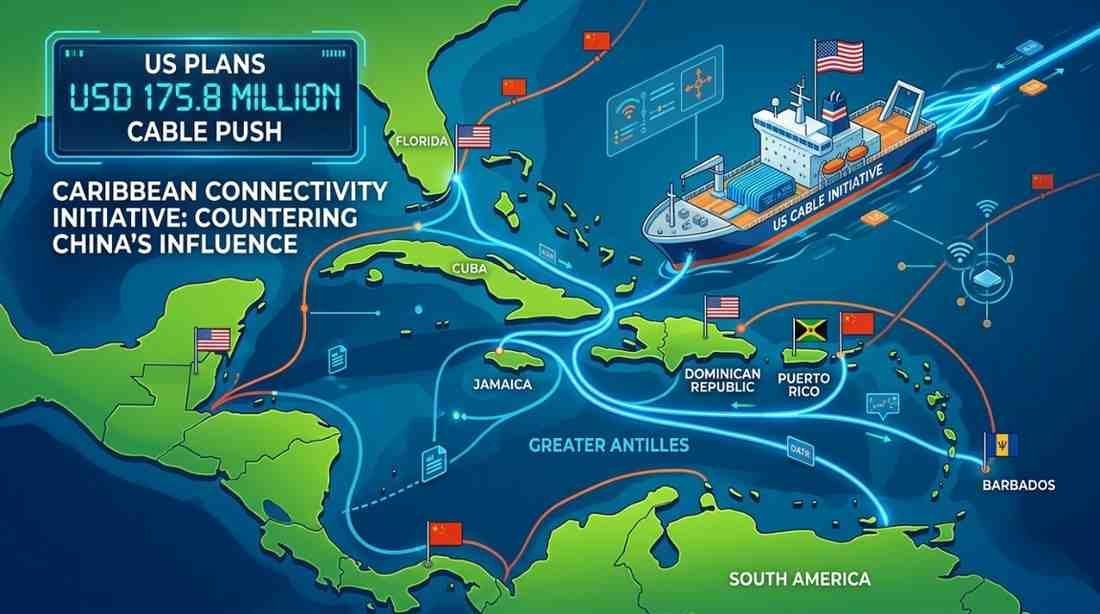
The United States is preparing a major Investment in telecommunications infrastructure across the Caribbean and Central America as part of its broader strategy to counter China‘s growing global influence. According to government documents submitted to congress, the Trump administration has proposed spending $175.8 million to replace aging undersea fiber-optic cables with what officials describe as secure and trusted alternatives.
The initiative goes beyond simply upgrading internet infrastructure. It represents an important chapter in the intensifying strategic competition between the United States and China, where digital connectivity, cyber security, and critical infrastructure have become central elements of National Security and foreign policy.
If approved, the project would help modernize communications networks across several countries while reinforcing Washington’s long-term presence in a region that has increasingly attracted Chinese investment over the past decade.
Why Undersea Cables Matter More Than Ever
Although satellites often receive public attention, nearly all international internet traffic travels through undersea fiber-optic cables laid across the ocean floor.
These submarine cables carry:
- International internet traffic.
- Global financial transactions.
- Cloud computing services.
- Government communications.
- Military and intelligence data.
- International voice and video communications.
Industry estimates indicate that more than 95% of global intercontinental data traffic moves through submarine cable systems rather than satellites. As a result, these networks have become critical national infrastructure comparable to highways, airports, or power grids.
Any disruption—whether accidental or deliberate—can significantly affect communications, commerce, and security.
US Caribbean Cable Project at a Glance
| Category | Details |
|---|---|
| Project Value | $175.8 million |
| Primary Goal | Replace aging undersea telecommunications cables |
| Region Covered | Caribbean and Central America |
| Main Objective | Promote secure telecommunications infrastructure |
| Strategic Focus | Reduce reliance on Chinese-backed infrastructure |
| Status | Proposed, pending congressional approval |
Why the US Is Investing in Digital Infrastructure
American policymakers increasingly view digital infrastructure as a strategic asset rather than merely a commercial investment.
Officials argue that communications networks influence:
- National security.
- Economic competitiveness.
- Cyber resilience.
- Emergency communications.
- Government operations.
- Regional partnerships.
The proposed cable replacement program seeks to ensure that participating countries have access to modern, resilient telecommunications systems supported by trusted technology providers.
According to administration officials, replacing older cable systems could improve network reliability while strengthening digital security across the region.
China’s Expanding Presence in the Americas
Over the past two decades, China has significantly expanded its economic footprint throughout Latin America and the Caribbean through infrastructure investment, trade, financing, telecommunications, mining, and transportation projects.
Many countries have benefited from Chinese financing for roads, ports, railways, energy projects, and digital infrastructure.
Washington, however, has expressed concerns that some strategic investments could create long-term geopolitical leverage or expose sensitive communications infrastructure to potential security risks.
The proposed undersea cable initiative reflects the United States’ effort to provide alternative investment options for regional partners.
How Undersea Cable Security Has Become a National Security Issue
Submarine cables are increasingly viewed as vital strategic assets because they connect governments, financial markets, emergency services, multinational companies, and military networks.
Potential risks include:
- Physical damage from anchors or fishing activities.
- Natural disasters such as earthquakes.
- Cybersecurity vulnerabilities.
- Espionage concerns.
- Geopolitical conflicts affecting critical infrastructure.
Governments worldwide have therefore increased investment in monitoring, protecting, and diversifying submarine cable routes to reduce operational risks.
Countries Expected to Benefit
The proposed program is expected to support projects benefiting several countries across Central America and the Caribbean.
| Country | Potential Focus |
|---|---|
| El Salvador | Telecommunications modernization |
| Guatemala | Secure connectivity improvements |
| Honduras | Digital infrastructure upgrades |
| Haiti | Communications resilience |
| Nicaragua | Infrastructure support (subject to US policy considerations) |
Administration documents indicate that implementation would involve cooperation with private-sector cable installers and regional partners.
A Broader Global Strategy Beyond the Caribbean
The cable initiative represents only one element of a much larger international strategy.
According to internal planning documents, the administration is considering allocating hundreds of millions of additional dollars toward programs designed to strengthen US partnerships across:
- Latin America.
- Africa.
- Asia.
- The Indo-Pacific.
These initiatives span digital infrastructure, cybersecurity, diplomatic engagement, economic development, and critical technology partnerships.
The broader objective is to strengthen relationships with partner countries while offering alternatives to infrastructure projects backed by geopolitical competitors.
Comparison: US and China Infrastructure Approaches
| Area | United States Strategy | China’s Approach |
|---|---|---|
| Primary Focus | Secure and trusted infrastructure partnerships | Large-scale infrastructure investment |
| Key Sectors | Digital networks, cybersecurity, telecommunications | Transport, ports, energy, telecommunications |
| Regional Objective | Strengthen strategic partnerships | Expand economic connectivity |
| Infrastructure Priority | Security and resilience | Development and connectivity |
What Makes Undersea Fiber Different from Satellites?
Many people assume satellite systems power most global internet communications. In reality, submarine fiber-optic cables remain the backbone of international connectivity.
Compared with satellites, fiber-optic cables generally provide:
- Higher bandwidth.
- Lower latency.
- Greater reliability.
- Lower operating costs.
- Higher capacity for global internet traffic.
This explains why governments continue investing heavily in submarine cable infrastructure despite rapid advances in satellite communications.
Economic Benefits Beyond Security
Modern telecommunications infrastructure supports far more than secure government communications.
Reliable high-capacity networks can contribute to:
- Digital commerce.
- Financial services.
- Cloud computing.
- Remote education.
- Telemedicine.
- Technology investment.
- Business competitiveness.
For many developing economies, improved international connectivity also makes it easier to attract foreign investment and participate in the global digital economy.
The Role of Congress
The proposed funding has been submitted to Congress as part of the administration’s broader foreign policy and national security priorities.
Congressional lawmakers will review the proposal before determining whether funding should be approved, modified, or incorporated into broader appropriations legislation.
The timeline for implementation will depend on legislative approval, contracting procedures, and coordination with participating countries.
Expert Insight: Infrastructure Is Becoming a New Form of Geopolitical Competition
Modern geopolitical competition increasingly extends beyond traditional military capabilities. Digital infrastructure, telecommunications, artificial intelligence, semiconductor Supply Chains, cybersecurity, and data governance have become major areas where leading global powers seek long-term influence.
Rather than focusing solely on defense agreements, governments are investing in technologies that shape future economic growth, digital sovereignty, and strategic resilience.
The proposed Caribbean cable initiative illustrates how telecommunications infrastructure has evolved into a key instrument of international diplomacy and national security policy.
Potential Challenges Ahead
While the proposal highlights significant strategic ambitions, successful implementation may face several practical challenges:
- Congressional funding approval.
- Coordination with regional governments.
- Complex undersea engineering projects.
- Environmental permitting requirements.
- Competition from existing infrastructure providers.
- Long project timelines.
Addressing these challenges will be important to ensure the project delivers both security and economic benefits.
Future Outlook
The proposed $175.8 million undersea cable initiative signals that telecommunications infrastructure will remain a major component of US Foreign Policy in the coming years. Even as Washington and Beijing continue diplomatic engagement, strategic competition over technology, digital connectivity, and critical infrastructure is expected to persist.
If approved, the program could strengthen internet resilience across the Caribbean and Central America while reinforcing US partnerships in the Western Hemisphere. At the same time, it reflects a broader global trend in which nations increasingly view secure digital infrastructure as essential to both economic development and national security.
Conclusion
The Trump administration’s proposal to invest $175.8 million in replacing aging undersea telecommunications cables highlights the growing importance of digital infrastructure in International Relations. While the initiative aims to modernize communications networks across the Caribbean and Central America, it also represents a broader effort to strengthen strategic partnerships and offer secure alternatives for critical infrastructure development.
As geopolitical competition increasingly shifts toward technology and connectivity, undersea cable systems are becoming as strategically significant as ports, airports, and energy networks. The outcome of this proposal could shape not only regional telecommunications but also the future balance of influence in one of the world’s most strategically important regions.
For breaking news and live news updates, like us on Facebook or follow us on Twitter and Instagram. Read more on Latest World on thefoxdaily.com.






COMMENTS 0