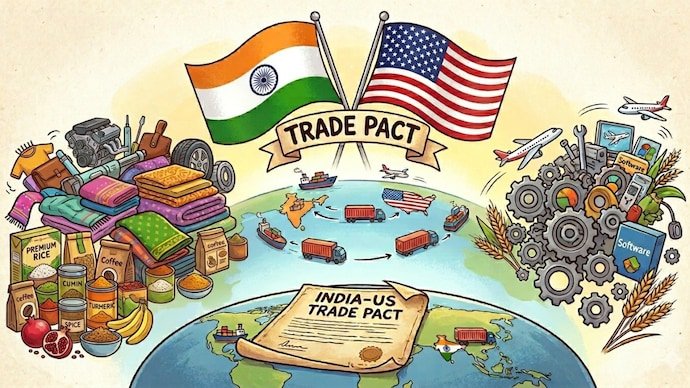
India and the United States are entering a decisive phase in their trade relationship as senior officials from both countries meet in New Delhi to finalize the details of an interim Trade Agreement. The four-day round of negotiations represents months of diplomatic engagement and could pave the way for a more comprehensive Bilateral Trade Agreement (BTA) between the world’s largest democracy and the world’s largest economy.
The talks come at a time when global supply chains are being reconfigured, geopolitical alliances are evolving, and countries are increasingly seeking trusted economic partners. Against this backdrop, the India-US trade negotiations carry significance far beyond tariffs and market access. They are also about economic security, strategic cooperation, technology partnerships, and long-term investment flows.
If successful, the agreement could mark one of the most consequential developments in India-US economic relations in recent years.
What Is Being Negotiated?
The current discussions focus on two interconnected objectives. The first is the completion of an interim trade pact that addresses immediate trade concerns. The second is advancing negotiations for a larger Bilateral Trade Agreement that could deepen economic integration across multiple sectors.
Negotiators are discussing a broad range of issues, including:
- Market access for goods and services
- Tariff reductions
- Non-tariff barriers
- Customs modernization
- Trade facilitation measures
- Investment promotion
- Supply Chain cooperation
- Economic security alignment
- Technology and innovation partnerships
Unlike traditional trade agreements focused primarily on tariffs, modern trade pacts increasingly address regulatory frameworks, digital commerce, supply chain resilience, and strategic economic cooperation.
Why This Trade Pact Matters Now
The timing of these negotiations is particularly important.
Global trade is undergoing significant transformation as businesses seek to diversify manufacturing locations, reduce supply chain risks, and strengthen economic resilience. Many multinational companies are actively exploring alternatives to concentrated production networks.
India has emerged as one of the primary beneficiaries of this shift.
Its large domestic market, expanding manufacturing sector, skilled workforce, and growing digital economy have positioned it as a key destination for investment and trade diversification.
For the United States, deeper economic engagement with India supports broader strategic objectives, including supply chain security, technological cooperation, and economic partnerships in the Indo-Pacific region.
The Evolution of India-US Trade Relations
The economic relationship between India and the United States has expanded dramatically over the past two decades.
What was once a relatively limited trade partnership has evolved into one of the most important bilateral economic Relationships in the world.
Trade in goods and services has grown substantially, while investment flows, technology collaboration, and business partnerships have increased across numerous sectors.
| Area of Cooperation | Importance |
|---|---|
| Goods Trade | Supports manufacturing and exports |
| Services Trade | Strengthens IT and professional services |
| Technology | Drives innovation and digital growth |
| Energy | Enhances energy security |
| Investment | Creates jobs and economic expansion |
| Defense and Security | Supports strategic cooperation |
The ongoing negotiations aim to build on this foundation and remove obstacles that continue to affect bilateral trade.
The Tariff Question at the Heart of the Discussions
One of the most closely watched aspects of the negotiations involves tariffs.
Tariffs directly affect the cost of imported goods and can significantly influence competitiveness, investment decisions, and consumer prices.
The proposed framework discussed by both countries includes tariff adjustments designed to facilitate trade and improve market access.
However, the situation has become more complex due to recent developments in US trade policy and legal challenges involving tariff measures.
Changes in the American tariff landscape mean negotiators may need to recalibrate parts of the original framework to reflect current realities.
This explains why the latest round of talks is viewed as particularly important.
India’s Market Access Commitments
As part of the broader discussions, India has explored the possibility of reducing or eliminating tariffs on various categories of American goods.
Several sectors are considered strategically important because they align with India’s industrial, agricultural, and economic priorities.
Products frequently discussed in trade negotiations include:
- Agricultural commodities
- Food products
- Energy resources
- Industrial equipment
- Technology products
- Aviation components
- Raw materials used in manufacturing
Expanding market access can create opportunities for businesses on both sides while increasing product availability and competition.
The Strategic Importance of Energy Cooperation
One of the most significant elements of the negotiations involves energy trade.
India remains one of the world’s fastest-growing energy consumers, while the United States has become a major energy exporter.
Greater energy cooperation offers several advantages:
- Diversified energy supplies
- Enhanced Energy Security
- Stable long-term procurement arrangements
- Reduced supply chain risks
- Support for industrial growth
Energy trade has increasingly become a central pillar of the India-US economic relationship and is likely to remain a major focus of future agreements.
How Businesses Could Benefit
If negotiations are successfully concluded, businesses across multiple sectors may benefit from improved market access and reduced trade barriers.
Potential advantages include:
- Lower transaction costs
- Simplified customs procedures
- Faster movement of goods
- Greater regulatory predictability
- Improved investment confidence
- Expanded export opportunities
For small and medium-sized enterprises, streamlined trade procedures can be particularly valuable because administrative costs often represent a larger burden relative to company size.
The Technology and Innovation Dimension
Modern trade agreements increasingly extend beyond traditional goods and services.
Technology cooperation has become a critical component of economic partnerships, especially between countries seeking to strengthen innovation ecosystems.
India and the United States already collaborate extensively in sectors such as:
- Artificial intelligence
- Semiconductors
- Cloud computing
- Digital services
- Cybersecurity
- Research and development
A successful trade agreement could accelerate collaboration in these areas by creating more favorable conditions for investment and cross-border partnerships.
Global Economic Implications
The significance of the negotiations extends beyond bilateral trade.
Together, India and the United States represent a substantial share of global economic activity. Their growing partnership influences investment flows, supply chain decisions, and regional economic strategies.
As geopolitical uncertainty continues to affect international commerce, stronger economic ties between major democratic economies could contribute to greater stability and predictability in global markets.
This is one reason why investors, multinational corporations, and policymakers around the world are closely monitoring the talks.
The Challenge of Balancing Domestic Interests
Every trade negotiation involves balancing competing priorities.
Governments must promote International Trade while protecting legitimate domestic interests.
In both India and the United States, policymakers face pressure from various stakeholders, including manufacturers, farmers, exporters, workers, consumers, and industry groups.
Negotiators therefore need to craft agreements that generate mutual benefits while addressing concerns about market access, competitiveness, and economic adjustment.
This balancing act is often one of the most complex aspects of trade Diplomacy.
An Overlooked Insight: The Real Story Is Supply Chain Realignment
Much of the discussion surrounding the trade pact focuses on tariffs and market access. However, the deeper significance lies elsewhere.
The Global Economy is currently experiencing one of the largest supply chain realignments in decades. Businesses are increasingly prioritizing resilience, diversification, and trusted partnerships over purely cost-based decisions.
India’s growing importance in global manufacturing, technology, and services makes it a natural partner in this transition.
The trade agreement is therefore not simply about reducing tariffs. It is about positioning India and the United States within an evolving economic architecture where supply chain security, economic resilience, and strategic cooperation are becoming just as important as traditional trade metrics.
This broader perspective helps explain why both governments have invested significant diplomatic capital in the negotiations.
Potential Challenges Ahead
Despite optimism, several challenges remain.
Trade agreements often involve complex technical negotiations, legal reviews, and political considerations.
Potential obstacles include:
- Sector-specific market access concerns
- Regulatory differences
- Domestic political pressures
- Implementation timelines
- Compliance mechanisms
- Changes in global trade conditions
Successfully addressing these issues will be essential for concluding a durable and mutually beneficial agreement.
What Happens Next?
The current round of discussions is expected to focus heavily on finalizing legal text and resolving outstanding issues within the interim framework.
If negotiators succeed in narrowing remaining differences, the agreement could move toward formal approval and implementation.
Officials from both countries have indicated that negotiations are approaching their final stages, although important technical work remains.
The outcome of these meetings will likely shape the trajectory of India-US economic relations for years to come.
Conclusion
The latest round of India-US trade negotiations represents a pivotal moment in one of the world’s most important economic partnerships. While immediate discussions center on an interim trade pact, the broader objective is the creation of a comprehensive Bilateral Trade Agreement capable of expanding trade, attracting investment, strengthening supply chains, and deepening strategic cooperation.
The stakes extend far beyond tariff reductions. The negotiations touch on energy security, technology collaboration, manufacturing growth, economic resilience, and the future structure of global supply chains.
As both countries seek to navigate an increasingly complex international economic environment, a successful agreement could unlock substantial opportunities for businesses, investors, and consumers while reinforcing a partnership that continues to grow in strategic importance.
Looking ahead, the coming weeks may prove decisive. If the remaining issues are resolved, the India-US trade pact could become a defining milestone in the next chapter of bilateral economic cooperation and a key driver of growth in an evolving global economy.
For breaking news and live news updates, like us on Facebook or follow us on Twitter and Instagram. Read more on Latest Business on thefoxdaily.com.






COMMENTS 0