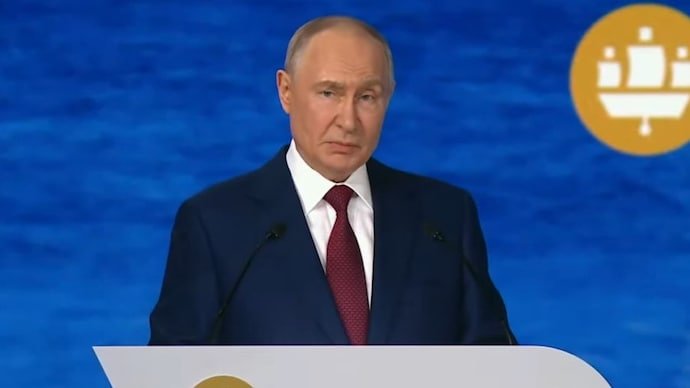
The global economic landscape is undergoing one of the most significant transformations of the 21st century. Speaking at the St. Petersburg International Economic Forum (SPIEF) 2026, Russian President Vladimir Putin declared that the BRICS bloc had already surpassed the G7 in economic size and would continue widening its lead in the years ahead. The statement was more than a political talking point. It reflected a broader reality that economists, investors, and policymakers have been observing for years: the center of global Economic Growth is steadily shifting toward emerging markets.
The timing of Putin’s remarks is particularly significant. The comments come amid growing tensions between BRICS nations and Western economies, concerns about the future of globalization, and ongoing debates over the dominance of the US dollar in international trade. With India holding the BRICS presidency in 2026 and several new members joining the bloc, the organization is attracting unprecedented global attention.
The question facing the world is no longer whether economic power is shifting. Instead, policymakers are asking how quickly this transition will occur and what it means for trade, investment, geopolitics, and the future international order.
What Is BRICS and Why Does It Matter?
BRICS began as an economic concept rather than a political alliance. The term was originally coined to describe Brazil, Russia, India, and china as emerging economies expected to drive global growth in the coming decades. South Africa later joined, transforming BRIC into BRICS.
Over time, the grouping evolved into a platform for economic cooperation, diplomatic coordination, and discussions about reforming international institutions. The bloc expanded further by welcoming Egypt, Ethiopia, Iran, Indonesia, and the United Arab Emirates, significantly increasing its economic and geopolitical influence.
Today, BRICS includes some of the world’s largest populations, fastest-growing economies, major energy producers, and critical manufacturing hubs. Together, these countries possess vast reserves of natural resources, agricultural production capabilities, industrial capacity, and consumer markets.
The Numbers Behind BRICS’ Rise
Putin’s argument is rooted in a trend that has been developing for decades. While advanced Western economies remain highly productive and technologically sophisticated, their growth rates have generally slowed due to aging populations, mature markets, and structural economic challenges.
By contrast, many BRICS nations continue to experience rapid industrialization, urbanization, technological adoption, and rising consumer demand.
According to international economic assessments based on Purchasing Power Parity (PPP), BRICS collectively accounts for a larger share of global economic output than the G7. PPP measures economic production by adjusting for local price differences and purchasing power, offering a broader perspective on economic scale.
| Economic Indicator | BRICS | G7 |
|---|---|---|
| Population Share | Over 45% of Global Population | Less than 10% |
| Global GDP Growth Contribution | Nearly Half of Annual Growth | Less Than One-Fifth |
| Natural Resources | Extensive Energy and Mineral Reserves | Limited Relative Share |
| Future Growth Potential | High | Moderate |
These figures help explain why BRICS is increasingly viewed as a major force shaping the future of the Global Economy.
Why Donald Trump Sees BRICS as a Challenge
Former US President Donald Trump has repeatedly criticized BRICS, particularly its efforts to reduce dependence on the US dollar. He has warned that attempts to create alternative payment systems or reduce dollar-based trade could undermine America’s economic influence.
The concern is understandable from Washington’s perspective. The US dollar has served as the world’s primary reserve currency for decades, providing significant advantages to the United States.
Dollar dominance allows the US to:
- Borrow at relatively lower costs.
- Exercise financial sanctions effectively.
- Influence global financial markets.
- Maintain substantial geopolitical leverage.
- Facilitate international trade through American financial institutions.
If major economies increasingly settle trade in local currencies or alternative systems, the influence derived from dollar dominance could gradually weaken.
However, most analysts believe any transition away from the dollar would likely be gradual rather than sudden. The dollar remains deeply embedded in global finance, international reserves, commodity markets, and cross-border transactions.
The Shift Toward a Multipolar Economic Order
Perhaps the most important aspect of Putin’s speech was not the comparison with the G7 but the broader idea of a multipolar world.
For much of the post-Cold War era, economic and financial power was concentrated within a relatively small group of Western nations. Institutions such as the International Monetary Fund, World Bank, and major Western financial centers played dominant roles in shaping global economic policies.
Today, emerging economies are demanding greater representation and influence. BRICS countries argue that international governance structures should better reflect the realities of the modern global economy.
This does not necessarily mean replacing existing institutions. Rather, many BRICS members seek reforms that provide developing nations with greater participation in decision-making processes.
India’s Strategic Position Within BRICS
India occupies a particularly important position within BRICS. Unlike some members that are heavily dependent on commodities or manufacturing exports, India combines strong domestic consumption, technological innovation, services exports, and a rapidly expanding middle class.
As the world’s most populous nation and one of the fastest-growing major economies, India increasingly serves as a bridge between developed and developing markets.
India’s leadership of BRICS in 2026 highlights its growing diplomatic and economic influence. New Delhi continues to maintain relationships with both Western nations and emerging economies, allowing it to play a balancing role within the bloc.
This unique position gives India significant opportunities to shape discussions on trade, technology, energy Security, digital infrastructure, and global governance reforms.
Trade, Energy, and Resources: The Real Strength of BRICS
Economic power is not determined solely by GDP figures. Control over strategic resources remains equally important.
Collectively, BRICS nations possess:
- Major oil and natural gas reserves.
- Large agricultural production capacities.
- Critical mineral resources needed for clean energy technologies.
- Important manufacturing supply chains.
- Growing consumer markets.
These advantages provide substantial leverage in an increasingly competitive global economy.
The energy transition toward electric vehicles, renewable energy, and advanced manufacturing is expected to increase demand for critical minerals, many of which are abundant within BRICS nations.
How Global Trade Is Changing
Putin argued that the center of global trade is shifting, and there is evidence supporting this claim. Trade flows are becoming more diversified as emerging economies increase commerce with one another.
South-South trade trade between developing countries has grown significantly over the past two decades. Countries are increasingly seeking alternative supply chains, new markets, and regional partnerships.
Digital commerce, infrastructure investments, logistics corridors, and local-currency trade agreements are accelerating these trends.
As a result, global trade is becoming less concentrated around a few traditional economic centers and more distributed across multiple regions.
The Challenges Facing BRICS
Despite its growing influence, BRICS faces several internal challenges.
- Diverse political systems and strategic priorities.
- Economic competition among member states.
- Geopolitical tensions between certain members.
- Differences in development levels.
- Currency and financial system complexities.
Unlike the European Union, BRICS is not an integrated political or economic union. Its strength lies in cooperation rather than centralized governance.
The bloc’s future success will depend on its ability to transform shared interests into practical policies and measurable outcomes.
Why This Matters for Businesses and Investors
The rise of BRICS is not merely a geopolitical story. It has real implications for global business, investment strategies, supply chains, and financial markets.
Companies seeking future growth increasingly view India, Indonesia, the UAE, Brazil, and other emerging markets as critical opportunities. Consumer demand, infrastructure development, technological adoption, and industrial expansion continue to attract investment.
Investors are also paying closer attention to emerging market assets, regional trade partnerships, and sectors benefiting from demographic growth.
The shift in economic gravity means businesses that ignore emerging markets risk missing some of the most significant growth opportunities of the coming decades.
A Comparison With Previous Economic Power Shifts
History shows that economic leadership is never permanent. The center of global commerce has shifted multiple times over the centuries from Asia to Europe, from Europe to North America, and now increasingly toward Asia and other emerging regions.
Each transition was driven by changes in technology, demographics, trade routes, productivity, and innovation.
The current rise of BRICS may represent another chapter in this long historical cycle rather than a sudden revolution.
The Future Outlook: A More Competitive Global Economy
The most likely outcome is not the replacement of the G7 by BRICS but the emergence of a more balanced and competitive international system. Western economies will remain highly influential, particularly in technology, finance, innovation, and advanced manufacturing. At the same time, BRICS nations are expected to contribute an increasingly larger share of global growth.
This dual reality points toward a multipolar economic order where influence is distributed across several major centers rather than concentrated within a single bloc.
For governments, businesses, and investors, understanding this shift will be essential for navigating future opportunities and risks.
Conclusion
Vladimir Putin’s declaration at SPIEF 2026 reflects a broader transformation already underway across the global economy. BRICS has evolved from a loose grouping of emerging markets into a significant economic force whose influence continues to expand through population growth, trade, resource ownership, and economic development.
While debates over the future of the US dollar and Western-led institutions are likely to continue, one reality is becoming increasingly difficult to ignore: the engines of global growth are no longer concentrated in a handful of advanced economies. Instead, they are spreading across emerging markets that collectively represent billions of people and an increasing share of the world’s economic activity.
Whether BRICS ultimately reshapes the international order remains to be seen. What is clear, however, is that the global economic map of the future will look very different from the one that dominated the last century.
For breaking news and live news updates, like us on Facebook or follow us on Twitter and Instagram. Read more on Latest World on thefoxdaily.com.



COMMENTS 0