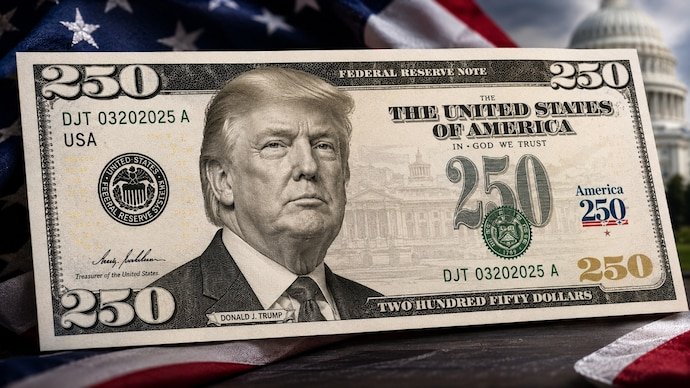
The possibility of President Donald Trump appearing on official United States currency is rapidly becoming one of the most controversial symbolic debates of his presidency.
According to statements from the US Treasury Department and reports from American media outlets, preliminary preparations are already underway for a proposed $250 banknote featuring Trump’s portrait despite the fact that current US law prohibits living people from appearing on American paper money.
If Congress ultimately approves the proposal, it would mark one of the most dramatic breaks from longstanding US currency traditions in modern history.
It would also transform a routine piece of government-issued money into a deeply political and cultural symbol tied to America’s upcoming 250th anniversary celebrations.
Supporters view the proposal as a patriotic tribute to the president serving during a historic national milestone. Critics, however, see it as a dangerous departure from institutional norms designed to prevent personality cults around sitting leaders.
The debate is no longer hypothetical.
Treasury officials have confirmed they are already preparing for the possibility.
What Exactly Is Being Proposed?
The proposal centres around introducing a new $250 banknote carrying Donald Trump’s portrait.
According to Treasury Secretary Scott Bessent, the department has already begun internal planning in case Congress changes existing law.
At present, US currency rules follow two major principles:
- No living individual may appear on US currency
- All notes must carry the phrase “In God We Trust”
The proposed legislation would specifically alter the first rule.
If approved, Trump would become the first living person to appear on US paper currency in more than 150 years.
Reports also suggest the Bureau of Engraving and Printing has already begun preparing mock-up designs featuring Trump at the centre of the note.
Why the $250 Note Is Politically Significant
The proposed note is not simply about introducing another denomination.
It carries enormous symbolic and political weight because currency represents national identity, legitimacy, and historical memory.
In the United States, the faces printed on money traditionally reflect historical figures viewed as foundational to the nation.
Current US banknotes feature presidents and statesmen such as:
| US Banknote | Featured Figure |
|---|---|
| $1 | George Washington |
| $5 | Abraham Lincoln |
| $10 | Alexander Hamilton |
| $20 | Andrew Jackson |
| $50 | Ulysses S. Grant |
| $100 | Benjamin Franklin |
These figures are historically distant from contemporary Politics.
Placing a currently serving president on a new banknote would dramatically alter that tradition.
Why the US Avoided Living People on Currency
The prohibition against living individuals appearing on US currency emerged partly from America’s historical discomfort with monarchy and personality-driven rule.
After independence from Britain, American political culture intentionally avoided practices associated with kings, emperors, and authoritarian rulers.
Many historians argue that the rule reflects a broader democratic philosophy:
Public institutions should belong to the nation, not to individual leaders.
In many countries, living rulers regularly appear on money. British monarchs, for example, have historically appeared on coins and banknotes during their reigns.
The United States took a different path.
American currency traditionally honoured deceased historical figures whose legacies were already broadly established.
That approach reduced the risk of currency becoming a political campaign tool or personality symbol for current leaders.
The 250th Anniversary Argument
Treasury Secretary Scott Bessent defended the proposal by linking it directly to America’s upcoming 250th anniversary celebrations.
The United States will mark its semiquincentennial in 2026 250 years after the Declaration of Independence.
Supporters argue that featuring the sitting president during such a historic milestone would be appropriate rather than unprecedentedly political.
Bessent suggested there was “nothing untoward” about commemorating the president serving during the anniversary year.
That framing attempts to position the proposal as ceremonial and patriotic rather than personal.
However, critics argue that anniversary symbolism does not erase the deeper constitutional and institutional questions involved.
Why Critics See the Proposal as Dangerous
Opponents of the idea argue the issue extends far beyond currency design.
For many critics, placing Trump on a banknote while still in office risks blurring the line between national institutions and personal political branding.
Concerns raised by critics include:
- Politicisation of national symbols
- Expansion of presidential personality culture
- Weakening long-standing democratic traditions
- Creating future precedent for other presidents
Some historians have also noted that democratic systems often avoid elevating sitting leaders into symbolic national iconography precisely to maintain institutional neutrality.
Currency, flags, courts, and Military institutions are generally designed to outlast individual administrations.
The Trump Brand and Political Symbolism
The proposal also reflects something unique about Donald Trump’s political identity.
Unlike many previous American presidents, Trump has consistently blurred the boundaries between political Leadership, personal branding, media spectacle, and celebrity culture.
Throughout his political career, Trump’s image has appeared across:
- Campaign merchandise
- Collectible memorabilia
- Digital branding
- Commercial products
- Political marketing campaigns
A Trump-branded currency note would therefore fit into a broader political style built heavily around visual symbolism and personal identity.
For supporters, that visibility reinforces strength and leadership.
For critics, it raises concerns about excessive personalisation of political power.
Could a $250 Bill Actually Enter Circulation?
Even if Congress approves the proposal, questions remain about whether a $250 bill would see widespread practical use.
The United States currently does not use banknotes larger than $100 in everyday circulation.
Historically, higher denominations such as $500, $1,000, and even $10,000 notes once existed but were discontinued decades ago because of limited public use and concerns involving organised crime and money laundering.
A modern $250 note would likely function more as:
- A commemorative symbol
- A collector’s item
- A ceremonial release
- A political statement
rather than a commonly used consumer currency.
The Role of Congress in the Proposal
The proposal cannot move forward through executive action alone.
Congress would need to formally approve legislation altering the long-standing prohibition on living individuals appearing on currency.
The legislation was reportedly introduced by Republican Congressman Joe Wilson of South Carolina.
It has remained within the House Financial Services Committee since being referred there in 2025.
For the proposal to become law, it would require:
- House approval
- Senate approval
- Presidential signature
Given the highly polarised nature of American politics, the measure would almost certainly trigger fierce national debate before any final decision.
Trump’s Expanding Presence on Official Symbolism
The proposed banknote is reportedly not the only symbolic first connected to Trump’s presidency.
Earlier, the Treasury Department announced plans involving Trump’s signature appearing on US paper currency during the 250th anniversary period.
That move itself drew attention because presidential symbolism on official financial instruments has historically remained limited.
The administration appears increasingly interested in linking Trump’s presidency directly to America’s 250-year milestone celebrations.
Supporters see this as natural political branding tied to a historic national event.
Critics view it as part of a broader effort to permanently associate national identity with a single political figure.
The Global Comparison: Leaders on Currency
Many countries around the world regularly feature living leaders or monarchs on currency.
Examples include:
- British monarchs
- Middle Eastern royal families
- Certain African and Asian political leaders
However, the United States historically distinguished itself by avoiding such practices.
That distinction reflected America’s self-image as a republic built around institutions rather than rulers.
If Trump appears on a US banknote while alive and serving politically, many historians believe it would mark a symbolic cultural shift away from that tradition.
The Economic Irony Behind the Debate
Interestingly, the proposed $250 note emerges during an era when physical cash itself is gradually declining in importance.
Digital payments, mobile wallets, online banking, and cryptocurrencies are increasingly reshaping how Americans transact.
This creates an unusual paradox:
At the exact moment cash becomes less central economically, currency symbolism may be becoming more politically important than ever.
In this sense, the debate is less about economics and more about identity, power, memory, and political messaging.
Would the Move Help or Hurt Trump Politically?
Politically, the proposal could energise both Trump supporters and opponents simultaneously.
Supporters may view the note as:
- A patriotic honour
- Recognition of political influence
- A historic tribute during America’s 250th anniversary
Meanwhile, opponents may see it as:
- Institutional overreach
- Personality-driven politics
- Violation of democratic norms
The Controversy itself may therefore become politically valuable, regardless of whether the bill ultimately passes.
Trump’s political career has often thrived on symbolic battles that dominate public conversation and media attention.
Conclusion
The proposal to place Donald Trump on a new $250 US banknote has quickly evolved into far more than a debate about currency design.
It has become a national conversation about tradition, symbolism, presidential power, and how modern America chooses to represent itself.
For more than 150 years, the United States deliberately avoided placing living individuals on paper currency as part of a broader effort to separate national identity from individual political leaders.
If Congress approves the proposal, that tradition would be fundamentally altered.
Supporters argue the move would appropriately commemorate America’s 250th anniversary under the president serving during the milestone year.
Critics warn it could weaken long-standing democratic norms designed to prevent political personality cults.
Whether the note is eventually printed or not, the controversy already reveals something deeper about modern American politics: symbols now matter almost as much as policy.
And few political figures in modern US history have understood the power of symbolism better than Donald Trump.
For breaking news and live news updates, like us on Facebook or follow us on Twitter and Instagram. Read more on Latest World on thefoxdaily.com.






COMMENTS 0