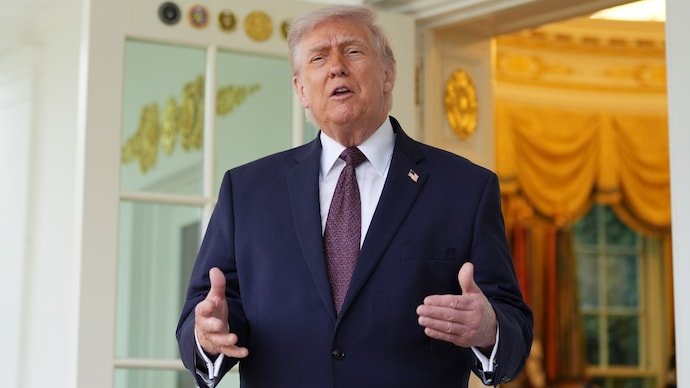
US President Donald Trump said on Wednesday that the ongoing war between the United States and Iran is “very close to being over,” while cautioning that Military operations are not yet complete. His remarks come as Washington prepares for a second round of diplomatic talks with Tehran, even as a naval blockade and regional tensions continue to shape the Conflict across West Asia.
Trump Signals Possible End to Conflict
In an interview, Trump expressed optimism that the war may soon conclude, suggesting that recent developments have pushed both sides closer to a resolution.
“I think it’s close to over, yeah. I view it as very close to being over.”
His comments indicate a potential turning point in a conflict that has seen significant military engagement, economic disruption, and geopolitical tension over the past several weeks.
However, Trump quickly balanced this optimism with a strong warning that the United States is not ready to fully disengage from the situation.
“If I pulled up stakes right now, it would take them 20 years to rebuild that country. And we’re not finished.”
This dual messaging reflects a strategic stance projecting progress toward peace while maintaining pressure on Iran.
Background: Escalation and Military Campaign
The conflict escalated sharply after the United States, along with Israel, launched a military campaign against Iran on February 28. The operation was justified by Washington as a necessary step to counter Iran’s alleged pursuit of nuclear weapons.
The strikes caused significant damage to infrastructure and resulted in the deaths of key Iranian leadership figures. In response, Iran carried out retaliatory actions targeting US interests across the region, leading to a broader escalation.
Trump acknowledged that Iran’s response was stronger than initially anticipated, highlighting the unpredictable nature of the conflict.
Naval Blockade Intensifies Pressure
A key element of the US strategy has been a naval blockade in the Strait of Hormuz, one of the world’s most critical shipping routes for oil and energy supplies.
The blockade was introduced after earlier Peace Talks in Islamabad failed to produce an agreement. Enforced by US warships and military personnel, the blockade has already disrupted maritime traffic, forcing several vessels to turn back from Iranian waters.
This move has not only increased pressure on Iran but also contributed to uncertainty in global Energy Markets and shipping industries.
Diplomatic Efforts Resume Amid Tensions
Despite ongoing military activity, diplomatic channels remain active. Trump indicated that a second round of talks with Iran could take place within days, possibly again in Islamabad.
The first round of negotiations ended without a breakthrough, with disagreements over Iran’s nuclear ambitions remaining a key obstacle.
Vice President JD Vance also emphasized the administration’s willingness to pursue a comprehensive agreement, often referred to as a “grand bargain,” while acknowledging the deep mistrust between the two nations.
“You are not going to solve that problem overnight.”
NEW: Trump says the war with Iran is “close to over” pic.twitter.com/FF54F9mBdr
— Resist Wire (@ResistWire) April 15, 2026
This highlights the complexity of the negotiations, where decades of geopolitical tension cannot be resolved quickly.
Strategic Importance of the Strait of Hormuz
The Strait of Hormuz continues to be a central focus of the conflict. As a major Global Oil transit chokepoint, any disruption in this region has immediate international consequences.
Ongoing tensions in the strait have raised concerns about potential escalation, especially as both military and commercial vessels navigate the area under heightened risk.
| Key Factor | Impact |
|---|---|
| Naval Blockade | Disrupted shipping routes and trade flows |
| Military Presence | Increased risk of confrontation |
| Oil Supply Routes | Potential global price volatility |
| Diplomatic Talks | Possible path toward de-escalation |
Ceasefire Window and Uncertain Next Steps
A temporary ceasefire currently appears to be holding, but uncertainty looms over what will happen once it expires on April 22. Neither the United States nor Iran has clearly outlined its next steps, leaving room for both renewed conflict and potential agreement.
The coming days are likely to be critical, as diplomatic efforts intensify and both sides assess their strategic positions.
Conclusion: Peace Within Reach or Pause Before Escalation?
Trump’s statement that the war is “very close to being over” offers a cautiously optimistic outlook, but his warning that the US is “not finished” underscores the fragile nature of the situation.
The combination of military pressure and renewed Diplomacy suggests that both sides may be seeking leverage ahead of a potential agreement. However, unresolved issues particularly around nuclear capabilities and regional security continue to pose significant challenges.
Looking ahead, the outcome will depend on whether ongoing talks can bridge deep-rooted differences. While peace may be within reach, the risk of escalation remains, making this a critical moment in one of the most closely watched geopolitical conflicts in the world.
For breaking news and live news updates, like us on Facebook or follow us on Twitter and Instagram. Read more on Latest World on thefoxdaily.com.






COMMENTS 0