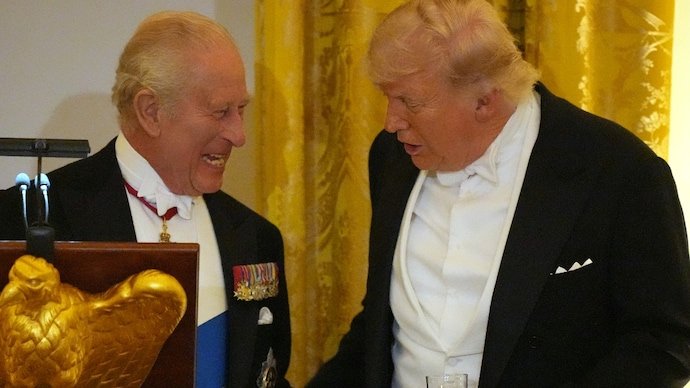
When King Charles III stood up to speak at a White House dinner and jokingly suggested that Americans might be speaking French if not for Britain, the room erupted in laughter. But beyond the humor, the remark carried layers of historical truth, political nuance, and diplomatic strategy. Moments like these are rarely accidental. They are carefully crafted to entertain, but also to remind, signal, and strengthen ties.
The exchange took place during a high-profile gathering between British and American leadership, where both sides aimed to project unity despite ongoing global tensions. While the tone remained warm and conversational, the King’s comment stood out not just because it was witty, but because it distilled centuries of geopolitical rivalry into a single, memorable line.
The History Behind the Humor
To understand why the “speaking French” remark resonated so strongly, it helps to look back at a time when North America was not yet the United States, but a contested space between European empires. Britain and France were the dominant powers competing for land, resources, and influence across the continent.
This rivalry reached its peak during the mid-18th century, particularly in the Conflict often referred to as the French and Indian War. The outcome of that struggle reshaped the future of North America. Britain emerged with control over vast territories, while France ceded much of its claim.
This shift had long-term consequences. Language, legal systems, and cultural norms across what would become the United States were heavily influenced by British rule. The King’s joke, therefore, wasn’t just playful exaggeration it reflected a genuine historical turning point.
Key Moments That Shaped the Outcome
| Historical Event | Time Period | Why It Matters |
|---|---|---|
| Colonial Rivalries | 1600s–1700s | Set the stage for British-French competition in North America |
| French and Indian War | 1754–1763 | Decisive conflict that weakened French control |
| Treaty Agreements | 1763 | Formal transfer of territories to Britain |
| American Independence | Late 1700s | New nation retained strong British cultural influence |
Had history unfolded differently, the linguistic and cultural identity of the United States might look very different today. That is what made the King’s remark both humorous and thought-provoking.
Humor as a Diplomatic Tool
In international Politics, words are rarely casual. Humor, in particular, is often used with precision. It can ease tension, build rapport, and deliver subtle messages without confrontation. King Charles’s comment did all three.
It also responded indirectly to earlier remarks about global influence and military history. Instead of engaging in direct debate, the King chose a softer approach one that allowed him to acknowledge history while keeping the atmosphere light.
This kind of communication is especially valuable in settings where leaders must balance honesty with diplomacy. A well-placed joke can say more than a formal statement, precisely because it invites the audience to think rather than react defensively.
The Evolution of the US-UK Relationship
What makes the moment even more interesting is the contrast between past and present. The United States and the United Kingdom were once adversaries. Today, they are among the closest allies in the world.
This transformation did not happen overnight. It evolved over decades through shared interests, mutual challenges, and growing alignment in values and governance. The relationship is often described as “special,” not because it is perfect, but because it is deeply interconnected.
What Defines This Relationship Today
- Strong military cooperation across global conflicts and peacekeeping missions
- Deep intelligence sharing and security collaboration
- Significant trade and economic partnerships
- Shared language and cultural influence
The King’s remark subtly reinforced this connection. By referencing history, he reminded both sides how far they have come from colonial conflict to strategic partnership.
Owning the Past with Confidence
Another notable aspect of the speech was its willingness to acknowledge difficult history. References to past conflicts, including attacks on American soil and colonial tensions, were presented with humor rather than defensiveness.
This approach signals confidence. Nations that can openly discuss their past, even the uncomfortable parts, often build stronger credibility on the global stage. It shows maturity and a willingness to move forward without erasing history.
In this case, the tone made all the difference. Instead of reopening old wounds, the remarks transformed historical events into shared memories something both sides could reflect on with perspective.
Why This Moment Matters Now
While the joke was rooted in the past, its relevance is very much tied to the present. The global political landscape is increasingly complex, with shifting alliances and rising uncertainties. In such an environment, symbolic gestures carry weight.
Moments like this help reinforce stability. They signal continuity in relationships, even as policies and priorities evolve. They also shape how the public perceives international partnerships.
At a time when geopolitical tensions can dominate headlines, a moment of humor can humanize leadership and remind audiences of shared values.
A Unique Perspective: The Power of “What If” in Politics
One of the most interesting aspects of the King’s remark is its use of a “what if” scenario. By imagining an alternate reality where Americans spoke French, he invited the audience to reconsider the importance of historical outcomes.
This technique is powerful because it simplifies complex history into a relatable idea. It encourages reflection without requiring deep academic knowledge. In doing so, it makes diplomacy more accessible to the public.
Leaders who use this approach effectively can bridge the gap between policy and public understanding. They turn abstract history into something tangible and memorable.
Comparison: Then vs Now
| Aspect | Past Dynamics | Present Reality |
|---|---|---|
| UK and US | Colonial conflict | Close strategic allies |
| Global Influence | Territorial control | Collaborative leadership |
| Communication Style | Formal and rigid | Flexible, often informal |
This shift highlights a broader trend in International Relations. Power is no longer defined solely by control over land, but by the ability to build and maintain alliances.
What Comes Next
Looking ahead, the relationship between the United States and the United Kingdom is expected to remain strong, but it will continue to adapt. Emerging challenges such as technological competition, economic shifts, and Global Security concerns will shape future collaboration.
The ability to maintain trust and communication will be critical. Moments like this where leaders connect through shared history and humor play an important role in sustaining that trust.
Conclusion
What appeared to be a simple joke at a formal dinner was, in reality, a layered and meaningful exchange. The moment when King Charles roasted Trump was not just about laughter it was about legacy, influence, and connection.
By drawing on history, the King reminded his audience that the present is built on the past. By using humor, he ensured that message was heard, remembered, and appreciated.
In a world where diplomacy often feels tense and transactional, such moments stand out. They show that even in the highest levels of power, a touch of wit can carry the weight of centuries and still leave room for a smile.
For breaking news and live news updates, like us on Facebook or follow us on Twitter and Instagram. Read more on Latest World on thefoxdaily.com.






COMMENTS 0