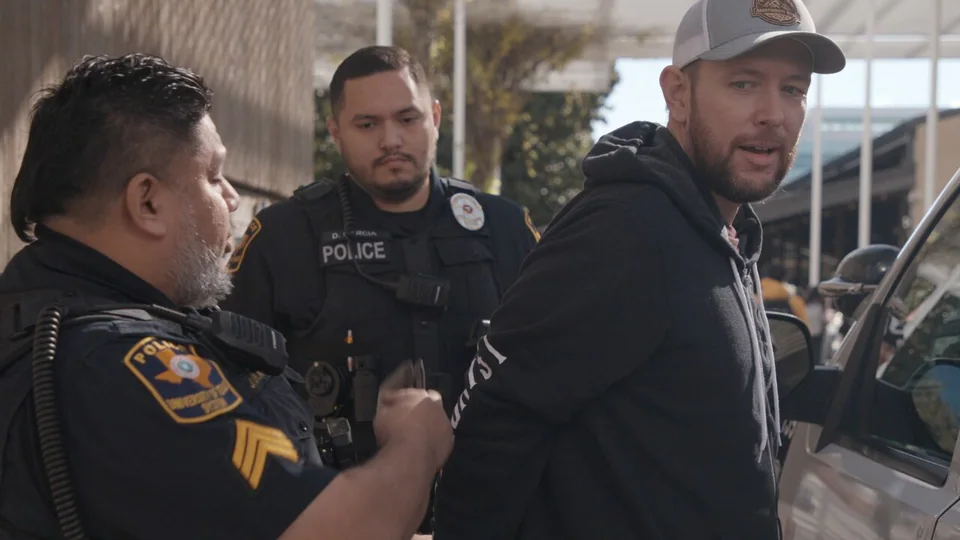
Anti-abortion activist T. Russell Hunter was arrested at the University of Texas at Dallas on Thursday, November 19, following a confrontation involving university officials and campus police. Hunter, who founded the anti-abortion organisation Abolitionist Rising, was reportedly taken into custody after administrators asked him and his associates to leave the campus following complaints from students.
Hunter was later released, confirming his freedom in a Facebook post. The arrest has triggered a debate among his supporters over free speech on university campuses, the right to engage in religious and political discussions in public spaces, and the limits universities can place on outside groups seeking to communicate with students.
According to statements published by organisations associated with Hunter, he and other activists were peacefully discussing abortion and Christianity with students when the confrontation occurred. However, the university had not issued an official statement explaining the circumstances of the arrest, and it remained unclear whether formal charges had been filed.
Why Was T. Russell Hunter Arrested at the University of Texas at Dallas?
The arrest reportedly followed an interaction between Hunter’s group and university administrator Tricia Losavio. According to Abolitionist International, Hunter and members of Abolitionist Rising were on campus discussing abortion and the Gospel of Christ with students when Losavio asked them to leave.
The organisation said the administrator cited complaints from students as the reason for asking the group to depart. Police were subsequently called to the scene, and Hunter was arrested outside the university campus.
Abolitionist Rising described the activists’ activities as peaceful conversations about abortion and Christianity. The organisation disputed the circumstances leading to the arrest and argued that its members were exercising their constitutional rights to discuss religious and political issues.
However, the available account primarily comes from Hunter’s organisation and its supporters. Without an official explanation from the university or police, the precise circumstances of the confrontation, the instructions given to the activists and the legal grounds for the arrest remain unclear.
Hunter Released After Spending Time in Police Custody
Hunter later confirmed that he had been released from custody through a Facebook post. He wrote, “I’m out. The Lord is good,” indicating that he was no longer being held by police.
Before his release, Abolitionist International claimed that officers handcuffed Hunter within approximately 90 seconds of arriving at the campus. The organisation alleged that police declined to review its legal arguments concerning the activists’ First Amendment rights and refused to speak with their attorneys.
The group also said Hunter remained in custody overnight. It shared a photograph showing him being booked into a police vehicle outside the UT Dallas campus as part of its account of the incident.
These claims have not been independently established through an official police account. The available information also does not confirm whether Hunter was formally charged, whether any citation was issued or whether his release was connected to a decision not to pursue prosecution.
Abolitionist Rising Claims Activists Were Exercising First Amendment Rights
Abolitionist Rising strongly criticised the arrest, arguing that political and religious speech should receive constitutional protection even when the message is controversial or unpopular.
In a statement shared on social media, the organisation said the First Amendment was not intended to protect only popular opinions. It argued that universities should allow students to encounter challenging ideas, participate in open discussions and engage with viewpoints they may find offensive.
The group framed Hunter’s arrest as an issue of free expression rather than simply a disagreement over campus access. Its position is that the activists were participating in peaceful discussions and should not have been detained for expressing their views.
The controversy highlights a distinction that often arises in disputes involving demonstrations and outside speakers at universities: constitutional protection for speech does not automatically grant unrestricted access to every campus location. The legal position can depend on whether the institution is public or private, the nature of the space, applicable campus policies and the conduct of the individuals involved.
For public universities, the First Amendment generally restricts government institutions from suppressing speech because officials or audiences disagree with its message. However, universities can impose reasonable and lawful restrictions concerning access, safety, disruption and the use of campus facilities.
Determining whether those restrictions were properly applied in Hunter’s case will require more information about the university’s policies, the specific location where the activists were present and the legal basis cited by police.
University of Texas at Dallas Has Not Issued an Official Explanation
As of the information available following the arrest, the University of Texas at Dallas had not released an official statement explaining why Hunter was detained or responding to the allegations made by his organisation.
The absence of an institutional account leaves several important questions unanswered. It is not clear whether the university considered the activists to be violating a campus policy, whether they were formally instructed to leave before police intervened or what specific legal grounds officers relied upon when making the arrest.
It is also unclear whether students had submitted formal complaints or whether the university had received objections about the group’s presence before the confrontation.
Without confirmation from university officials or law enforcement, claims made by either side should be treated with caution. An arrest does not by itself establish that a person committed a crime, and the available information does not confirm that Hunter faced any formal charges.
Who Is T. Russell Hunter?
T. Russell Hunter is an Oklahoma-born activist associated with the American anti-abortion movement. He is best known for founding Abolitionist Rising in 2023, an organisation that campaigns for the complete and immediate criminalisation of abortion in the United States.
Hunter has been involved in anti-abortion activism since at least the early 2010s. Before establishing his own organisation, he was associated with groups including Abolish Human Abortion and Free The State.
His activism is rooted in the abolitionist position within the anti-abortion movement. Supporters of this approach argue that abortion should be treated as a criminal offence and that legal protections for abortion should be eliminated. This position is generally more uncompromising than approaches that seek restrictions based on gestational limits or specific exceptions.
Hunter graduated from the University of Oklahoma with a degree in the History of Science. Through Abolitionist Rising, he has continued campaigning for policies aimed at ending legal abortion and increasing criminal penalties associated with the practice.
What Is Abolitionist Rising?
Abolitionist Rising is an anti-abortion organisation founded by Hunter in 2023. Its central objective is the complete abolition of legal abortion in the United States, including the removal of legal protections that permit the procedure.
The organisation’s activities include public advocacy, political messaging and direct engagement with people about abortion. Its approach is based on the belief that abortion should be criminalised rather than regulated through existing legal frameworks.
The group describes its work in religious and moral terms, frequently connecting its opposition to abortion with Christian beliefs. This approach was also reflected in its account of the UT Dallas incident, which described Hunter and his associates as discussing abortion and the Gospel of Christ with students.
Its positions have placed it within the more hardline section of the American anti-abortion movement. The group’s campaign for immediate and comprehensive criminalisation distinguishes it from organisations that support narrower restrictions or incremental legislative changes.
Why the UT Dallas Arrest Has Triggered a Free Speech Debate
The arrest has attracted attention because it involves two issues that frequently collide on American university campuses: the right to express controversial political or religious opinions and an institution’s authority to regulate activities on its property.
Universities are important spaces for public debate, but they also have responsibilities to maintain campus safety and ensure that academic activities can continue without unlawful disruption. The challenge is determining where legitimate institutional regulation ends and unconstitutional restrictions on expression begin.
In the United States, the First Amendment protects freedom of speech and religious expression against government restrictions. Public universities are generally subject to these constitutional protections, although the specific rules governing campus access and demonstrations can vary according to the location and circumstances.
The content of a speaker’s message is an important consideration. A public institution generally cannot prohibit expression simply because students or staff find its political or religious position offensive. At the same time, constitutional protection does not give outside visitors an unconditional right to enter restricted areas or ignore lawful instructions governing campus activities.
In Hunter’s case, the key unanswered issue is whether the university and police acted under a valid campus or legal restriction or whether the activists were prevented from speaking because of the views they were expressing. Establishing that distinction will require an official account and further details about the incident.
What Happens Next After Hunter’s Release?
Hunter’s release has ended his immediate detention, but it does not necessarily resolve the legal questions surrounding the arrest. The available information does not establish whether the police investigation has concluded or whether prosecutors intend to pursue any charges.
An official statement from UT Dallas or the relevant law enforcement agency could clarify why the activists were asked to leave, what happened before the arrest and whether officers believed a specific law or campus rule had been violated.
The incident may also lead to renewed scrutiny of how universities manage outside speakers, religious outreach and political advocacy. Institutions must balance their responsibility to maintain orderly campus operations with the constitutional protections applicable to public universities.
For now, the controversy remains centred on competing accounts of the confrontation. Hunter and his supporters maintain that the activists were peacefully exercising their First Amendment rights, while the university has not publicly explained its position in the information available.
The arrest has therefore raised questions about campus access and freedom of expression, but a definitive assessment of the incident will depend on the legal grounds for Hunter’s detention and any further explanation from university or police officials.
For breaking news and live news updates, like us on Facebook or follow us on Twitter and Instagram. Read more on Latest World on thefoxdaily.com.




COMMENTS 0