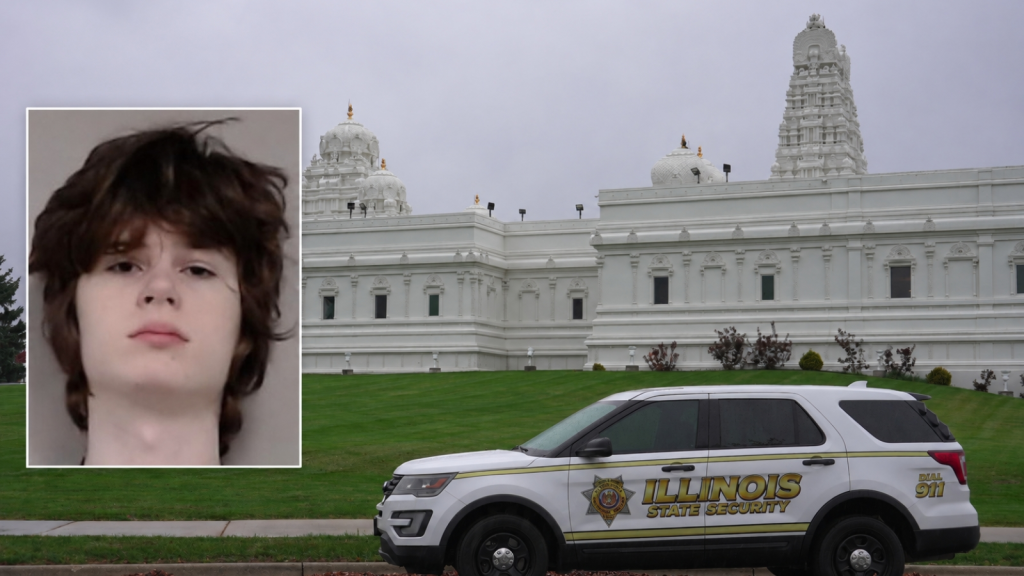
US authorities have revealed further details about an alleged mass shooting plot targeting a Hindu temple in Aurora, Illinois, raising concerns about the safety of Indian Americans and other minority communities. Investigators allege that 19-year-old Alexandros Paporakis planned an attack on the Sri Venkateswara Swami (Balaji) Temple, approximately 40 miles west of downtown Chicago.
The investigation intensified after a co-worker reportedly alerted police to disturbing statements and electronic messages in which Paporakis allegedly threatened Indian people. Prosecutors say he discussed plans for violence, shared material showing a rifle and later claimed that his weapon had jammed before he could carry out the alleged attack.
A search of his home in Palatine, Illinois, reportedly uncovered an AR-style rifle without a serial number, loaded magazines, around 300 rounds of ammunition, a tactical vest and a patch depicting Nazi symbolism. Investigators also found an eight-page document containing racist language and alleged plans to kill non-white people.
Paporakis faces felony charges of making a terrorist threat and unlawfully possessing a rifle. He remains in detention, and the allegations against him have not been tested at trial. Authorities have not reported any injuries connected to the incident.
Suspect’s Car Reportedly Entered Temple Parking Lot
One of the most significant developments emerged from surveillance footage examined by investigators. According to reporting by the Associated Press, Palatine Police Chief William Nord said a red Acura RDX registered to Paporakis entered the Sri Venkateswara Swami (Balaji) Temple’s parking lot at approximately 12:25 pm on Sunday, October 11.
The vehicle reportedly left less than 15 minutes later. The timing has drawn attention because investigators believe the suspect may have been preparing to carry out an attack that day.
Authorities had previously said the precise intended location was still under investigation. The reported surveillance footage subsequently provided a connection between a vehicle registered to Paporakis and the Hindu temple that investigators believe may have been targeted.
The temple, located in Aurora, serves Hindu devotees from across the Chicago metropolitan area. A mass shooting at such a religious gathering place could have endangered worshippers, employees, volunteers and visitors.
Investigators have not publicly established every detail of what happened during the vehicle’s reported visit. However, the brief appearance at the temple has become a central part of the emerging account of the alleged plot.
Co-Worker’s Warning Led Police to Investigate
According to prosecutors, Paporakis made disturbing statements to co-workers at a Taco Bell restaurant, including an alleged declaration that he “couldn’t wait to kill Indian people”. He reportedly described Sunday as a “special day”, prompting concern about the possibility of imminent violence.
A co-worker subsequently contacted authorities after receiving communications that allegedly contained threats and material connected to weapons. NBC Chicago reported that the co-worker contacted Mount Prospect police, who passed the information to investigators in Palatine.
The information prompted law enforcement to investigate Paporakis and seek a search warrant. Police ultimately arrested him near his home on Sunday evening, according to reporting cited in the case coverage.
The co-worker’s account became particularly significant after Paporakis allegedly sent further messages describing what had happened with his weapon. Prosecutors say he told the co-worker that the gun had jammed and that he had left quickly, but intended to “retry”.
He allegedly sent the co-worker a video showing an AR-style rifle and a photograph of himself wearing a tactical vest. Investigators have cited these communications as part of the evidence underpinning the criminal case.
The alleged statements and messages remain allegations presented by authorities. Their significance will ultimately be assessed through the legal process as prosecutors pursue the charges.
Eight-Page Document Allegedly Described Plans for Mass Violence
Investigators reportedly recovered an eight-page document attributed to Paporakis that contained racist slurs, white supremacist views and an alleged plan to kill as many non-white people as possible.
According to prosecutors, the document expressed hostility towards several racial and religious groups, including Indian, Jewish and Black people. News reports also described a document titled “Why I Fought: A.K.A.: (Aurora Shooter’s Manifesto)”, which allegedly contained extremist beliefs and references to violence against South Asians, particularly people of Indian descent.
The material is reported to have portrayed the author as a white supremacist and neo-Nazi who fantasised about mass murder. Investigators are examining the document alongside the alleged threats, electronic communications and physical evidence recovered during the inquiry.
Documents of this kind can become important evidence in cases involving alleged threats of mass violence because they may help investigators assess a suspect’s stated intentions and identify potential targets. However, the presence of extremist material does not by itself determine guilt; prosecutors must establish the relevant criminal allegations in court.
The reported references to Indian people have heightened concern within the Indian American community, particularly because the location under investigation is a place of worship. The case has also renewed attention to the threat that racially motivated violence can pose to religious institutions and minority communities.
Weapons, Ammunition and Tactical Equipment Found at Home
Authorities say the search of Paporakis’ home uncovered a collection of weapons-related items and material that investigators consider relevant to the alleged plan.
Reported evidence included:
- An AR-style rifle without a serial number.
- Loaded magazines and approximately 300 rounds of ammunition.
- A tactical vest.
- A patch depicting Nazi symbolism.
- A gas canister labelled with a racial slur targeting South Asians.
- An eight-page document containing alleged white supremacist views and plans for mass violence.
NBC Chicago reported that the rifle had been modified. Authorities have not publicly established through a trial whether each recovered item was connected to a specific planned action, and the evidence remains part of an ongoing criminal investigation.
The combination of the reported weapons, ammunition, tactical equipment and alleged threats has raised questions about how far preparations may have progressed. Prosecutors contend that the suspect’s communications and the vehicle’s reported presence at the temple support their allegations.
The case also illustrates the role that information from members of the public can play in identifying possible threats. In this instance, the co-worker’s decision to report the alleged communications gave authorities information that led to further investigation and the suspect’s arrest.
Indian Government Expresses Deep Concern
India’s Ministry of External Affairs has expressed concern over the alleged plot and called for a thorough investigation by US authorities.
MEA spokesperson Randhir Jaiswal said the incident was “obviously a matter of deep concern for us”. He said the case highlighted broader concerns about hate crimes and racial discrimination affecting Indian communities in the United States.
India called on US authorities to investigate the alleged plot thoroughly, bring those responsible to justice and take necessary measures to prevent similar incidents. The government’s response underlined the importance it attaches to the safety and security of Indian nationals and members of the Indian diaspora.
The Consulate General of India in Chicago also said it appreciated the timely action taken by law enforcement. The consulate said it was in contact with members of the Indian diaspora while monitoring developments in the case.
The diplomatic response comes as authorities continue to investigate the circumstances surrounding the alleged threat. While the suspect’s arrest has reduced the immediate uncertainty surrounding the reported plot, the case has left members of the local Hindu and Indian American communities concerned about their safety.
Hindu Temple Strengthens Security After Alleged Threat
The Sri Venkateswara Swami (Balaji) Temple said its leadership was in contact with police and had introduced additional security measures following the incident.
In a statement, the temple said the safety of its devotees, employees and volunteers was its highest priority. It confirmed that enhanced measures had taken effect immediately, including an increased armed security presence at the temple.
The announcement was intended to reassure worshippers while the investigation continued. Places of worship are often open to large numbers of visitors, making security planning a concern for religious institutions responding to credible threats.
US Representative Raja Krishnamoorthi, who represents Illinois’ 8th congressional district, said he had visited the temple with his family on Sunday without knowing about the alleged threat.
“I visited not knowing that there was an attacker lying in wait with a sinister motive to commit a mass shooting, and only because his AR-15 weapon jammed was he not able to commit a massacre that day,” Krishnamoorthi told the Associated Press.
He said he had increased his own security following the alleged plot and urged the FBI to investigate and prosecute the matter as a Hate Crime. He also called on the Trump administration to release federal nonprofit security grants intended to help protect religious institutions.
“People are really shaken up,” he added.
Aurora Mayor John Laesch said police were reaching out to other temples in the area to ensure that religious leaders knew whom to contact if they received threats. The outreach reflects concerns that the incident could have implications beyond the individual temple named in the investigation.
US Lawmakers Condemn Alleged White Supremacist Plot
The allegations prompted condemnation from US lawmakers and civil rights advocates, many of whom warned about the consequences of anti-Indian and anti-Hindu hostility.
Senate Democratic leader Chuck Schumer said in a post on X that anti-Indian and anti-Hindu rhetoric was at an alarming level in the United States and warned that hatred could turn into violence.
Schumer also said bigotry against any community had no place in the country and stressed that people should be able to live and practise their faith openly, regardless of race or religion.
The Congressional Asian Pacific American Caucus, known as CAPAC, said the alleged plot illustrated the danger that white supremacist ideology poses to minority communities and houses of worship.
In a statement signed by lawmakers including Suhas Subramanyam, Grace Meng and Judy Chu, the caucus said every American should be able to worship freely and without fear.
CAPAC also cited an increase in anti-South Asian hate speech on X, claiming that such content had risen by 240 per cent over two years. The caucus attributed part of the increase to influential figures amplifying racist rhetoric and directing hostility towards immigrant communities.
Congressman Greg Stanton described the alleged plan as an act of white supremacist hate against Indian Americans, while Senator Jacky Rosen said the case had shaken the Hindu community across the country.
Manjusha Kulkarni, co-founder of Stop AAPI Hate, welcomed the fact that the alleged plot had been thwarted but said the fear experienced by Hindu, Indian and South Asian communities would not disappear simply because no one was injured.
Kulkarni also highlighted the timing of the alleged threat, noting that the temple had been celebrating Navratri, a nine-day Hindu festival associated with devotion and celebration.
Her comments reflected broader concerns among community advocates that racist hostility can undermine the sense of security people need to participate in religious and cultural events.
Suspect Remains in Detention as Case Proceeds
Paporakis was ordered detained after appearing in court on October 14. He faces felony charges of making a terrorist threat and unlawfully possessing a rifle, with his next hearing scheduled for October 30.
The Cook County Public Defender’s Office has cautioned that the proceedings remain at an early stage and could develop into a lengthy legal process. The allegations made by prosecutors and law enforcement have not yet been tested at trial.
The charges announced so far relate to the alleged threats and unlawful rifle possession. Officials and community representatives have also called for scrutiny of whether the alleged conduct should be investigated and prosecuted as a hate crime.
Authorities have not reported injuries in connection with the incident. The investigation remains ongoing, and further proceedings will determine how the evidence is considered by the court.
Investigation Puts Focus on Safety of Religious Minorities
The alleged plot has raised difficult questions about the security of religious institutions and the risks posed by threats rooted in racial or religious hatred. For the Hindu temple in Aurora, the immediate response has included closer coordination with law enforcement and additional security measures.
For Indian Americans and other South Asian communities, the case has also prompted renewed discussion about the distinction between hateful rhetoric and threats that may signal a risk of physical violence. Community advocates have argued that authorities must respond seriously to credible threats while ensuring that allegations are investigated through proper legal procedures.
The reported sequence of events from a co-worker’s warning and the suspect’s alleged communications to the search of his home and the discovery of weapons-related evidence will remain central to the case as it proceeds.
For now, Paporakis remains in detention, the temple has strengthened its security, and law enforcement agencies continue their investigation. The allegations have not been proven in court, but the incident has prompted concern among officials and community leaders about protecting people from targeted violence and ensuring that houses of worship remain safe places for religious practice.
With inputs from Associated Press, NBC Chicago and PTI.
For breaking news and live news updates, like us on Facebook or follow us on Twitter and Instagram. Read more on Latest World on thefoxdaily.com.





COMMENTS 0