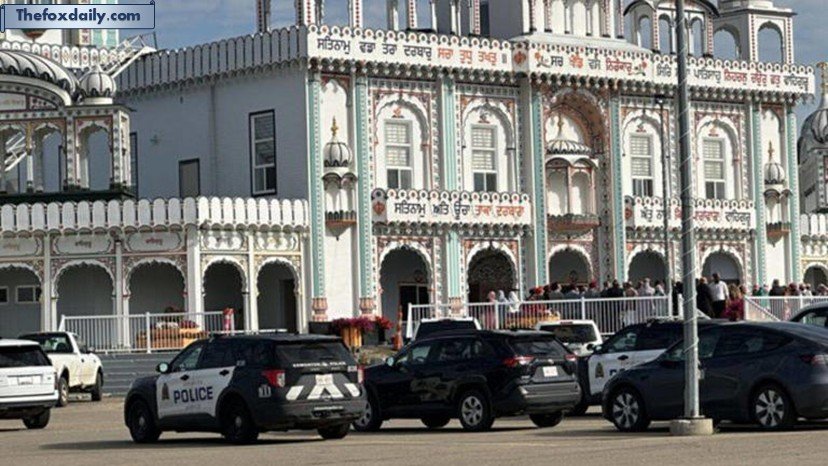
Morning prayers at a Sikh gurdwara in northeast Edmonton were disrupted by a violent confrontation on Friday after a 27-year-old man allegedly entered the temple and stabbed two men. The victims, aged 75 and 51, suffered non-life-threatening injuries and were taken to hospital.
The Edmonton Police Service arrested the suspect after witnesses intervened and restrained him inside the Nanaksar Sikh Gurdwara. Police have not established a motive, but the force’s Hate Crimes Unit is working with investigators to determine whether the attack was motivated by hatred toward the Sikh community.
The incident has drawn particular concern because it happened inside a place of worship during morning prayers, when members of the congregation had gathered at the temple. It also comes amid wider concerns raised by Sikh organizations about threats and incidents affecting places of worship in Alberta.
What happened at the Edmonton gurdwara
Edmonton police said they first received a report at about 4:49 a.m. Friday that a man was walking in traffic on Highway 15 near Horsehill Road. Roughly 15 minutes later, officers began receiving reports of a stabbing at the Nanaksar Sikh Gurdwara in the area of 14 Street and Horsehill Road.
According to the police account, the man entered the gurdwara and attempted to gain access to the prayer area. Staff confronted him, and the encounter escalated. Two male patrons were stabbed during the confrontation.
Witnesses then intervened and detained the man until officers from the Edmonton Police Service’s Northeast Branch arrived at approximately 5:10 a.m. Police took the suspect into custody, while emergency medical crews treated the two injured men.
The victims, aged 75 and 51, were transported to hospital with injuries that police described as non-life-threatening. The suspect was also injured and taken to hospital.
The Edmonton Police Service said its Investigative Response Team assumed responsibility for the case and began working with the Hate Crimes Unit to establish whether the incident was hate-motivated. Charges were pending in the initial police account.
Why police are examining a possible hate crime
The involvement of a hate-crimes investigation does not mean police have concluded that the attack was motivated by anti-Sikh hatred. That distinction is important.
Investigators must establish what prompted the suspect to enter the gurdwara, why he attempted to access the prayer area and what led to the confrontation. Evidence gathered from witnesses, the scene and the suspect will help determine whether the attack was an act of violence without a hate component or whether religious identity played a role.
Police have therefore stopped short of assigning a motive. The investigation is examining the hate-crime angle rather than declaring it established.
This distinction matters because an attack occurring at a religious institution can generate immediate fear within a community even before investigators know why it happened. For Sikh worshippers, the location of the incident adds an additional layer of concern: a space ordinarily associated with prayer, community service and hospitality became the scene of serious violence.
Who were the two injured men?
Police initially described the victims as male patrons of the gurdwara. Representatives of the Nanaksar Gurdwara Gursikh Temple later identified them as a temple priest and a longtime volunteer.
Community accounts said several people were inside the building when the incident unfolded during morning prayers. The people present intervened when the suspect was confronted, helping prevent the situation from becoming even more serious.
The victims’ ages also highlight the circumstances of the confrontation. One was 75 and the other 51. Both were taken to hospital, and their injuries were reported as non-life-threatening.
Police Chief Warren Driechel said the incident did not result in more serious injuries or deaths, while acknowledging the trauma experienced by the victims and the wider community.
The attack happened during morning prayers
The timing of the incident is significant because the gurdwara was operating as a place of worship when the confrontation occurred. Morning prayers had brought members of the congregation into the building before the violence interrupted the gathering.
Reports from the temple community indicated that the gathering was also connected to preparations for a Sikh wedding. Despite the disruption, people were later allowed to return to the building and the wedding proceeded.
That decision illustrates one of the immediate challenges for a religious community after an attack: restoring normal activity while people are still processing what happened.
A gurdwara is not simply a building used for religious ceremonies. It is also a community space where people gather, eat, volunteer and participate in religious and cultural activities. Sikh gurdwaras are traditionally open to visitors regardless of faith or background, meaning accessibility is an important part of how these institutions function.
That openness can also create difficult Security questions after a violent incident. Increasing security may reassure worshippers, but measures that make a gurdwara feel inaccessible can conflict with the welcoming role such institutions are intended to play.
Witnesses played a critical role
One of the most significant details emerging from the investigation is that witnesses intervened before police arrived.
Edmonton police said witnesses detained the suspect, allowing officers to take him into custody when they reached the temple. That intervention appears to have brought the immediate confrontation under control while emergency responders treated the injured men.
The sequence also explains why the police investigation is likely to depend heavily on witness accounts. Investigators will need to reconstruct the suspect’s movements, his interactions with staff and worshippers, the precise circumstances of the stabbing and what happened immediately before and after the attack.
Evidence from inside the gurdwara, together with witness statements and other investigative material, will be important in establishing what happened and whether the suspect acted with a particular motive.
Suspect had a history of violent offences
Edmonton police later said the 27-year-old suspect was known to them and had a significant history of violent offences dating back to 2015.
Police said he had been released from a federal institution on August 20, one day before the gurdwara attack. He had been serving a sentence connected to aggravated assault and assaulting a peace officer.
Police Chief Warren Driechel said the man had served about 20 months of a 31-month sentence and had been required to report to a halfway house in Edmonton after his release. Police said he did not report as required.
These details provide important background to the case, but they do not establish why the gurdwara was targeted. A previous history of violence and the question of whether the latest incident was hate-motivated are separate issues that investigators must examine independently.
The circumstances surrounding the suspect’s release may become relevant to questions about his actions before the attack, but they should not be treated as evidence of a religious motive without supporting evidence.
Why the hate-crime question matters to Edmonton’s Sikh community
The central unanswered question is motive.
If investigators determine that the attack was motivated by hostility toward Sikhs or their religion, it would have implications beyond the two injured men. Religious communities often assess the safety of their places of worship collectively after an incident, particularly when violence occurs inside a sacred space.
If investigators instead determine that there was no evidence of a hate motive, that finding would be equally important. It would help distinguish an apparently targeted religious attack from another form of violent behaviour that happened to occur inside a gurdwara.
For now, neither conclusion has been established.
That uncertainty has not prevented concern within the wider Sikh community. Representatives have questioned whether the attack was an isolated act or part of a broader pattern of hostility toward Sikh institutions.
Recent concerns about Sikh places of worship in Alberta
The Edmonton stabbing has occurred against a backdrop of other incidents that have unsettled Sikh communities in Alberta.
Global News reported that Calgary police were investigating threatening calls made to two Sikh temples on August 15. Police said the investigation remained ongoing and that they did not believe there was an active threat to the community or either location at that time.
Those incidents are separate from the Edmonton stabbing, and there is no established evidence in the available information linking them.
That distinction is especially important when discussing community safety. Several incidents occurring within a short period can understandably heighten anxiety, but investigators must establish connections through evidence rather than assumption.
The Sikh community has also faced other incidents in Alberta that have generated concern. In one separate case, police said there was no evidence that the fatal shooting of Birinder Singh on the QEII highway in March was motivated by hate or racial bias.
These cases demonstrate why motive is so important. An incident can have a profound impact on a community without necessarily meeting the legal or investigative criteria for a hate-motivated crime.
What happens in a hate-crime investigation?
In a case such as the Edmonton gurdwara stabbing, investigators have to examine both the physical evidence and the circumstances surrounding the alleged offence.
That can include determining what the suspect said or did before the attack, whether there was evidence of hostility toward a religious group, whether the location was deliberately selected and what other evidence might establish intent.
The fact that an incident happened at a religious institution can be an important investigative consideration, but the location alone does not prove a hate motive.
The Edmonton Police Service has specifically assigned its Hate Crimes Unit to work with the main investigative team. That allows investigators with expertise in hate-motivated incidents to examine the evidence while the broader Criminal Investigation continues.
Security versus openness at gurdwaras
The attack also raises a difficult practical question for Sikh institutions: how can places of worship remain open and welcoming while protecting people from violence?
Members of the Sikh community have emphasized that gurdwaras are open to people of different backgrounds. Visitors can enter, participate in community life and access services such as communal meals. That openness is central to the institution’s social role.
Following a violent incident, however, communities may consider measures such as improved awareness among volunteers, Emergency Response planning, communication systems and coordination with local police.
None of those measures can guarantee that violence will never occur. They can, however, affect how quickly a community recognizes a developing threat and responds to an emergency.
The Edmonton incident demonstrated the value of people inside the building reacting quickly. Witnesses confronted and restrained the suspect before police arrived, while emergency services transported the injured men to hospital.
What could happen next in the Edmonton gurdwara case?
The immediate focus will be on the police investigation and the condition of the two injured men.
Investigators will need to establish a detailed timeline beginning with the report of a man walking in traffic before the gurdwara calls came in. They will also examine the suspect’s movements, the confrontation inside the building and the circumstances surrounding the stabbings.
The motive investigation will be closely watched by the Sikh community because the answer could determine how the incident is understood publicly and legally.
Charges are also an important next step. Because police had not announced charges in the initial account, conclusions about the suspect’s legal responsibility should be reserved for the court process.
For the community, another immediate issue will be restoring confidence in the safety of the gurdwara. The fact that worshippers were able to return and continue with the planned wedding showed an effort to resume normal community life despite the morning’s violence.
The bigger issue is determining motive without rushing to judgment
The Edmonton gurdwara stabbing is serious regardless of the eventual motive. Two men were injured inside a place of worship, and the incident interrupted a gathering of worshippers.
At the same time, determining whether it was a hate crime requires evidence. The police investigation is designed to answer that question, and the distinction between suspicion and proof should remain clear while the case develops.
For Sikh residents of Edmonton and Alberta, the incident has understandably raised questions about safety. For Law Enforcement, the challenge is to investigate those concerns while establishing the facts of this particular case.
The most important developments ahead will therefore be the findings of the Edmonton Police Service, any charges laid against the suspect and evidence concerning motive. Until those questions are answered, the clearest established facts are that a 27-year-old man allegedly entered the Nanaksar Sikh Gurdwara during morning prayers, two men were stabbed, witnesses intervened, and police are investigating whether hatred played any role in the attack.
For breaking news and live news updates, like us on Facebook or follow us on Twitter and Instagram. Read more on Latest World on thefoxdaily.com.



COMMENTS 0