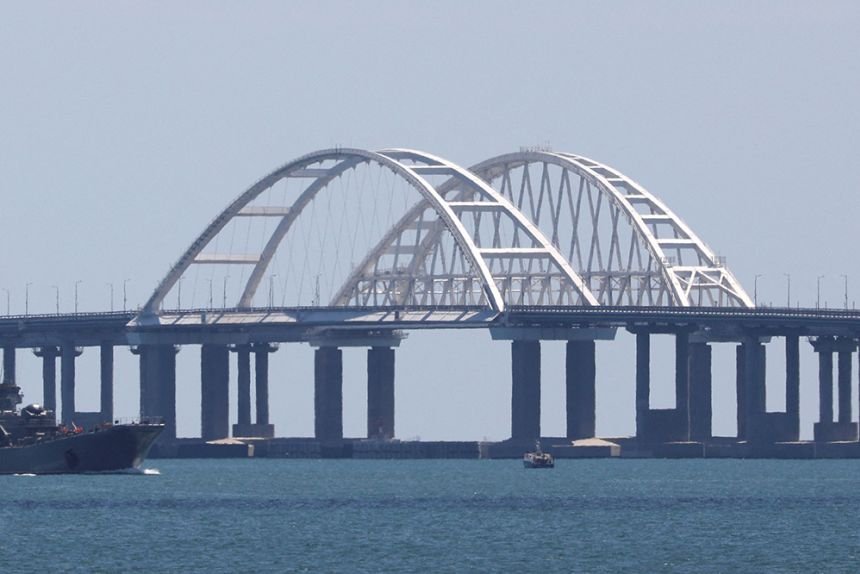
Russia’s strategically important Kerch Bridge, which connects the country to occupied Crimea, was struck for the third time in a week early Thursday, disrupting rail traffic and adding pressure to a critical military and logistical route. The latest incident came just days after a section of the bridge’s road span collapsed, highlighting the growing vulnerability of infrastructure that Moscow considers essential to maintaining its control over the peninsula.
The attacks also unfolded at a politically sensitive moment, as Russian President Vladimir Putin was meeting US President Donald Trump and Chinese President Xi Jinping in Shenzhen, China. The bridge has become a prominent symbol of Russia’s annexation of Crimea in 2014 and a key route for transporting military supplies, fuel, passengers and commercial goods.
Russia’s Transport Ministry said rail services were partially restored on Thursday afternoon and reported no casualties from the latest incident. However, the repeated strikes have raised questions about the bridge’s structural condition, the security of Russian supply routes and the ability of Ukraine to target infrastructure deep behind Russian-controlled lines.
What Happened to the Kerch Bridge in the Latest Attack?
The latest strike occurred early Thursday, marking the third reported attack on the Kerch Bridge within the same week. Rail traffic between mainland Russia and occupied Crimea was halted following the incident, disrupting one of the most important transport connections serving the peninsula.
The disruption came only days after a section of the bridge’s road infrastructure collapsed. The sequence of incidents has made this week’s damage particularly significant, although the precise extent of the latest structural impact was not immediately established.
Russia’s Transport Ministry subsequently announced that some rail traffic had resumed by Thursday afternoon. The ministry also said there were no casualties in the latest incident.
Russian Deputy Prime Minister Marat Khusnullin told state news agency TASS that individual sections of the bridge could be reopened within one or two months. His remarks suggest that repairs or restoration work may take time, although the timeline for the full return of normal operations remains uncertain.
The repeated disruption is important because the bridge carries both road and railway traffic. Damage to either part can affect civilian travel and commercial movement, while interruptions to rail services can complicate the transportation of supplies to Russian forces operating in Crimea and southern Ukraine.
Why the Kerch Bridge Is So Important to Vladimir Putin
The Kerch Bridge, also known as the Crimean Bridge, connects Russia’s Krasnodar region with the Crimean Peninsula across the Kerch Strait. It is the only direct bridge connection between mainland Russia and Crimea, making it strategically important for Moscow’s control of the occupied territory.
Russia constructed the bridge after its 2014 annexation of Crimea, an action widely condemned internationally and regarded by Ukraine as an illegal seizure of its territory. Putin made the project a major priority, presenting the structure as a symbol of Russia’s connection with the peninsula.
Beyond its political significance, the bridge has an important logistical role. It supports the movement of people, vehicles, commercial cargo and military supplies between Russia and Crimea. Its railway connection is particularly relevant because rail transport can move large quantities of equipment and supplies over long distances.
Russian state media has described the $3.7 billion project as having been designed to handle approximately 40,000 cars each day, along with 14 million passengers and 13 million tonnes of cargo annually. These figures illustrate the scale of the infrastructure and the importance Moscow has attached to keeping it operational.
For Ukraine, the bridge represents more than a transport route. It is a symbol of Russian control over territory that Kyiv considers Ukrainian, while also serving as a potential supply corridor for Russian military operations. Disrupting it therefore carries both military and political significance.
Ukraine Says Bridge Attacks Are Part of a Wider Operation
Ukrainian President Volodymyr Zelensky has described previous attacks on the Kerch Bridge as part of what he called an unprecedented operation responding to Russian strikes against Ukrainian infrastructure.
Zelensky said the earlier strikes, carried out using Ukrainian-made weapons, represented the seventh stage of the operation. His remarks placed the bridge attacks within a broader Ukrainian effort to target infrastructure supporting Russia’s military presence and operations.
Ukraine has repeatedly targeted the bridge since Russia launched its full-scale invasion in February 2022. Earlier attacks damaged parts of the structure and forced Russia to undertake repairs and introduce security measures.
The damage reported this week appears more significant than that caused by some previous incidents, particularly because it has involved repeated disruptions and the collapse of part of the road bridge. However, the available information does not establish the full extent of the structural damage or the precise methods used in every incident.
Ukraine has also intensified attacks on Crimea over the past six months. Russian-installed authorities imposed a state of emergency during the summer amid widespread power outages and fuel shortages on the heavily militarised peninsula.
The wider pattern suggests that Crimea remains an important target in Ukraine’s campaign to weaken Russian military logistics and challenge Moscow’s ability to sustain its presence there.
Putin Threatens Retaliation After Meeting Trump and Xi
The third reported strike on the bridge came as Putin was participating in high-level diplomatic engagements in Shenzhen. The Russian leader met Trump ahead of their historic trilateral discussions with Chinese President Xi Jinping, placing the bridge incident alongside efforts to discuss the future of the war in Ukraine.
Speaking to reporters after the trilateral meeting, Putin threatened retaliation against Ukraine over the attack. He also claimed that the bridge served “purely peaceful purposes”, despite its widely recognised strategic role in connecting Russia with occupied Crimea and supporting transport to the peninsula.
Kremlin aide Yuri Ushakov said Putin emerged from his meeting with Trump in an “excellent mood”, adding that Ukraine had been the main subject of their discussion, according to TASS.
Before the meeting, Trump had praised his relationship with Putin, describing the Russian president as “my friend”. The US president has renewed efforts to secure a negotiated end to the war, although his approach has at times drawn criticism from Kyiv and European allies, who have accused him of adopting Russian narratives about the conflict.
The bridge attack added another complication to these diplomatic discussions. While negotiations focus on possible ways to end the war, the latest developments demonstrate that military operations and infrastructure strikes continue to shape the situation on the ground.
Russian Drone Attacks Hit Kyiv as War Continues
While the Kerch Bridge was facing another disruption, Russia launched a renewed drone assault on Kyiv on Thursday afternoon. Ukrainian air defences intercepted or disabled many of the incoming drones, but several reportedly reached the capital and struck buildings in central areas.
Authorities reported that two people were killed in the wider Kyiv region, while five others were injured in the Ukrainian capital. The attacks demonstrated that the damage to Russian infrastructure had not brought an immediate pause in Moscow’s own military campaign.
Projectiles also struck near the embassies of the Netherlands and Austria in Kyiv, according to the two governments. Staff members at both diplomatic missions were unharmed, although the Dutch embassy sustained minor damage, the country’s foreign minister said.
The proximity of the strikes to foreign diplomatic facilities added to the seriousness of the attack. Although the available information did not indicate that embassy personnel had been injured, damage to diplomatic premises highlights the risks faced by international missions operating in the Ukrainian capital.
Russia Also Targets Ukrainian Energy and Port Infrastructure
The daytime drone assault followed overnight Russian strikes on Ukrainian energy facilities, port infrastructure and vessels. Russia’s Defence Ministry said its forces had struck two power substations in Odesa, a fuel storage facility in Chornomorsk and a cargo ship transporting goods to the port of Odesa.
The ministry also said Russian forces had attacked a power substation in the northeastern city of Sumy. These facilities are important to Ukraine’s electricity supply, fuel distribution and commercial transport networks.
Energy infrastructure has remained a major target throughout the war. Attacks on substations and other power facilities can disrupt electricity distribution, affect industrial activity and create additional pressure on households and essential services.
Port infrastructure is equally important because Ukraine relies on maritime routes to move agricultural products, industrial goods and other cargo. Damage to ports, fuel storage facilities and vessels can complicate trade and increase the logistical challenges facing the Ukrainian economy.
The combination of attacks on infrastructure in both countries illustrates how the conflict increasingly affects transport, energy and supply networks alongside military positions.
Europe’s Coalition of the Willing Discusses Ukraine Peace Efforts
As Putin met Trump and Xi in China, Ukraine’s key allies gathered in Berlin for a meeting of the Coalition of the Willing. The group includes countries supporting Kyiv and seeking to coordinate diplomatic and security efforts as negotiations over the war continue.
US envoys Steve Witkoff and Jared Kushner attended the meeting. German Chancellor Friedrich Merz used a joint press briefing to emphasise the group’s continued support for Ukraine, while British Prime Minister Andy Burnham said progress towards peace had clearly been made.
Burnham also said Europe was ready to enter negotiations, signalling that European governments wanted a role in shaping any future settlement rather than leaving the process exclusively to Washington and Moscow.
Kushner said Trump had joined the coalition’s meeting by telephone and shared his assessment of the discussions in Shenzhen. According to Kushner, the US president had delivered a strong message to both Putin and Xi about his desire for peace and wanted to engage actively with them to advance that objective.
The participation of US envoys in Berlin, alongside Trump’s direct discussions with Putin and Xi, reflects the diplomatic activity taking place on several fronts. However, the continued exchange of attacks shows that a political agreement remains difficult to secure.
Could Repeated Attacks Disrupt Russia’s Military Supply Routes?
The Kerch Bridge’s importance lies in its ability to connect Russia directly with Crimea and support the movement of large quantities of goods and equipment. Repeated damage can force Russian authorities to suspend services, inspect infrastructure and redirect transport through alternative routes.
Rail disruptions are particularly relevant to military logistics. Trains can transport heavy equipment, fuel and other supplies in quantities that would be difficult to move as efficiently by road. If rail services are interrupted for an extended period, Russian forces may face additional logistical pressure.
However, the bridge is not the only route through which Russia can move supplies towards Crimea and its military positions in southern Ukraine. Alternative land routes through Russian-controlled territory may help reduce the impact of disruptions, although they can involve longer journeys and additional logistical requirements.
The repeated attacks also create a security challenge for Russia. Protecting a long bridge connecting two strategically important areas requires continuous surveillance, air defence and infrastructure security. Further strikes could force Moscow to devote additional resources to protecting and repairing the route.
For Ukraine, targeting the bridge offers a way to put pressure on a major Russian logistical asset without necessarily engaging Russian forces directly on the battlefield. The effectiveness of this strategy, however, depends on the extent of the damage, the duration of disruptions and Russia’s ability to restore operations.
What Happens Next for the Crimean Bridge?
The immediate priority for Russian authorities will be to assess the damage and restore normal road and rail operations. The partial resumption of rail traffic on Thursday indicates that some services were able to restart, but Khusnullin’s estimate that individual sections could take one or two months to reopen points to a potentially longer repair process.
The repeated strikes also raise questions about whether Russia can maintain uninterrupted transport links to Crimea while Ukraine continues targeting the peninsula and infrastructure supporting its military presence.
Politically, the incident adds pressure to already complicated discussions over ending the war. Putin’s threat of retaliation indicates that Moscow is not treating the latest attack as an isolated infrastructure incident, while Ukraine has framed its strikes as part of a wider response to Russian attacks on its own infrastructure.
For now, the Kerch Bridge remains both a practical transport connection and a powerful symbol of Russia’s control over occupied Crimea. Its repeated disruption demonstrates how infrastructure has become central to the military and political contest between Moscow and Kyiv. Even as diplomatic efforts intensify involving Washington, Moscow, Beijing and European governments, the latest attacks show that the war’s strategic calculations continue to be shaped by events on the ground.
For breaking news and live news updates, like us on Facebook or follow us on Twitter and Instagram. Read more on Latest World on thefoxdaily.com.





COMMENTS 0