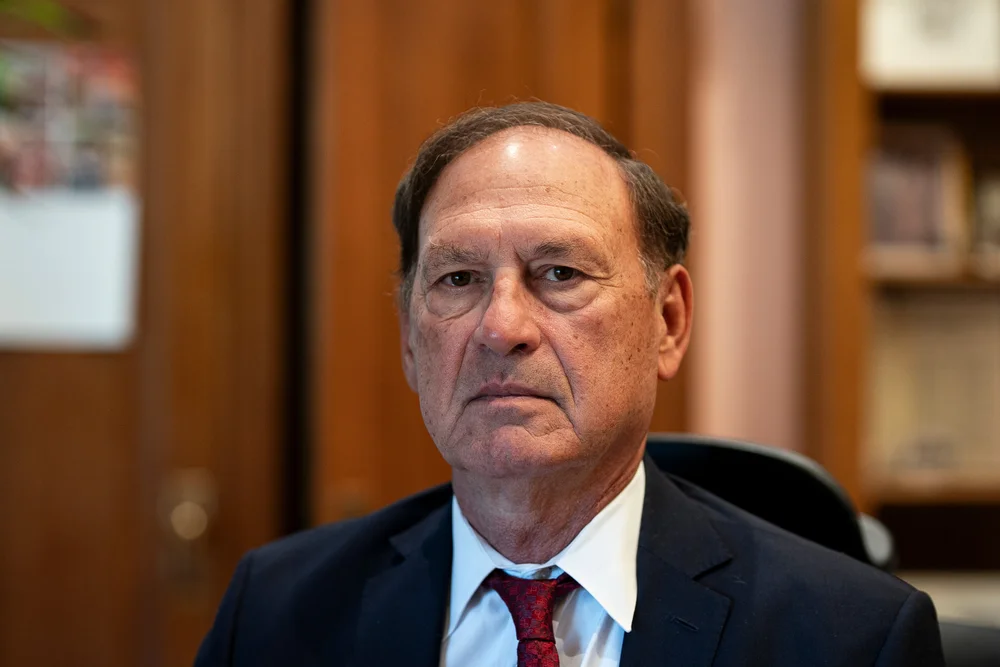
US Supreme Court Justice Samuel Alito has warned that the judiciary remains vulnerable to pressure from both the executive branch and Congress, arguing that lawmakers could effectively halt the Supreme Court’s operations by withholding funding. His remarks highlighted the challenges of preserving judicial independence while the court faces growing disputes over presidential authority and the role of federal judges.
Speaking at the Federalist Society’s annual National Lawyers Convention in Washington, DC, on Thursday night, Alito described the judiciary as the “least dangerous” branch of the federal government because it depends on the other branches for resources and enforcement. He said Congress has considerable influence through its control over government spending.
“Congress can turn off the lights of the Supreme Court and stop everything from happening if they will not fund their activities,” Alito said, adding that lawmakers could take several other steps to influence the institution.
He stressed that protecting judicial independence was essential to maintaining the constitutional system. However, Alito also criticised some lower-court judges for issuing what he described as unjustified orders that block presidential policies, revealing the tension between judicial oversight and executive power.
Alito Warns Congress Could Disrupt Supreme Court Operations
Alito’s comments focused on Congress’s constitutional authority over federal spending. Although the Supreme Court is an independent branch of government, its administrative operations, staffing, security and other activities depend on funding approved through the federal appropriations process.
Congress therefore has significant influence over the resources available to the federal judiciary. A decision to withhold or restrict funding could affect the court’s ability to carry out its work, even though lawmakers cannot simply abolish its constitutional role through an ordinary budget decision.
Article III of the US Constitution establishes the federal judiciary and provides important protections for federal judges. Supreme Court justices hold office during good behaviour, and their compensation cannot be reduced while they remain in office. These safeguards are intended to protect judges from direct political retaliation over their decisions.
However, constitutional protections for judicial tenure and salaries do not eliminate Congress’s authority over appropriations. The judiciary still requires funding for court facilities, employees, technology, security and administrative functions.
Alito’s warning was therefore about the practical vulnerability of the institution rather than a suggestion that Congress could legally abolish the Supreme Court by simply switching off its funding.
Remarks Come After Democrats Gain Control of Congress
The justice’s comments came shortly after Democrats secured control of both the House of Representatives and the Senate in the US midterm elections. The political shift could change the relationship between Congress and the Supreme Court, particularly as lawmakers debate judicial accountability, court ethics and the institution’s structure.
Alito did not directly mention the election results or identify any particular party in his remarks. Nevertheless, the timing brought renewed attention to the possibility that Congress could use its spending authority to influence the judiciary.
Debates over the Supreme Court’s funding and oversight are not new. Some Democratic lawmakers have previously discussed using budgetary measures to press the court to adopt stronger ethics requirements. In 2023, senators proposed withholding a portion of funding until the court implemented stricter ethics standards.
The Supreme Court subsequently adopted its first formal code of conduct for justices. However, questions about enforcement, financial disclosures, gifts and judicial accountability have continued to generate debate.
Justices Elena Kagan and Amy Coney Barrett also visited Capitol Hill during the summer to discuss the judiciary’s budget and security requirements. Their engagement highlighted the court’s dependence on Congress for resources, particularly as concerns about threats against judges and judicial institutions have increased.
Alito Describes Judiciary as the Least Dangerous Branch
During his conversation with conservative author Mollie Hemingway, Alito discussed the relative power of the three branches of the US government. He described the judiciary as the least powerful because it lacks the executive branch’s ability to enforce decisions directly and Congress’s authority over legislation and spending.
His comments reflected a long-standing idea in American constitutional debate: courts depend on other institutions to implement their rulings and maintain their operations.
However, Alito cautioned that limited institutional power does not mean judicial decisions are harmless. He used the comparison of a hand grenade, a 500-pound bomb and a nuclear weapon to illustrate the different levels of power exercised by government institutions.
He described the hand grenade as the least dangerous of the three, while stressing that it could still cause significant damage. The analogy suggested that the judiciary may have fewer direct powers than the political branches but can still produce major consequences through its rulings.
The Supreme Court’s decisions can determine the legality of government policies, interpret constitutional rights and establish legal standards that affect millions of Americans. Its influence can therefore extend well beyond the immediate parties involved in a case.
Justice Criticises Lower Courts for Blocking Presidential Policies
Alongside his defence of judicial independence, Alito expressed concern about what he described as excessive intervention by some federal district judges. He argued that certain lower-court decisions have gone too far in preventing presidents from implementing policies while legal challenges move through the courts.
He said presidents have increasingly become frustrated when Congress does not enact their legislative priorities. As a result, administrations have attempted to achieve more through executive authority and unilateral action.
Those decisions can then face immediate legal challenges from opponents seeking injunctions or other court orders to stop their implementation. According to Alito, litigants often choose judicial districts where they believe they are more likely to obtain a favourable ruling.
He argued that some judges have responded with broad orders that prevent presidential initiatives from moving forward while appeals are pending. Such disputes can take years to resolve, potentially leaving an administration unable to implement a policy for much of a four-year presidential term.
Alito acknowledged that lower-court judges are dedicated and skilled but said they are not infallible. He argued that some have made serious mistakes and, in certain cases, have gone “far astray” in exercising their authority.
What Is the Supreme Court’s Emergency or Shadow Docket?
Alito linked the growing use of emergency court proceedings to the increasing number of disputes over presidential actions. The issue has attracted attention because the Supreme Court can issue temporary or preliminary decisions while the underlying legal cases continue in lower courts.
The practice is commonly known as the emergency docket or, among critics, the shadow docket. Unlike the court’s regular merits docket, which generally involves extensive written arguments, public hearings and detailed opinions, emergency applications can be considered on a much faster schedule.
These applications may involve requests to pause lower-court decisions, allow a government policy to take effect temporarily or prevent an action while an appeal is pending. The court’s decisions can have significant consequences even when they do not finally resolve the underlying constitutional or legal dispute.
The emergency docket has become particularly prominent in cases involving presidential authority, immigration enforcement, federal agency decisions and other major government policies.
Supporters of emergency intervention argue that the Supreme Court must be able to respond quickly when lower-court orders interfere with federal authority or create immediate legal complications. Critics, however, have raised concerns about limited explanations, compressed proceedings and the possibility that consequential policies could take effect before courts have fully examined their legality.
Trump Administration Has Secured Important Emergency Rulings
The Trump administration has obtained a number of favourable interim rulings from the Supreme Court, allowing several government initiatives to proceed while legal challenges remain unresolved.
These cases have involved immigration enforcement, changes to the federal government and construction plans for a White House ballroom. The administration has relied on emergency applications to seek relief from lower-court orders that restricted or delayed its actions.
Such decisions do not necessarily represent final judgments on the legality of the underlying policies. An emergency order may temporarily change the position while the case continues through the appeals process.
The distinction is important because a temporary ruling allowing a government action to proceed does not automatically mean the Supreme Court has conclusively determined that the action complies with the Constitution or federal law.
The court’s conservative majority has nevertheless made its emergency decisions an important part of the legal disputes surrounding the Trump administration. The frequency and consequences of these rulings have also intensified debate about how the Supreme Court should handle urgent applications involving major policy questions.
Why Nationwide Injunctions Have Become a Point of Dispute
One of Alito’s central concerns involved broad orders issued by district-court judges. These can include nationwide injunctions, which seek to prevent the federal government from enforcing a policy beyond the immediate parties involved in a lawsuit.
Supporters of broad injunctions argue that they can be necessary when a government policy affects people across the country and a narrower order would not provide adequate relief. They also contend that courts must be able to prevent potentially unlawful government actions from causing widespread harm before a final judgment.
Critics argue that a single district judge should not have the power to block a federal policy nationwide based on an early assessment of a case. They say such orders can interfere with the executive branch and create uncertainty when different courts reach conflicting conclusions.
Alito’s remarks reflected the latter concern. He argued that when a district judge issues an order that is later overturned, the president may already have lost a substantial portion of the administration’s time in office.
The debate involves a difficult constitutional balance. Courts must be able to review executive decisions and protect legal rights, while the executive branch needs sufficient authority to carry out its responsibilities. The scope of judicial remedies and the timing of appeals remain important questions in that balance.
Federalist Society Convention Provides Platform for Judicial Debate
Alito delivered his remarks during the Federalist Society’s annual National Lawyers Convention in Washington, DC. The organisation brings together conservative and libertarian lawyers, judges, academics, elected officials and legal professionals to discuss Constitutional Law and judicial policy.
The event included a black-tie dinner named in honour of former Supreme Court Justice Antonin Scalia. Alito spoke with Mollie Hemingway, a conservative author and commentator, before an audience of lawyers, judges and other attendees.
The Federalist Society has played an influential role in the American conservative legal movement and has been an important network for lawyers and judicial nominees associated with originalist and textualist approaches to constitutional interpretation.
Its members do not all share identical views on every legal issue, and the organisation says it does not take official positions on legal or political questions. However, its influence on judicial appointments and legal debates has made its annual convention a significant event in the US legal calendar.
Judicial Independence Remains at the Centre of the Debate
Alito’s remarks highlighted two related but distinct concerns: the vulnerability of the judiciary to political pressure and the possibility that judges themselves may overstep their authority.
Judicial independence is designed to ensure that courts can decide cases according to the law rather than the political preferences of elected officials. Constitutional protections for judges, separation of powers and independent decision-making are central to that system.
At the same time, federal judges exercise authority within constitutional and legal limits. Their decisions can be reviewed through appeals, and higher courts can overturn orders that they find legally incorrect.
The tension becomes especially visible when courts review major executive actions. A president may argue that an administration needs room to implement its agenda, while challengers may contend that the same actions violate federal law or constitutional protections.
Alito’s comments did not propose a specific solution to these disputes. Instead, they underscored the institutional pressures facing the Supreme Court as it navigates its relationship with Congress, the president and lower federal courts.
With Democrats preparing to exercise control over both chambers of Congress and the Trump administration continuing to defend its executive actions in court, questions about judicial funding, emergency rulings and the limits of presidential power are likely to remain prominent in the US constitutional debate.
For breaking news and live news updates, like us on Facebook or follow us on Twitter and Instagram. Read more on Latest World on thefoxdaily.com.





COMMENTS 0